Caryota
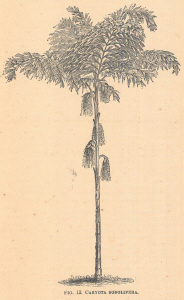
(old Greek name karuotis, used by Dioscorides; the Greeks first applied this name to their cultivated Date). ORD. Palmae. A genus of about a dozen species of very noble stove Palms, with bipinnate leaves, the ultimate divisions of which have the shape of the fins and tail of a fish--features which distinguish the present from all other genera of the order. They attain their full size before commencing to flower; the spadices, which are developed first at the top, and last at the very foot of the trunk, are large, and their spikes hang down in bundles. When the flowers have been produced form the trunk, nearly at ground level, the plant dies, unless it has previously developed suckers. Two species, sobolifera and urens, are frequently employed in sub-tropical gardening, from June till September, and their unique appearance renders them well suited for the purpose. When in a young stage, Caryotas form excellent ornaments for dinner tables, &c. They require a compost of loam and vegetable mould in equal parts, with the addition of a little sand; thorough drainage, and a liberal supply of water during the growing season, are essentials to success. Propagated easily by seeds, or by suckers; the first named are frequently produced in this country.
C. Cumingii (Cuming's).* l. large, dark green, spreading, bipinnate, 4ft. to 6ft. in length, and 3ft. in width; pinnules 8in. to 10in. long, sub-falcate, obliquely wedge-shaped below, and erosely toothed upwards. The spadices hang in drooping tassel-like tufts from the axils of the leaves, and the flowers are succeeded by bright red berries, which lend an additional charm to this beautiful stove plant. Trunk or stem slender, about 10ft. high. Philippine Islands, 1841. (B. M. 5762.)
C. maxima (largest). l. bipinnate; pinnae coriaceous, rigid, elongated, dimidio-lanceolate, acuminate. Stem tall. Java, 1849. C. mitis (mild). l. reclining; pinnae cuneiform, oblique, praemorse. h. 20ft. China, 1820.
C. propinqua (neighbouring). l. bipinnate; pinnae coriaceous, sessile, dimidiato-rhomboid, obtuse or acuminate, praemorse. Stem tall. Java, 1850.
C. purpuracea (purple). l. bipinnate; pinnae unequal, both in size and shape; petioles clothed with rusty tomentum h. 30ft. Java 1848 This species resembles c. urens, but is more compact, the petioles are not so long, and the leaves more numerous.
C. Rumphiana (Rumph's).* l. bipinnate, spreading, 3ft. to 8ft. long; pinnules sessile, coriaceous, obliquely cuneate and praemorse, 4in. to 6in. in length, and the same in breadth at the widest part, lying very flat and even, and deep green in colour. Indian Archipelago. Very handsome and distinct.
C. sobolifera (sucker-bearing).* l. bipinnate; pinnae bright light green; petioles, when young, clothed with a short black scaly tomentum. Malacca, 1843. An elegant, slender-stemmed, some-what dwarf species, not very unlike C. urens in the form of the leaves. Suckers are more freely produced by this species than by any other.
C. urens (stinging). l. bipinnate, spreading, 3ft. to 12ft., or even more, in length; pinnules obliquely cuneate, sub-coriaceous, erose, caudate, 6in. to 9in. in length, and 4in. in breadth, dark green. Stem stout. h. 50ft. India, 1788. Probably the largest-growing species.