Cedrus
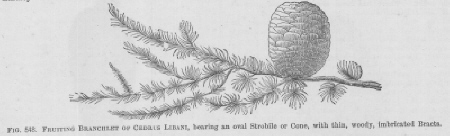
(from Latin Cedrus, Greek Kedros, a name for a coniferous tree from the time of Homer). Cedar. ORD. Coniferae. Majestic evergreen trees, with large spreading branches, rigid, scattered and clustered leaves and erect oblong or oval cones rounded at the top; scales of the cones broad, thin, coriaceous, entire, closely appressed, at length deciduous. It is commonly supposed that a rich soil is needed for the Cedar, but this is only correct in a certain degree; a rich loam or sandy clay being, perhaps, the best. An open sub-soil is the most indispensable condition, as will be proved from their healthy state in natural mountainous regions. The Cedar does not like pruning, either in root or branch, and if the top is removed, the tree assumes the form of an enormous bush, of picturesque and grand proportions. Growing in its natural state, it takes a broad, conical form, till it reaches its full height, when the lateral branches begin to extend outwards, and the top then assumes a broad, flat surface. Cones seldom make their appearance on the Cedar of Lebanon before it attains forty years of age, and it has been known not to produce them before the tree was 100 years old. The catkins appear in autumn, and the cones require tow years to arrive at maturity. The seeds are difficult to extract from the cones, which do not drop from the tree, but will hang for many years; nor does the influence of the sun cause them to shed the seeds. The cones have therefore, to be gathered by April, and the seed-lings must be planted out in the open nursery the following spring. The Cedar resembles other Coniferae in the formation of its roots, which strike out a great distance, if not transplanted, and thus lose the advantage which is derived from a bushy root. It is of somewhat slow growth, but is often slower than is necessary, from defective management and an unsuitable situation. Several authorities are agreed in regarding the three species as mere varieties of one. In any case, from a garden standpoint, they possess quite sufficient characteristics to justify separate specific descriptions.
C. atlantica (Atlantic).* Very closely allied to C. Libani, but mainly differing in the foliage, which, in the present species, is shorter, usually less than 1in. long, and of a glaucous green or silvery hue. It is also of more erect pyramidal habit than the Cedar of Lebanon. h. 80ft. to 120ft. Atlas Mountains of Algeria, 1843.
C. Deodara.* Deodar or Indian Cedar. l. fascicled, acute, triquetrous, rigid, larger than those of C. Libani, and of a bluish but dark green, covered with a light glaucous bloom. One of the most beautiful members of Coniferae, and having an elongated pyramidal or conical outline. Leading shoot and branchlets pendulous. h. 150ft. to 200ft. Western Himalayas, 1822. The best-known varieties are the following: C. D. robusta (sturdy) has coarser and larger leaves and thicker branches, and C. D. viridis (green) or tenuifolia (thin-leaved) is of slender habit, with bright green foliage. Other forms mentioned in nursery-men's catalogues are: argentea, albo-spica, erecta, and verticillata glauca.
C. Libani.* Cedar of Lebanon. l. tufted, short, rigid, dark green. Cones oblong, oval, pedunculate, purplish, but ultimately brown, 3in. to 4in. long; scales with a somewhat membranous margin. Branches horizontal, rigid, tubuliform, disposed in distinct whorls; branchlets flat, fan-like, very numerous and thickly set. h. 60ft. to 80ft. Lebanon and Taurus in Syria, 1683. This magniflcent tree has well been called "The Patriarch of the Tribe." There is a form called argentea (silvery) which has highly glaucous foliage, and also a diminutive form, known as nana.
C. L. brevifolia (short-leaved). The Cypress Cedar. This distinct variety differs principally from the type in its much shorter leaves.