Home › C › Cereus (About species of this genus)
Cereus (About species of this genus)
About 200 species of this genus are known, natives of tropical and sub-tropical America, the West Indies, and the Galapagos Islands. (See also Pilocereus.) To those described on pp. 299-300, Vol. I., the following should now be added:
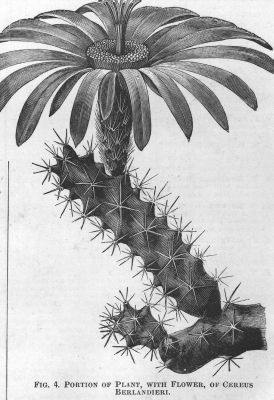
C. Berlandieri (Berlandier's).* fl. 4in. across, produced on the young, upright stems; petals bright purple, strap-shaped, in an irregular ring; stamens rose-coloured, clustered. Summer. Stems procumbent, not more than 6in. long and 3/4in. thick, bearing, along the ridges, little tubercles, crowned with short spines. South Texas and Mexico. Plant dwarf, creeping, very soft and watery.
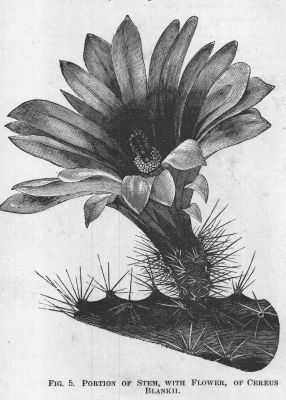
C. Blankii (Blank's). This only differs from C. Berlandieri in having deep rose flowers, flushed with crimson, and longer, broader, and less spreading petals. Summer. Mexico (at high elevations).
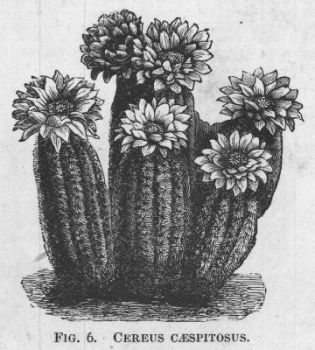
C. caespitosus (tufted). fl. deep rose-coloured; petals thirty to forty, oblong, acute, obtuse, or mucronate; tube having eighty to one hundred cushions clothed with long, ashy wool, and six to sixteen brown or blackish spines. Stems 4in. to 6in. high, 3in. to 4in. in diameter, simple or clustered, cylindric-ovoid, pale greyish or whitish, with scanty brown wool; ribs twelve to eighteen, 1/2in. to 3/4in. broad at base; cushions close-set, with twenty to thirty straight spines 1/4in. or more in length. New Mexico and Texas. (B. M. 6669.) C. ctenoides (comb-like).* fl. 3in. to 4in. across, produced in the ridges near the top of the stem; petals bright yellow, resembling a Convolvulus; stamens yellow; pistil white. June or July. Stem 3in. to 5in. high, about 3in. in diameter, egg-shaped, producing offsets at the base; ribs fifteen or sixteen, spiral, with closely-set cushions of whitish spines 1/4in. long. Texas. Rare in cultivation.
C. Engelmanni (Engelmann's). fl. purplish-carmine; sepals fifteen to twenty, ovate-lanceolate, prickly; petals acute; stigmas twelve, green, erect. fr. red, ovate. Stem ovate-cylindrical, eleven to thirteen-ribbed, bearing the flowers laterally at the apex; prickles radiating, whitish, about thirteen in a tuft. California, 1885. (R. G. 1174 [1175 a in text].) C. enneacanthus (nine-spined). fl. freely developed on the ridges near the top of the stem; petals deep purple, spreading; tube spiny; pistil and stamens yellow. Stem seldom exceeding 6in. in height, less than 2in. in diameter, cylindrical, bright green, tufted in old specimens; ribs shallow, broad, irregular on the top, with spine cushions on the projecting parts; spines frequently twelve (although the specific name implies only nine) to a tuft. Texas. A rare plant in cultivation.
C. Fendleri (Fendler's). fl. purple, sub-erect, 3in. in diameter; calyx tube and ovary bearing cushions covered with short spines; inner sepals twelve to fifteen; petals sixteen to twenty-four. June. Stem ovoid or sub-cylindric, 5in. to 7in. high, 3in. to 4in. in diameter, pale green, simple or rarely branched at base; ribs nine to twelve, 1/2in. deep; radial spines seven to ten, the central one 1 1/2in. long. New Mexico, 1880. (B. M. 6533.) C. hypogaeus (underground). fl., 2in. long, the tube short, with a few spine tufts; petals purplish, margined with yellow, oblong, mucronate. Aerial stems cylindric or clavate, seven or eight-angled; tubercles with two to five or more bristle-like spines and three to five longer central ones. Underground stem minute, unarmed. 1883. (R. G. 1085.) C. leptacanthus (slender-spined).* fl. several to a branch; petals deep purplish-lilac in the upper half, the lower part white, forming a shallow cup, notched on the edges; stamens white; anthers and stigma orange. May and June. Mexico, 1860. Habit as in C. Berlandieri.
C. multiplex (proliferous). fl. 6in. to 8in. long and across; sepals pointed; petals 2in. or more in length, 1in. wide, spreading out quite flat; tube clothed with small, hairy scales. Autumn. Stem globose, becoming pear-shaped with age, about 6in. high; ridges angled, clothed with clusters of about a dozen spines, the central one longest. South Brazil, 1840. C. m. cristatus (crested). Stems fasciated and divided into numerous crumpled, flattened branches. A remarkable monster.See Fig. 11. C. paucispinus (few-spined). fl. axillary towards the top of the stem, 3in. broad; calyx sub-cylindric, with ten to fifteen clusters of short, pale spines; petals about thirty, dark red, tinged brown, elongate-spathulate, with concave tips. May. Stems 5in. to 9in. high by 2in. to 4in. in diameter; ridges irregular in shape, 1/2in. to 3/4in. in diameter; tubercles variable; spines three to seven, stout, pale red-brown. New Mexico, 1883. (B. M. 6774.) C. Philippii (Philipp's). fl. yellow, with reddish-tinted segments, about 1 1/2in. long, campanulate; stamens in two distinct whorls, the outer arising from the base of the petals, the inner whorl united in a tube around the style. Stem cylindric, eight to ten-angled, the angles tubercled; tubercles with about eight short and four or five long spines. Chili, 1883. (R. G. 1079, f. 1.) C. procumbens (trailing).* fl. 3in. long and broad, developed on the ends of the branches; petals bright rose-purple, spreading and recurved; anthers forming a corona-like ring, enclosing the rayed stigma. May and June. Stems spreading, prostrate, emitting upright branches 3in. to 4in. high, 1/2in. thick, generally only quadrangular or square, with small spines in tufts along the angles. Mexico. A pretty little Cactus.