Home › E › Echinocactus (To the species described on pp)
Echinocactus (To the species described on pp)
To the species described on pp. 499-501, Vol. I., the following should now be added:
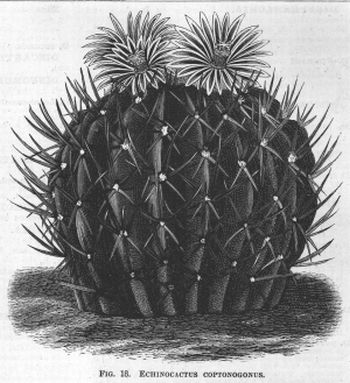
E. coptonogonus (wavy-ribbed). fl. 2in. across, Daisy-like, with a very short tube; sepals and petals white, with a purple, central stripe; stamens red, with yellow anthers. April and May. Stem globose, depressed at top; ribs ten to fourteen, strong, sharp-edged, wavy, with spine tufts set in little depressions along the margins; spines five to a tuft, the two upper ones 1in. long, quadrangular, the two lower ones shorter, flattened, the central one longest. Mexico. SYN. E. interruptus.
E. cornigerus (horn-bearing). fl, small; sepals brownish-red; petals purple, narrow. Stem spherical, greyish-green; ribs fourteen to twenty-one, stout, wavy; spines in tufts about 2in. apart, stouter than in any other species, the three erect, horn-like ones yellow, the broad, tongue-like one purple, very strong. Mexico and Guatemala. Probably not yet cultivated in England. SYNS. E. latispinus, Melocactus latispinus.
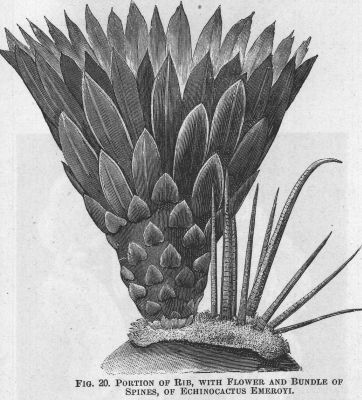
E. Emeroyi (Emeroy's). fl. 3in. long; petals red, with yellowish margins, spreading; stamens deep yellow; tube clothed with kidney-shaped scales or sepals. Autumn. Stem globose, 1ft. to 2ft. in diameter; ribs about thirteen, with large, rounded tubercles; spines in star-shaped bundles of eight or nine at the apices of the tubercles, angled, articulated, 1in. to 4in. long, with hooked points. Lower Colorado and California.
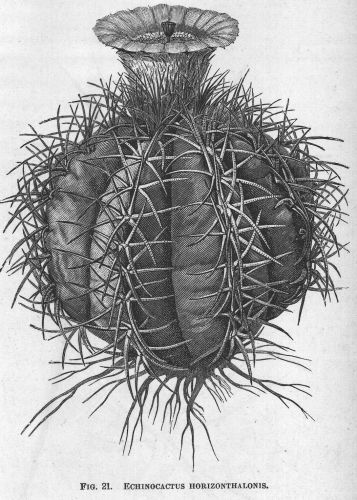
E. equitans (equitant). A synonym of E. horizonthalonis. E. Haselbergii (Haselberg's). fl. ochreous-yellow and red, 1in. to 1 1/2in. in diameter, sessile, broadly campanulate, with a short, red, spiny tube; segments about forty. April. Stem globose or oblate, 3in. in diameter; tubercles small, convex, appearing almost vertically disposed in innumerable parallel series, but really spirally arranged, convex, crowned with a tuft of white hairs; spines twenty to a tuft, silvery, acicular, 1/2in. long, stellately spreading. Native country unknown. (B. M. 7009.) E. horizontalis (horizontal). A synonym of E. horizonthalonis. E. horizonthalonis (spreading-spined). fl. terminal, 4in. across, scented, cup-shaped, springing from the young spine tufts; petals in two rows, deep rose, paler on the inside; stamens with white filaments and yellow anthers. May and June. Stem globose, usually flattened at top; ribs or ridges eight or nine, large, greyish-green; spines in crowded, star-like clusters along the edges of the ribs, strong, slightly curved, horn-like, marked with numerous rings. Mexico. SYNS. E. equitans, E. horizontalis.
E. interruptus (interrupted). A synonym of E. coptonogonus. E. Joadii (Joad's). fl. bright yellow, handsome, 2in. in diameter; calyx tube furnished with tufts of slender spines, mixed with curly hairs; petals numerous, narrow-oblong, acute; stigmas crimson. Stem globose, many-ribbed; spines brownish, the outer ones fifteen to eighteen, radiating, the inner ones six or seven, longer and stouter, directed outwards. Uruguay (?), 1885. (B. M. 6867.) E. Johnsoni (Johnson's). fl. purple or pink, 2in. to 2 1/4in. long and wide, with numerous reniform sepals on the ovary and tube; petals ovate, obtuse. Stem medium-sized, 4in. to 6in. high, with seventeen to twenty-one low, rounded, interrupted, close-set, often oblique ribs, densely covered with stoutish, reddish-grey spines, the outer ten to fourteen 1/2in. to 1 1/4in. long, the upper longest; the central four stouter, recurved, 1 1/2in. long. Southern Utah. (R. G. 1883, p. 58.) E. latispinus (broad-spined). A synonym of E. cornigerus. E. polycephalus (many-headed). fl. enveloped at base in a dense mass of white wool, which hides the tube; petals bright yellow, 1in. long, spreading like a saucer; stamens yellow, numerous. Spring. Stems numerous in old plants, the largest 1 1/2ft. to 2 1/2ft. high, cylindrical, globose when young; ribs twelve to twenty, sharply defined; spines in clusters 1in. apart, reddish, broad, flattened on the upper side, annulated, the central ones over 3in. long in old plants, and sometimes curved. California and Colorado, 1886. Warm house. See Fig. 22.
E. Pottsii (Potts'). fl. yellow, about 2in. across, short-tubed, several expanding together on the top of the stem. Summer. Stem globular, 1 1/2ft. in diameter; ridges about a dozen, rounded and even, with acute sinuses; spines 1in. long, bristle-like, arranged in clusters of seven or nine, with a cushion of white wool at the base. California, 1840. Warm house. See Fig. 23. E. Scopa cristatus (crested). A curious monstrosity, owing its origin to fasciation, such as occurs in the Cockscombs, Echeverias, &c. The plant shown at Fig. 24 is grafted on the stem of a Cereus.
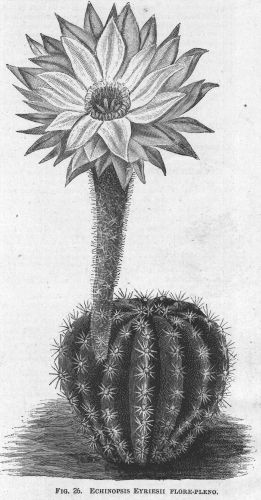
E. senilis (old). fl. light pink, 1 1/2in. long, 1in. in diameter, having a scaly, cylindrical tube. Stem stout, cylindric, with sixteen or eighteen ribs, having tufts of numerous hair-like spines, curving upwards. Chili, 1886. (R. G. 1230 A.) E. Wislizeni (Wislizen's). fl. greenish-yellow, about 2in. long and broad, developed only on large plants. Summer and autumn. Stem depressed when young, large and cylindrical when old; ridges about a score, regular and sharp-edged, bearing bundles of spines at regular intervals, the outer and shorter ones being white and spreading, while from the middle of each tuft arise three 2in. long and one 3in. long, with the point hooked, and as strong as steel. See Fig. 25.