Home › E › Epidendrum (Tropical America)
Epidendrum (Tropical America)
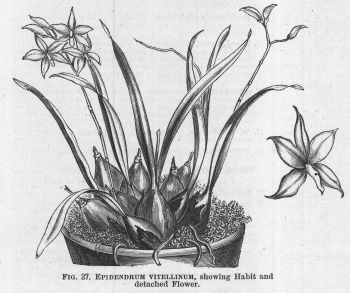
Tropical America is the headquarters of this genus. To the species and varieties described on pp. 512-4, Vol. I., the following should now be added. Unless otherwise specified, stove treatment is required. E. amabile (lovely). A synonym of E. dichromum.
E. arachnoglossum (cobweb-lipped). fl. reddish-purple (carmine-violet), in a short, corymbiform or roundish raceme; sepals and petals acute, recurved; lateral lobes of lip roundish, pectinate, the middle one cuneate, deeply bilobed; column violet, club-shaped. l. distichous, alternate, glabrous, sessile, oblong-lanceolate, obtuse, fleshy. Stems tufted, erect, naked above. New Grenada, 1883. (R. H. 1882, p. 554.) E. a. candidum (white). fl. wholly white, with the exception of the orange lateral calli of the lip. 1886.
E. atropurpureum album (white). A white-lipped variety. E. a. Randi (Rand's). fl., sepals and petals greenish-brown, with paler margins; lip white, large, marked with contiguous, red veins at the base. Amazons, 1886. SYN. E. Randianum (L. 49).
E. Barkeriola (Barkeriola). fl., sepals and the light rose-coloured petals nearly equal; lip white, with a deep purple blotch and some short purple lines on the disk, where there are two raised lines, pandurate or obovate; raceme one-sided. l. lanceolate, acute, wavy, reddish beneath and on the margins. 1884. SYN. Barkeria Barkeriola.
E. Christyanum (Christy's). fl. greenish and brown, in an erect raceme; sepals oblong, apiculate; petals spathulate; lateral segments of lip sub-quadrate, extrorse, the middle one triangular, apiculate; column trifid. l. ligulate, acute. Pseudo-bulbs long-pyriform, two-leaved. Bolivia, 1884. E. ciliare (ciliated). fl. fragrant, several in a raceme, each with a long bract at base; sepals and petals greenish-yellow, linear, acute; lip white, three-parted, the lateral lobes pectinately incised, the middle one setaceous, much longer. Winter. l. in pairs. Pseudo-bulbs oblong, obtuse. Tropical America. (B. R. 784.) E. cuspidatum (B. M. 463; B. R. 783; L. B. C. 10) is considered a variety of this species, but the flowers are yellower and larger, and the middle lobe of the lip is linear-lanceolate, and not appreciably longer than the side ones. 1844.
E. cuspidatum (cusp-pointed). A variety of E. ciliare. E. densiflorum (dense-flowered). A variety of E. polyanthum. E. Endresii (Endres'). fl. as large as those of E. ellipticum; sepals white, tipped green, the upper one cuneate-oblong, acute, the lateral ones triangular; petals white, spathulate; lip blotched mauve, curiously cut, with two triangular edges at the base, the anterior lacinia cuneate-obreniform. l. about a dozen, like those of Box Costa Rica, 1883. (G. C. n.s., xxiii., p. 504.) E. Flos-aeris (air-flower). A synonym of Arachnanthe moschifera. E. fraudulentum (fraudulent). fl. light rose-coloured, small, the column and lower part of the ovary purple, the keel and calli yellow. 1886. E. fulgens (brilliant) A synonym of E. Schomburgkii. E. ibaguense (Ibague). fl. in a dense, almost globose head; sepals and petals orange; lip yellow, obcordate, the lateral lobes cordate, rounded at the tip and fringed. l. very fleshy, amplexicaul, oblong, obtuse. Stems tall, slender, the upper portion leafy, the extreme end leafless. New Grenada, Peru. (F. M. 390.) E. ionocentrum (violet-spurred). fl., sepals and petals lemon-coloured, spotted with greenish-brown, lanceolate, acuminate; lip white, violet or purple in the centre; raceme twenty to twenty-four flowered. Pseudo-bulb broad. Otherwise like E. Brassavolae.
E. Kienastii (Kienast-Zolly's). fl., sepals and petals very light rose, with darker purple veins, the sepals lanceolate, the petals very cuneate at base; lip white, with fine purple, callose lines on the wavy mid-partition, the side partitions cuneate-ligulate, two-toothed outside; raceme several-flowered. l. usually two, 6in. long, 1/2in. to 1in. broad, cuneate-oblong, acute. Mexico, 1887.
E. Mathewsii (Mathews'). fl., sepals and petals stained purplish outside, small, nearly transparent, the lateral sepals connate half-way up; lip deep, dull blood-purple, shining, orbicular, bifid at apex, convex above, concave beneath, completely concealing the lateral sepals. l. distichous, rigid, fleshy. Stems short, procumbent. 1886.
E. O'Brienianum (O'Brien's). A hybrid between E. evectum and E. radicans, and in habit very much resembling the latter. In colour the flowers are a brilliant carmine, faintly shaded orange, except the crests on the lip, which are bright yellow, as in E. radicans; the segments are longer than in E. evectum, but have the same general shape, and the lobes of the lip are much like those of the last-mentioned species. The plant, like its parents, grows rather tall.
E. oncidioides (Oncidium-like). fl. yellow, blotched brown, very fragrant; sepals and petals obovate, unguiculate; lip three-lobed, the lateral lobes narrow, obtuse, flat, much shorter than the roundish, cuspidate middle one, the disk three-keeled; panicle long, racemose. l. two or three, 2ft. long, 1 1/2in. wide. Stem 3ft. to 4ft. high. Surinam. (B. R. 1623; I. H. ser. v. 28.) E. paytense (Payta). fl. of a brilliant scarlet-vermillion, with some orange on the lip, which is also marked with some darker spots. l. short, very strong, oblong, acute, tinted purplish-brown. Shoots stiff, with purplish-brown sheaths. Columbia and Peru, 1885.
E. polyanthum (many-flowered). fl. orange or salmon-colour, with a strong scent of cowslips; sepals ovate-lanceolate, acute, striated; petals linear, reflexed; lip three-lobed, three-ribbed, the lateral lobes sub-cuneate, retuse, the middle one retuse; panicle strict, simple. l. distichous, ovate-lanceolate, acute. Mexico, 1841.
E. p. asperum (rough). A variety having the ovaries and rachis densely covered with small warts. 1885.
E. p. densiflorum (dense-flowered). fl. greenish, with a little pink on the edges and in the middle of the lip. 1836. SYN. E. densiflorum (B. M. 3791). E. pristes (saw-like). fl., sepals and petals light cinnabar, lanceolate, the petals serrated in the upper half; lip yellow, spotted cinnabar, trifid, serrated, the mid-lobe small, bilobed, with a flexuose keel at the base of the disk. l. very minutely serrulated. Stems slender. 1886. A handsome plant. E. pseudepidendrum auratum (golden). fl., disk of the lip crimson, the borders deep orange. 1885. A fine variety.
E. punctulatum (slightly dotted). fl. stellate, in a slender panicle; sepals and petals brown inside, green outside, lanceolate, acute; lip sulphur, with minute dots, trifid, the side laciniae square, the middle one sessile, ovate, acute, the mid-nerves thickened; column brown and green; border of the anther-bed white, spotted brown. Mexico, 1885. Greenhouse. E. Randianum (Rand's) A synonym of E. atropurpureum Randi. E. Sceptrum (sceptre). fl. small, sometimes three dozen in a raceme; sepals and petals golden-yellow, spotted dark purple, the sepals lanceolate, the petals obovate; lip white at base, profusely marked bright purple; racemes 1ft. 2ft. long. September and October. l. long, thin, remote, lorate. Pseudobulbs pear-shaped, compressed, 1ft. long. Venezuela. New Grenada. E. Schomburgkii (Schomburgk's). fl. rich vermilion-scarlet; sepals and petals linear-lanceolate; lip three-lobed, strongly keeled, bicallose at base, the lateral lobes broadly semi-ovate, rounded and lacerated behind, the front lobe cuneate, gradually widening upwards, the edge denticulate, the apex shortly cuspidate; raceme short, close or corymbiform. l. distichous, oblong, obtuse, fleshy. Demerara, &c. A handsome species (B. iv. 165; B. R. 1838, 53.) SYN. E. fulgens.
E. Stamfordianum Leeanum (Lee's). fl., sepals and petals ochre-coloured inside, covered with purple, hieroglyphic markings, scarcely translucent outside; lip light rose, purple-spotted inside, broad. 1887. E. S. Wallacei (Wallace's). fl., middle lacinia of the lip obcordate, quite entire and very narrow; column shorter than in the type. Mountains south of Bogota, 1887.
E. stenopetalum (narrow-petaled). fl. rose-coloured, few, produced at the tips of the pseudo-bulbs; lip a little darker than the sepals and petals, having a square, white area at the base, with a small, yellow crest, adhering to the column for quite half the latter's length. West Indies and Central America, 1887.
E. trachychilum (rough-lipped). fl. very leathery, disposed in a dense, much-branched panicle; sepals and petals olive-brown, the sepals oblong, much-spreading, the petals somewhat conformed; lip deep yellow, studded with red warts, white and spotted pink on the callus, brilliant green with red warts on the lower lobes. L. straight, ensiform, much shorter than the scape. Pseudo-bulbs elongated, two-leaved. Mexico, 1885. Greenhouse. (R. G. 1205.) E. vitellinum giganteum (gigantic). A synonym of E. v. majus. (W. S. O. ser. iii. 27.) E. Wallisii (Wallis'). fl. numerous, about 1 1/2in. across, scented; sepals and petals golden-yellow, spotted carmine-crimson, ligulate-oblong; lip white, with radiating, tubercled lines of magenta-purple, broad, cuneately flabellate; racemes drooping. October and November. l. distichous. Stems several feet in height, spotted brownish-purple, leafy. New Grenada. (W. O.A. ii. 74.)