Important: Safety Warning
This page recommends pest-control substances such as arsenic compounds, strychnine, or cyanide — in some cases applied to food crops. These substances are lethal to humans and animals, and their use is now banned or strictly controlled.
This information has been left in for historical purposes but should not be acted upon.
Gooseberry
(Ribes). The Gooseberry is a hardy deciduous shrub, native of various parts of Europe, including Britain, where it is either indigenous or has been introduced at an early period, and become naturalised. Its cultivation is neglected in France, Italy, Spain, and Southern Europe, but is much practised in Britain, where the fruit has been highly esteemed since the time of Henry VIII., and is still one of the most popular grown. Plants, under favourable conditions, are recorded as having attained an age exceeding forty years. Two remarkable ones are stated to have been growing about the year 1821, against a wall in the garden of the late Sir Joseph Banks, at Overton Hall, each measuring upwards of 50ft. from one extremity of the branches to the other. Gooseberries succeed well in the North of England and Scotland, and the fruits attain a higher flavour in these parts, where the temperature is moderate and comparatively cool, than in the hotter climate of the South, where they frequently become prematurely ripened by scorching sun and an insufficiency of moisture. In Lancashire, Cheshire, and neighbouring counties, the raising of Gooseberries has received special attention; more, perhaps, by encouragement offered for very large fruits, than for their superior quality when ripe. These large-fruited varieties are, however, valuable in a green state for cooking, being sufficiently grown for the purpose before the smaller sorts, which are, as a rule, of the highest flavour when gradually and properly ripened. The crop is a valuable and usually remunerative one in the neighbourhood of large towns, where there is a demand for the fruit, both in a green and ripened state. It is one of the earliest in use for cooking, bottling, or preserving when green, and, when ripe, a selection of varieties and a cool aspect, will ensure a supply for dessert from an early season until late in the autumn. Although the bushes are quite hardy, the leaves and tender young fruits are very liable to destruction by late spring frosts, if these suddenly happen after a spell of mild weather.
Propagation may be readily effected by seeds, cuttings, layers, or suckers. The first method is only adopted with a view to raising new varieties, as none of those existing reproduce themselves true from seed; neither will the product be restricted to fruit of the same colour as that from which the seeds were collected. If any are required, they should be washed from the ripe fruit, merely dried on sheets of paper, and then sown in the open ground, afterwards covering with about 1in. of light soil. The young seedlings will be ready for transplanting the following autumn, and will usually require about three years' growth before fruiting. Propagation by cuttings is the mode generally practised, and it is one that is tolerably certain, if the cuttings are healthy and properly put in. Strong, well-ripened shoots should be selected, and taken off, if possible, at their junction with the older wood. The tops will require shortening to make the cutting about 1ft. long, and all eyes must be carefully removed from the lower half before placing in the soil. Early autumn is the best time for this operation. An open piece of moist ground should be selected, and the cuttings inserted thickly in trenches 4in. deep, the soil being then filled in and evenly trodden, and other lines cut out in a similar way, about 1ft. apart. Under this treatment, plenty of time is allowed the cuttings to callus before spring, and good plants, ready for training in any form desired, will be available the following year. Layering is a certain method for increasing any variety in summer, by pegging the branches down, and covering them with some light soil. Large branches, or merely their tops, may thus be successfully rooted and removed to permanent positions the same season. Such plants are not so symmetrical as others raised from cuttings; but the method is useful for the perpetuation of scarce varieties. Suckers have the disadvantage of continually increasing themselves in a similar way from the base. They are objectionable on this account, as it is difficult to keep all the eyes removed from the part which is under ground. Cultivation, Site, &c. The Gooseberry thrives in any good garden soil that is of a moist, rather than dry, character, and not sufficiently heavy to cake hard in dry weather. For growing specially fine fruit, a rich loamy soil, with plenty of decayed manure, should be prepared, and plenty of water supplied throughout the summer. An open situation is best for giving the highest flavour to ripe fruit; but, if too much exposed to easterly or other cold winds in spring, there is a danger of much injury being caused to the crop thereby. In the hottest parts of the country, the bush form is the best for the open quarter, as the branches then help to shade each other, and protect the fruits that hang underneath from scorching sunshine, which tends to prematurely ripen them. For an autumn supply for dessert, late varieties should be planted in a north border, or trained on a wall with that aspect, and protected from birds. Such plants are, as a rule, more likely to escape injury from spring frosts, as early growth is not encouraged, on account of the absence of sun on the plants. In planting bush trees in the open quarter, a distance of about 6ft. apart should be allowed, and the plants in each line placed opposite the angles formed by those in the preceding one. The intervening space may at first be partly occupied by some other crop until the Goose-berries are established. The latter should have the soil removed a little with a fork each autumn, and a dressing of manure applied round the stems. In the more northern parts of the country, a southern aspect, with exposure to sunshine, is most suitable, such as a position afforded by planting and training the trees thinly as espaliers. A number of sorts are naturally of a pendent habit, and are, consequently, best adapted for growing in the bush form. In districts like Lancashire, where very large fruits are grown, a special system of culture is adopted to attain that end, by planting in prepared soil, watering the roots, and placing, for a supply of moisture, saucers full of water under the limited number of fruits retained after severe thinning-out has been practised. This is only a means adopted for special purposes, to obtain large specimens, and it is generally conducted at the expense of high flavour. Where there is a prodigious crop, it is advisable, so soon as safety from frost is insured, to thin out some for use in the younger stages.
Pruning and Training. Gooseberries required for bushes in an open quarter should have a clear stem above ground of about 6in., to admit of the soil being hoed and forked underneath. If, on replanting the first year after inserting the cuttings, three shoots can be obtained at this height, they should be shortened to three or four eyes each. The following summer, two new shoots should be secured from each, and the laterals kept stopped for forming spurs, the main branches being cut back to about 1ft. the next autumn, and these, in due course, allowed two more each; this being sufficient to form, if evenly regulated, what is considered a perfect tree. Some of the pendulous varieties require propping with forked sticks, to keep the branches and fruit off the ground; others, of an erect, vigorous habit, may require tying down. In the annual pruning of established trees, the spurs should be preserved, and strong, well-ripened shoots of the previous summer retained, so far as practicable, to replace old wood, which does not bear fine fruit. Although plenty of room must be allowed each branch for the admission of light and air, it is not well to have them too thin in southern localities, on account of the shade from sunshine afforded the fruit by the leaves. When planted to cover north walls, the fan system of training may be adopted, and part of the old wood annually replaced; or the plants may be inserted, when young, 3ft. apart, and three shoots conducted from each at equal distances perpendicularly, afterwards pruning, in summer, with a view to limiting the production of fruit from spurs. Gooseberries succeed well in such a position; and if dessert varieties of good constitution are planted, and the necessary protection from birds, &c., is afforded, a supply may be secured much later than from the open ground.
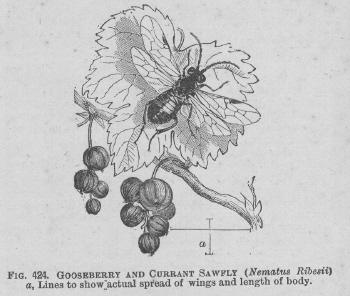
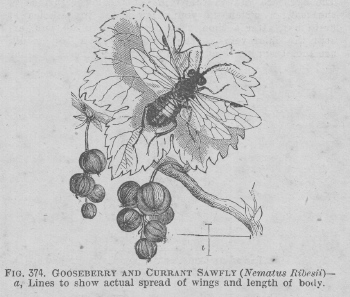
Insects, &c. The Gooseberry suffers severely from the ravages of several destructive insects, which feed on the leaves so far as to entirely defoliate the trees. The principal depredators are the caterpillars of the Magpie Moth (Abraxas grossulariata) and of Phalaena Vanaria, and the larvae of the Gooseberry and Currant Sawfly (Nematus Ribesii). Hand-picking, persistently practised from the first appearance of the insects, is the most certain cure; but this is almost impossible in extensive collections. Bushes situated near much-frequented walks, or placed under protection from birds, have been observed to become more infested than others fully exposed. This infers that birds of some sort, although it is doubtful which, either eat the insects or carry them away to feed their young. Cuckoos are considered special friends for this purpose; and sparrows, sparrow-hawks, and tomtits, have also been observed to visit the bushes frequently when infested with caterpillars; but whether for eating them or not, is somewhat uncertain. Lightly syringing the bushes, in the evening, with water, and then dusting with lime or flowers of sulphur, also scattering some of each and some soot round the plants, are means usually adopted as remedies. As most of these insects undergo their transformation in a young state, on or beneath the ground, various methods for destroying them there have been recommended, such as occasionally dusting with newly-slaked lime or Hellebore powder; or covering the soil, in spring, to a depth of 3in., with fresh tan. Great destruction is frequently caused to Gooseberries in some localities by birds, particularly bullfinches, picking out the buds in spring, and also devouring the fruit when ripe. A limited number of trees may be covered with netting; but, in a large collection, it is difficult to stop these attacks, when once begun.
Sorts. Gooseberries are divided into classes that are distinguished from each other by the colour of the fruits and the absence or presence of hairs on the skins. Varieties in each colour are very numerous, many of the smaller fruits being of the highest flavour, while the larger ones are fit for cooking earlier in the season. Those having red skins are variable in flavour, a large quantity being more or less acid. On account of their late-keeping properties, the best red sorts are most valuable for dessert fruit in autumn, after the majority of the others are past. The highest flavour is attained in the amber and yellow varieties, which are very tender in the skin, and mostly early in ripening. Many of the green ones are large, and contain but little pulp in proportion. Others of the same colour are small, but remarkably thin-skinned and rich in flavour when ripe. Amongst white sorts, there are several of good quality, but they are not so generally cultivated as the others. Subjoined is a selection from the leading varieties in each class. Those marked F, are specially recommended for flavour; and others marked s, for size.
Class I. Fruit with Red Skin.
Conquering Hero (s). Fruit dark red, very long and large, a little hairy. Branches slender, large, and spreading.
Crown Bob. Fruit bright red, of good flavour, roundish-oblong, hairy. Branches pendulous.
Dan's Mistake (s). Fruit light red, very large, hairy. Branches strong, erect. Useful variety for exhibition.
Dr. Hogg (F). Fruit purplish-red, long, broad, downy. Branches short-jointed, erect, vigorous.
Henson's Seedling. Fruit deep red, medium, of good flavour, very hairy; late. Branches erect. An abundant bearer.
Ironmonger (F). Fruit dark red, small, hairy. Branches spreading. Often confounded with, but inferior to, Red Champagne. SYN. Hairy Black. Keen's Seedling (F). Fruit bright red, medium, oblong, very hairy; early. Branches pendulous. Great bearer.
Lion's Provider. Fruit light red, long, a little hairy. Branches long, slender, erect.
London (s). Fruit dark red, very large, roundish-ovate, smooth. Branches pendulous. A rather tender and uncertain bearer, but the largest gooseberry known.
Miss Bold (F). Fruit light red, medium, very downy; early. Branches spreading.
Monarch. Fruit deep red, very large, oblong, hairy. Branches strong, erect. A good bearer.
Plough Boy. Fruit light red, shaded yellow, very long, smooth; late. Branches slender, spreading.
Raspberry (F). Fruit dark red, small, hairy; early. Branches spreading, pendulous.
Red Champagne (F). Fruit light red, small, roundish-oblong, hairy. Branches very erect. A good bearer. SYNS. Countess of Errol and Ironmonger of Scotland.
Red Turkey. Fruit dark red, small, obovate, smooth; late. Branches somewhat erect.
Red Warrington (F). Fruit red, roundish-oblong, hairy; late, hangs well in autumn. Branches pendulous. One of the best for general cultivation. SYNS. Aston Seedling, Volunteer.
Rifleman. Fruit red, very large, roundish, hairy. Branches erect. A good bearer.
Rough Red (F). Fruit dark red, small, very hairy; early. Branches upright, spreading.
Wilmot's Early Red. Fruit dark red, large, smooth. Branches pendulous.
Wonderful (s). Fruit purplish-red, very large, smooth. Branches short-jointed, stiff, very tender in spring.
Class II. Fruit with Yellow Skin.
Broom Girl (F). Fruit large, with long stalk; skin dark yellow, hairy; early and first rate. Branches strong, erect.
Catherina (S). Fruit yellow, very large, obovate, slightly hairy. Branches slender, spreading.
Criterion. Fruit greenish-yellow, medium, a little hairy. Branches spreading, pendulous.
Drill (s). Fruit greenish-yellow, large, long, smooth; late. Branches spreading.
Early Sulphur (F). Fruit bright yellow, medium, very hairy; early and abundant. Leaves pubescent above. Branches erect.
Fanny. Fruit pale yellow, large, round, hairy. Branches erect.
Garibaldi (s). Fruit pale yellow, large, long; skin hairy. Branches spreading, pendulous.
Gipsy Queen (F). Fruit pale yellow, large, smooth; early. Branches slender, pendulous.
High Sheriff. Fruit deep yellow, large, round, very hairy. Branches spreading, pendulous.
Leader (F). Fruit greenish-yellow, medium, of rich flavour, smooth; early. Branches spreading.
Leveller (s). Fruit greenish-yellow, very large, long, smooth. Branches spreading. An excellent bearer.
Lord Rancliffe. Fruit pale yellow, medium, round, hairy. Branches straight, spreading.
Moreton Hero (F). Fruit pale yellow, large, oval, smooth; skin thin. Branches free, spreading.
Mount Pleasant (s). Fruit deep yellow, long, hairy; late. Branches vigorous, spreading.
Peru (s). Fruit pale yellow, large, tapering, slightly hairy. Branches spreading, pendulous.
Rumbullion. Fruit pale yellow, small, very downy; early; much cultivated for bottling. Branches erect.
Smiling Beauty (F). Fruit yellowish-white, large, oblong, quite smooth; early. Branches pendulous.
Sulphur. Fruit yellow, small, roundish, hairy, and of good flavour; rather late. Branches erect. SYN. Rough Yellow.
Yellow Ball (F). Fruit yellow, medium, thick-skinned, smooth. Branches erect.
Yellow Champagne (F). Fruit small, of rich flavour, hairy; late. Branches erect. One of the best yellows. SYN. Hairy Amber.
Class III. Fruit with Green Skin.
Glenton Green (F). Fruit medium, oblong, with very hairy, thick skin. Leaves pubescent above. Branches pendulous.
Green Gascoigne (F). Fruit deep green, small, round, hairy; early. Branches erect. Free bearer.
Green London (s). Fruit bright green, medium, smooth. Branches short-jointed, spreading.
Green Overall (F). Fruit dark green, of good flavour, medium size, smooth. Branches spreading. An excellent variety.
Green River. Fruit deep green, smooth, medium, oval. Branches spreading.
Green Walnut (F). Fruit dark green, smooth, medium, obovate; skin thin; early. Branches long, spreading. SYNS. Nonpareil, Smooth Green.
Gregory's Perfection. Fruit green, downy, large, round. Branches pendulous. Good late variety.
Heart Of Oak (F). Fruit smooth, large, oblong; skin green, with yellowish veins; footstalk thick, tapering into the fruit. Branches pendulous.
Hebburn Prolific (F). Fruit medium, roundish, hairy. Branches erect. An early and abundant bearer.
Jolly Anglers. Fruit large, oblong, of good quality, downy; late. Branches erect.
Keepsake. Fruit green, large, smooth, sometimes a little hairy; ripens early. Branches vigorous, pendulous.
Laurel. Fruit pale green, downy, large, obovate; late. Branches erect. An abundant bearer. SYN. Green Laurel.
Lord Eldon (F). Fruit dark green, smooth, round, very rich flavour; early. Branches slender, spreading.
Pitmaston Greengage (F). Fruit small, obovate, smooth, of rich flavour; hangs well. Branches erect.
Random Green (F). Fruit deep green, smooth, large, of good flavour. Branches spreading. A good bearer.
Roseberry (F). Fruit large, round; skin dark-green, smooth. Branches vigorous, erect. A very productive and good variety.
Shiner (S). Fruit very large, round, smooth, one of the largest gooseberries grown. Branches spreading.
Stockwell. Fruit bright green, long, smooth. Branches slender, spreading.
Telegraph (S). Fruit large, long, smooth; late. Branches short-jointed, spreading.
Thumper (S). Fruit large, flat-sided, smooth, of good flavour; late. Branches pendulous.
Thunder (F). Fruit large, roundish, hairy, of excellent flavour; early. Branches short-jointed, erect.
Class IV. Fruit with White Skin.
Abraham Newland (F). Fruit white, large, oblong, slightly hairy, rich-flavoured; late. Branches erect.
Adams's Snowball. Fruit medium, roundish; skin hairy. Branches pendulous.
Antagonist (S). Fruit creamy-white, very large, long, hairy, of good flavour. Branches spreading. A heavy cropper, and the largest white gooseberry grown. Bright Venus (F). Fruit medium, obovate, slightly hairy; hangs well. Branches erect.
Careless (S). Fruit creamy-white, large and long, smooth, very handsome. Branches slender, spreading. An abundant bearer.
Cheshire Lass. Fruit large, oblong, downy, of rich sweet flavour. Branches erect. Very early, and a good bearer.
Crystal (F). Fruit small, roundish, smooth. Branches spreading, pendulous. A valuable late variety.
Early White (F). Fruit roundish-oblong, downy, of rich flavour; skin thin; very early. Branches spreading.
Hero of the Nile (S). Fruit greenish-white, large, smooth. Branches spreading.
King of Trumps (F). Fruit roundish-oblong, slightly hairy, of good flavour. Branches slender, spreading.
Lady Leicester (S). Fruit large; skin whitish, with green veins, hairy; early. Branches spreading.
Mayor of Oldham (F). Fruit greenish-white, round, smooth, of excellent flavour. Branches spreading.
Princess Royal. Fruit large, obovate, hairy, of good flavour. Branches pendulous. A good bearer.
Queen of Trumps (S). Fruit long, flat-sided, smooth, large, and of excellent flavour. Branches vigorous, spreading.
Royal White. Fruit small, round, slightly hairy. Branches erect. Snowdrop (F). Fruit very large, roundish, of excellent flavour; skin white, with broad green veins, hairy. Branches slender, spreading. One of the best grown.
White Champagne (F). Fruit small, roundish, sweet and rich, hairy. Leaves pubescent above. Branches erect.
White Fig. Fruit small, obovate, smooth; will hang till it shrivels. Branches erect.
White Lion. Fruit large, obovate, slightly hairy, rich flavour. Branches pendulous. Very late variety.
Woodward's Whitesmith (F). Fruit white, downy, large, roundish-oblong, of excellent flavour. Branches erect. Rather early, an abundant bearer, and one of the best in cultivation. SYNS. Hall's Seedling, Lancashire Lass, Sir Sidney Smith, &c.