Juniperus
(the old Latin name used by Virgil and Pliny). Juniper. ORD. Coniferae. A genus of about twenty-seven species of hardy or nearly hardy evergreen trees or shrubs, natives of the temperate or cold regions of the Northern hemisphere. Flowers dioecious; males in solitary or crowded catkins. Cones small, globose, baccate, of four to six decussate or whorled, confluent, fleshy scales. Fruit berry-like, ripening the second year. Leaves needle-shaped, linear or lanceolate, rigid or flexible, or scale-like, scattered or imbricated, not clustered. J. communis, the species most commonly grown, thrives in almost any position. On the sides of hills, the trunk grows long; while on the tops of rocky mountains, or in boggy land, the species becomes merely a tufted shrub. All the members of this genus may be readily propagated by seeds, which retain their vitality, when kept in the berry, for several years. When sown, they lie one year, and often two years, before they come up. Propagation may also be effected by cuttings, planted in sandy soil, in a shady situation, in the autumn, and covered with a hand glass during winter; or by layers.
J. bermudiana (Bermuda). Barbados or Bermuda Cedar. l. dimorphous, acicular, and arranged in threes on the young plants, but becoming scale-like and imbricated as the tree becomes aged. h. 40ft. to 50ft. Bermudas, 1683. A somewhat tender species, assuming a densely-branched pyramidal form in its native country. This tree furnishes the wood used in the manufacture of "cedar" pencils. It is very rarely seen in England. (G. C. n. s., xix. 657.)
J. californica (Californian). l. ternate, short and thick, mostly acute. fr. reddish, dry and sweetish. Branches stout, spreading, with thick branchlets. Shrub, or sometimes a tree from 20ft. to 35ft.
J. chinensis (Chinese).* l. ternate or opposite, linear, flat, acute, and spreading, or small, scale-like, and closely imbricated. China, 1804. A very handsome shrub or tree, of erect or elongated pyramidal habit, with short branches and dimorphous foliage. The female and male plants are distinct, both in habit and aspect. The male is the more desirable, and is much more generally grown; it has numerous branches, the higher ones ascending, or nearly erect, and all very much ramified. The female plant has the branches longer, more distant, and more spreading, than those of the male; the small berries are of a brownish-violet colour. (S. Z. F. J. ii. 126, 127.) The varieties of this species are numerous.
J. c. albo-variegata (white-variegated). A pretty form, differing from the male type in having the foliage interspersed with silvery-white among the ordinary green growth, and in having many of the terminal shoots pure white. Japan.
J. c. aurea (golden). A very beautiful and distinct form, of garden origin, differing from the type in being suffused with bright gold, which it retains all the year round, and which is heightened by full exposure to the sun.
J. c. densata (dense). According to Messrs. R. Smith and Co., this is a female form, and has somewhat the appearance of the species, but the leaves are larger and more plentiful. The main stem grows upright, and all the branchlets, which are very numerous, are more or less pendulous. This variety forms a dense pyramidal growth, and is very ornamental. h. 10ft. to 20ft. Himalayas.
J. c. japonica (Japanese).* l. arranged in threes, close set, at first acicular, but ultimately scale-like, distinctly marked with two silvery glaucous lines above. Stem usually divided, but sometimes single. h. 2ft. Japan and North China. A small and compact-growing shrub, very desirable for rockwork.
J. c. j. aurea (golden). A very loose-growing form, having the growth of the current season tinged with golden-yellow, which gradually changes to light green. Primary branches few, robust, and comparatively long.
Two other forms, described by Smith, are: glauca (glaucous), a very distinct form, having the foliage of a glaucous or bluish tint; and Leeana (Lee's), which has leaves about 1/2in. long, and forms a densely-branched and vigorous-growing shrub.
J. communis (common).* Common Juniper. l. subulate, rigid, sharp-pointed, spreading, and opposite, or in threes, usually glaucous above and green below. h. 3ft. to 20ft., varying according to the elevation at which it is found. Northern hemisphere (Britain). Well-grown specimens of this species, nicely furnished with branches, are most desirable plants. The wood is finely-veined, of a yellowish-brown colour, and has an aromatic scent. The varieties of it are, for the most part, well worth growing. The following call for special mention:
J. c. canadensis (Canadian). A dwarf spreading bush of inelegant habit, seldom exceeding 3ft. in height. Northern United States, &c., 1820.
J. c. compressa (compressed). A very compact-growing variety, having a conical form, and slender, erect branches and branchlets, which grow close together. h. 1ft. to 3ft. This is one of the smallest of Conifers; the very diminutive size of the plant rendering it interesting. It is found on the Pyrenees at a great elevation.
J. c. cracovia (Cracow). Polish Juniper. An erect, robustgrowing variety, well-clothed with leaves, and sometimes having the terminal branchlets pendulous. h. 12ft. to 15ft. Poland.
J. c. fastigiata (pyramidal). Swedish Juniper. A more erectgrowing form than the type. and somewhat resembling the Irish Juniper, but more robust in growth, and with foliage more glaucous, and of a light green. In habit, it is either columnar or angular, and is not usually considered very ornamental. SYN. J. c. suecica.
J. c. hemisphaerica (half globe-headed). l. short, rigid, needle-shaped, in threes, glaucous. South Europe. A curious and interesting little shrub, with a dense rounded habit. SYN. J. echiniformis.
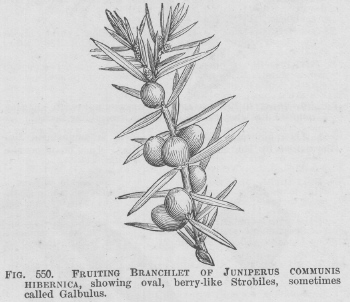
J. c. hibernica (Irish).* Irish Juniper. A well-known and desirable variety, with a somewhat columnar habit of growth, and a peculiar silvery-glaucous appearance; the branches are erect, with numerous, rigid, close-set branchlets. It is the handsomest of all the varieties of J. communis, and thrives best on cool clay or peat soils. SYN. J. stricta. There is a form with prettily-variegated leaves.
J. c. nana (dwarf). A pretty dwarf procumbent shrub, with short branches and branchlets, covered with shorter, broader, imbricated, incurved leaves, glaucous above and green beneath. Alpine parts of Europe, &c. SYN. J. nana.
J. c. oblonga (oblong-fruited). A procumbent shrub, with slender branches and branchlets, clothed with long, attenuated leaves, which are of a deeper and brighter colour than the type. Caucasus. This variety rarely thrives well in England. It is very distinct as regards the colour of its foliage, and it sometimes takes an erect habit. SYN. J. oblonga.
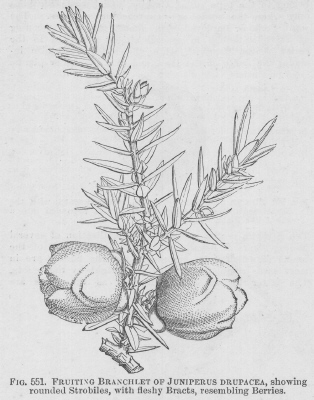
J. c. suecica (Swedish). A synonym of J. c. fastigiata. J. drupacea (drupe-fruited).* l. in threes, broader and stouter than those of any other species, very sharp-pointed, and light green. The fruits of this species are remarkable, both in size and colour; they are of deep purple, covered with a glaucous bloom, and are about the size of the common sloe. Branches numerous, short, imparting a columnar or elongated conical form to the tree. Trunk straight, erect. h. 8ft. to 10ft. Northern Syria, &c., 1854. This is a very handsome and distinct species, and is particularly ornamental as a plant for lawns.
J. dumosa (brambly). A synonym of J. recurva squamata.
J. echiniformis (hedgehog-like). A synonym of J. communis hemisphaerica.
J. excelsa (tall).* l. opposite or (rarely) in threes, thick, decurrent, loosely imbricated, having a greyish-green hue. Branches short, much ramified. h. 20ft. to 40ft. Asia Minor, 1806. A compact-growing and very distinct ornamental tree, having a pyramidal shape; it is somewhat tender, but forms handsome specimens in sheltered situations. The varieties are not numerous.
J. e. stricta (upright).* This variety differs from the type principally in having a more tapering outline and more glaucous foliage. It is an extremely pretty species, of garden origin, and well deserves cultivation.
J. Fortunei (Fortune's). A synonym of J. sphaerica.
J. fragrans (fragrant). A synonym of J. occidentalis.
J. macrocarpa (large-fruited). A shrub of more open and spreading habit than the common Juniper; it has also longer leaves, and, as its name implies, bears larger berries. It is rarely other than an inelegant bush in British gardens. h. 10ft. to 12ft. Mediterranean region.
J. nana (dwarf). A synonym of J. communis nana.
J. neoboriensis (Naumberg). l. short, rigid, very glaucous. A very distinct species, with a pyramidal or fastigiate habit, and short branches; probably of garden origin. According to Messrs. Veitch, the Juniper cultivated in British gardens under this name is evidently a variety of J. communis.
J. nepalensis (Nepaul). A synonym of J. recurva.
J. oblonga (oblong). A synonym of J. communis oblonga.
J. occidentalis (Western).* l. in whorls of three; when young, spreading, sharp-pointed, glaucous; but when in an adult state, short, blunt, imbricated, and closely appressed to the stem. Berries small, deep purple, covered with a glaucous bloom. h. 10ft. to 50ft. California. A conical, erect-growing species, of a peculiar colour. When bruised, its branches emit a very strong scent. It is a very handsome plant for lawns. SYN. J. fragrans.
J. o. Burkei (Burke's). A desirable variety, of neat, compact habit, and of a more decided blue-glaucous tint than the type.
J. oxycedrus (sharp-Cedar). l. sharp, spreading, needle-like, in whorls of three. h. 10ft. to 12ft. Spain, Portugal, &c., 1739. A large, bushy, much-branched shrub, with slender pendulous branches. This species may be distinguished from the common Juniper by its somewhat broader and shorter leaves, with more prominent white bands on the under side. In Great Britain, owing to climacteric causes, it attains but small proportions, has an inelegant habit, and is quite destitute of any ornamental qualities. SYN. J. rufescens.
J. pachyphloea (thick-barked).* l. subulate, almost squamiform, closely imbricated, thick and broad at the base, sharp-pointed. A slender, upright tree, with a whitish appearance, a tapering habit, and short, erect branches. New Mexico. A remarkable, but scarcely handsome species. J. phoenicea (Phoenician).* l. small, scale-like, in threes, imbricated, scarcely glaucous. h. 15ft. to 18ft. Mediterranean region, 1683. A large pyramidal shrub, with a profusion of slender pendulous branches, growing in tufts. It is a handsome plant for growing near water, or on rockwork, in almost any situation.
J. p. lycia (Lycian). This form is described as being a creeping shrub. It is interesting, from producing the resinous gum known as Olibanum, which is used as incense in religious ceremonies on the Continent. (A. F. B. iv. 2367.)
J. procumbens (procumbent).* A glaucous creeping species, having a spreading habit, and never rising more than a few inches from the ground. It closely resembles J. Sabina in the colour of its foliage, but the young growth is more glaucescent. It is a very ornamental plant for rockwork. Canada and Northern United States. SYNS. J. prostrata and J. repens.
J. prostrata (prostrate). A synonym of J. procumbens.
J. recurva (recurved). l. loosely imbricated, sharp-pointed, usually in whorls of three, greyish-green. Branchlets recurved, pendulous, feathery. h. 5ft. to 8ft. Nepaul, 1817. A graceful and handsome plant when healthy, but liable to attacks of Red Spider. It should be grown in a cool soil. The male form, usually called densa, is much shorter in foliage, and very much dwarfer in habit, than the female form. SYNS. J. nepalensis and J. repanda. (G. C. n. s., xix. 468.)
J. r. squamata (scaly-leaved). l. rigid, sharp-pointed, scaly, usually in threes, glaucescent. Branches with numerous short stiff branchlets. A large creeping shrub, with a much-branching and spreading habit, and rather more peculiar than ornamental. h. 3ft. Nepaul, 1824. SYN. J. dumosa.
J. repanda (repand). A synonym of J. recurva.
J. repens (creeping). A synonym of J. procumbens.
J. rigida (stiff-leaved). l. very distinct, about 1/2in. long, linear, rigid, erect, sharp-pointed, produced in whorls of three, marked with a glaucous furrow on the upper side. Branches drooping; when young, slender, and of a lively green, slightly tinged with yellow. h. 15ft. Japan, 1861. An ornamental species, with an upright and somewhat irregular habit. (S. Z. F. J. ii. 125.)
J. rufescens (reddish-berried). A synonym of J. oxycedrus.
J. Sabina.* Common Savin. l. small, scale-like, imbricated, some-what acute. h. 5ft. to 8ft. South Europe, 1548. An ornamental much-branched shrub, having a spreading, irregular habit, and with numerous reclinate or trailing branches. It thrives best in a light soil, and in airy situations.
J. S. tamariscifolia (Tamarisk-leaved).* A very ornamental low-growing, densely-branched, and trailing species. It has a neater habit than the type, and its foliage is of a brighter green. An excellent plant for rockwork, banks, &c. This variety is sometimes known as the Carpet Juniper. SYN. J. sabinoides. (Enc. T. & S. 2022.)
J. S. variegata (variegated). A very distinct and pretty variegated form, having its branchlets creamy-white or pale yellow. It should not be grown in too sunny a position.
J. sabinoides (Sabina-like). A synonym of J. Sabina tamariscifolia.
J. Sheppardi glauca (Sheppard's glaucous). A synonym of J. sphaerica Sheppardi.
J. sphaerica (globular-fruited). l. scale-like, imbricated. Berries of a globular or spherical form. North China, 1846. This species "combines the upright mode of growth of J. chinensis with the habit of J. phoenicea in its much-divided tufted branches and scale-like leaves; the colour of the foliage being, on the whole, brighter than the latter, and less glaucescent than the former. It shows the same peculiarity as J. phoenicea, in often departing from the dioecious character of the Juniper, so that particular branches are sometimes found loaded with berries, while the remainder of the plant has none" (Veitch's "Manual of the Coniferae"). SYN. J. Fortunei.
J. s. Sheppardi (Sheppard's). l. acicular, rigid, not imbricated, sharp-pointed, assuming in autumn, and with the young growth, a very glaucous or almost silvery whiteness. It is a very pretty shrub, and has a rather spreading habit. China. SYN. J. Sheppardi glauca.
J. stricta (upright). A synonym of J. communis hibernica.
J. thurifera (incense-bearing).* Frankincense Juniper. l. subulate, imbricated, in opposite pairs, light glaucous green. Branches slender, numerous, much divided, densely clothed with leaves. h. 15ft. to 25ft. South-west Europe, 1752. (A. F. B. iv. 2369.) A very ornamental, small, pyramidal tree, with an erect, slender, tapering trunk.
J. virginiana (Virginian).* Red Cedar. l. usually subulate and spreading in young plants, and very minute, scale-like, and closely imbricated. Branches at first erect, but ultimately usually decumbent, having numerous crowded branchlets. Trunk erect, of varying shades. h. 10ft. to 15ft. towards its Western limits, often a large tree, 60ft. to 90ft. high. United States, 1664. A well-known ornamental tree, usually of pyramidal form, and having beautiful bright red heart-wood. Its timber has an aromatic fragrance, and is largely employed in the manufacture of various utensils in its native country. The varieties of this species are somewhat numerous.
J. v. alba variegata (white-variegated). A form having a portion of the leaves white, and the remainder of greenish-yellow.
J. v. aurea-variegata (golden-variegated). A variable form, sometimes having the terminal branches and branchlets deep yellow, while at others the variegation is but a spot. It should be grown in a shady situation.
J. v. Bedfordiana (Bedford's). A handsome form, having the branches longer and more slender than the type; ultimate branches filiform, pendulous.
J. v. dumosa (bushy). A dwarf form, having a roundish, spreading, compact head. It resembles J. Sabina tamariscifolia.
J. v. elegans (elegant). A handsome free-growing variety, the entire plant being suffused with cream-coloured spots, which it retains throughout the winter and summer.
J. v. glauca (silvery). Silver Cedar. A very handsome variety, having a whitish appearance when making growth. It has a pretty cone-shaped habit, and is thickly branched from the ground upwards.
J. v. humilis (dwarf). A distinct and attractive variety, having the shoots branching out in a remarkable angular form.
J. v. pendula (pendulous). Weeping Red Cedar. According to Gordon ("Pinetum"), "there are three forms of the pendulous Red Cedar to be found in collections; one of the male form, another the female, and the third a bright green one. The male kind has shorter and much more numerous branchlets, while the female one has longer, more slender, and much fewer branchlets; the third variety is of a light glossy green." The female form is superior to the others.
J. v. Schotti (Schott's). A distinct variety, of pyramidal habit, and distinguished by its peculiar light green foliage.
J. v. tripartita (three-parted). A very pretty dwarf spreading variety, somewhat resembling J. Sabina in habit, but much denser.