Kalmia
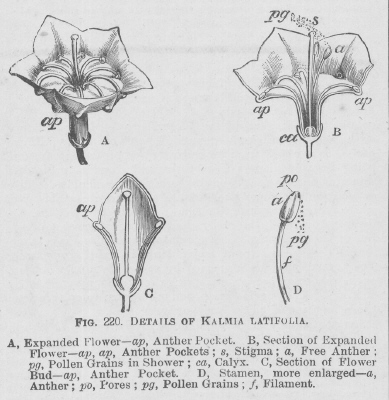
(named in honour of Peter Kalm, 1715-1799, a pupil of Linnaeus, who travelled in Canada and the Northern States, and became Professor at Abo). American Laurel. ORD. Ericaceae. A genus comprising six species of ornamental hardy evergreen shrubs, of which one is from Cuba, and the rest from North America, extending from Florida to California and the Arctic regions. Flowers rose-coloured, purple, or white, showy, clustered or rarely scattered; bracts ovate to subulate, coriaceous, or firm and persistent; corolla broadly campanulate or sub-hypocrateriform. Leaves entire. Kalmias thrive under treatment similar to Rhododendrons and such-like plants, in a peaty soil, where the roots are provided with ample moisture. The best-known and most-grown species is K. latifolia. It is well adapted for forcing, in spring, for greenhouse or conservatory decoration. For this purpose, the plants should be potted up during winter, after the blossoms have well set. Propagated by cuttings of young shoots, inserted in sandy peat, and placed in a shady situation, under a hand glass; or by seeds, sown in shallow pans of sandy peat, and kept in a cold frame until the seedlings are large enough to handle, when they may be gradually hardened off, and transferred to the open air.
K. angustifolia (narrow-leaved).* fl. purple or crimson, not half so large as those of K. latifolia, disposed in lateral corymbs. Early summer. l. mostly in pairs or threes, oblong, obtuse, 1in. to 2in. long, petioled, light green above, dull or pale beneath. h. 2ft. to 3ft. Canada, 1736. A very pretty species. (B. M. 331.) There are several varieties, differing chiefly in the size of parts, and in the deeper and lighter shade of the corolla. The dwarf one, known as nana, is especially worth mention.
K. cuneata (wedge-shape-leaved). fl., corolla white or whitish, 1/3in. in diameter; inflorescence lateral, nearly glabrous. May and June. l. oblong, with cuneate base, 1in. long, almost sessile, and chiefly alternate, mucronate. h. 2ft. North and South Carolina, 1820. A low, somewhat pubescent shrub.
K. glauca (glaucous).* fl. lilac-purple, 1/2in. to 2/3in. in diameter; bracts large; sepals ovate, scarious-coriaceous, much imbricated. Spring. l. opposite, or rarely in threes, almost sessile, oblong or linear-oblong, or appearing narrower by the usual strong revolution of the edges, 1in. or less long, glaucous-white beneath. h. 1ft. to 2ft. 1767. (B. M. 177.)
K. hirsuta (hairy). fl. scattered and axillary, on pedicels longer than the leaves; corolla rose-purple, barely 1/2in. in diameter; sepals ovate-lanceolate, leaflike, as long as the corolla, at length deciduous, leaving the old capsules bare. Summer. l. nearly sessile, plane-oblong or lanceolate, 1/4in. to 1/2in. long. h. 1ft. South-east Virginia to Florida, 1786. A free-branching shrub. (B. M. 138.)
K. latifolia (broad-leaved).* Calico Bush. fl., inflorescence very viscid-pubescent; corolla rose-colour to white, 3/4in. in diameter; fascicles numerous, crowded in compound terminal corymbs. Summer. l. alternate, or occasionally somewhat in pairs or threes, oblong or elliptical-lanceolate, acutish at both ends, petioled, bright green. h. 3ft. to 10ft. (in the South Alleghanies, sometimes 20ft.) Mountainous districts of Canada, Western Florida, &c., 1734. One of the most useful, elegant, and attractive of dwarf flowering shrubs. It is a slow-growing subject, but is generally of very easy culture. For cutting purposes it is also useful, if a corymb of flowers is taken with a good stem and a few leaves; but the blossoms can be seen nowhere to more advantage than on the bush. (B. M. 175.)