Home › L › Lycaste (To the species and varieties)
Lycaste (To the species and varieties)
To the species and varieties described on p. 304, Vol. II., the following should now be added:
L. citrina (citron-coloured). fl. large, thick and fleshy; sepals and petals lemon-coloured; lip white, marked lilac. Brazil. A robust, but rare plant, with the habit of Bifrenaria Harrisoniae.
L. Cobbiana (Cobb's). fl., sepals greenish-yellow; petals greenish-white; lip white, distinctly fringed. September. Pseudo-bulbs long and narrow. Native country unknown.
L. costata (ribbed). fl., very pale yellow; dorsal sepal oblong-lanceolate, the lateral ones broadly lanceolate-falcate, united at base in a conical spur; petals obversely lanceolate, shorter than the sepals; lip three-lobed, concave, the middle lobe roundish-cordate, recurved at apex, entire, the lateral ones short, ovate; bracts cucullate, acute. Pseudo-bulbs angular, ovate-conical, each terminated by two lanceolate, petiolate leaves. Columbia, 1842. (B. R. xxix. 15; R. G. 1141.) L. cristata Randi (Rand's). A synonym of L. Randi.
L. c. Modiglianiana (Cavalier Modigliani's). fl. almost whitish. 1888. L. Denningiana (Denning's). fl. almost as large as those of L. gigantea; sepals and petals whitish-green, the latter rather smaller than the former; lip reddish-brown, the front lobe oblong, blunt, toothleted, reflexed, the disk bearing a large, rhomboid, acute appendage. l. cuneate-oblong. Pseudo-bulbs broadly pyriform, furrowed, glaucous. Ecuador. L. Deppei punctatissima (much-dotted). fl. whitish-green, thickly marked with small, dark purple dots; lip yellow, having radiating, purple lines. Guatemala, 1882.
L. grandis (great). fl. chocolate-brown, barred on the lower half of the lanceolate, acuminate sepals and petals with yellowish-green and cream-colour, the edges creamy; lip with a blackish purple claw, widening into an oblong, obtuse, creamy front lobe, which is hairy on the apical portion, and has a pair of oblong lobes on each side of it, the two basal ones being incurved and pale chocolate-brown, and the two front ones horizontal and blackish-purple. Brazil, 1884. A curious Orchid. SYN. Paphinia grandis (W. O. A. iv. 145). L. Harrisoniae (Mrs. Harrison's). A synonym of Bifrenaria Harrisoniae. L. jugosa punctata (dotted). fl. greenish-yellow, spotted with reddish-black. 1883.
L. j. rufina (rufous). fl., sepals pale yellowish-green; petals speckled with blackish-purple; lip marked brown. 1883.
L. Lindeniana (Linden's). fl. large and showy; sepals and petals lanceolate, acuminate, the central part dark reddish-purple (broken up into lines and spots on the sepals), the margins white; lip white, with a dark purplish-brown base, the front lobe hastate, with numerous filiform and papillate crests. l. elliptic, acute. Pseudo-bulbs oblong-ovoid, 2in. to 2 1/2in. long. Orinoco. SYN. Paphinia Lindeniana.
L. macrophylla (large-leaved). fl. bold; sepals olive-green; petals pale nankeen-sulphur, nearly as long as the sepals, broadly rounded and undulated at the extremity; lip pale sulphur, spotted purple on the edges of the lobes, and having a tongue-shaped appendage. l. ample, lanceolate, plaited. Pseudo-bulbs large, ovate, ribbed. Caraccas, 1837. SYN. Maxillaria macrophylla.
L. plana (flat). fl. about 3 1/2in. across; sepals madder-red, flat, oblong, spreading; petals white, with a rosy-crimson eye-blotch on their recurved tips; lip small, white, spotted rosy-crimson, the roundish front lobe serrated, the appendage oblong, blunt, and obsoletely three-lobed. Winter. l. bold, oval-lanceolate, plicate. Pseudo-bulbs large, ovate-oblong, ribbed. Bolivia, 1841. (B. R. 1843, 35.) L. p. Measuresiana (Measures'). fl., sepals reddish-brown, tipped green, green outside; petals and lip white, densely spotted rose-purple, except on the margins of the petals. Bolivia, 1887. A beautiful, free-flowering variety. (W.O.A. vii. 306.) L. Randi (Rand's) fl. 2 1/4in. expanse; sepals and petals purplish-red, transversely barred, and longitudinally striped along the margins with white; lip marked with the same colours, crested; peduncles two-flowered. l. 3in. to 4in. long. Pseudo-bulbs ellipsoid, 1in. long. 1886. (L. 30.) SYNS. L. cristata Randi, Paphinia Randi.
L. rugosa (wrinkled). fl. creamy-white, covered with red spots, which now and then become confluent, large, of a waxy appearance; raceme pendulous, two-flowered. l. thin, linear, acuminate. Pseudo-bulbs very small, terete, furrowed. 1882. A remarkable and attractive Orchid, of dwarf growth. SYN. Paphinia rugosa.
L. Schilleriana (Schiller's). fl., sepals greenish-brown, about 4in. long, spreading; petals pure white, smaller, converging over the base of the lip; lip pure white in front, with a faint tinge of yellow at the base; scapes about 6in. high. l. and pseudo-bulbs as in L. Skinneri, but the leaves more erect. Central America.
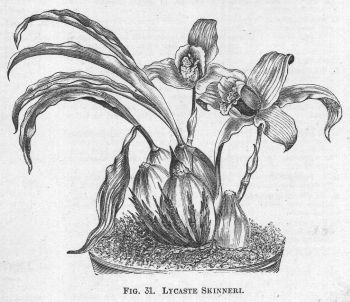
L. Skinneri alba (white). fl., sepals and petals pure white; lip white, with the faintest tinge of yellow about the centre, the tongue-shaped appendage yellow. Guatemala, 1841. (F. M. ser. ii. 35, f. 1.) The type is shown at Fig. 31.
L. S. amabilis (lovely). fl. about 6in. across; sepals pale rose, about 2in. broad; petals magenta, broad; lip white, blotched pale rosy-purple. Guatemala. L. s. nigro-rubra (blackish-red). fl. very large; sepals rather deep mauve or lilac-rose; petals of a rich puce-purple or plum-colour; side lobes of the lip deep rose, the front lobe deep blood-purple, the appendage yellow. Guatemala. A handsome variety. (F. M. ser. ii. 35, f.2.) L. S. reginae (queenly). fl., sepals light rosy-purple; petals and lip dark magenta-purple. Guatemala, 1887. (W. O. A. vi.283.) L. S. roseo-purpurea (rose and purple). fl. 7in. across; sepals and petals bright rose; lip intense magenta-crimson. Guatemala. L. S. vestalis (vestal). fl. white, 7in. across; sepals 1 3/4in. wide; petals faintly veined pale rose on the inner face; lip faintly marked pale rose. Guatemala.