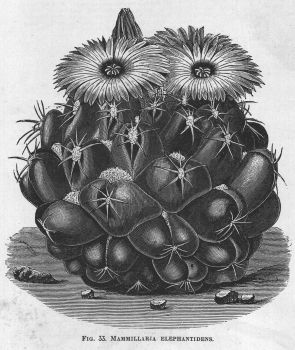
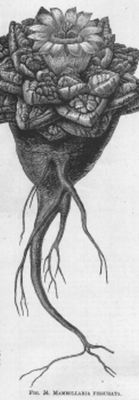
Mammillaria
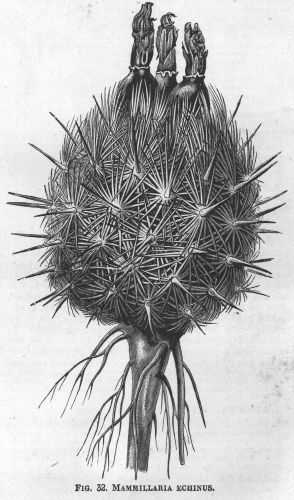
(from mamilla, a little treat, diminutive of mamma, the nipple; the plants are covered with mammaeform tubercles, spirally disposed, the mammae bearing radiating spines at the apex, and deciduous tomentum). Haworth, who founded the genus, wrote it Mamillaria. Including Anhalonium. ORD. Cacteae. A genus comprising about 300 species of greenhouse succulent perennials, natives of Mexico, the warmer parts of North America, Brazil, and rarely occurring in the West Indies and Bolivia. Flowers produced towards the summit of the plants, usually in a transverse zone, solitary, and growing from the axil of one of the tubercles, or teats. Stem cylindrical or globular, seldom exceeding 10in. or 12in. in height, and usually only 3in. to 6in. high, and from 1in. to 3in. in diameter. The tubercles, or mamillae, range in size from minute elevations scarcely 1/16in. high to 1in. high and as much in diameter, varying in form from cylindrical, spindle-shape, conical, or ovoid, to angular and irregularly pyramidal, spirally arranged around the stem, and spiny at the apex. Concerning this genus, Mr. Lewis Castle remarks, in his "Cactaceous Plants" : "It would be very difficult to find any plants in the whole vegetable kingdom which present such beautiful examples of symmetry as the Mammillarias, and in their own family they are unique in this respect; for, though many of the grotesque Opuntias, Cereuses, and Echinocactuses, possess larger and more brilliant flowers, and they are surpassed in horticultural value by the Phyllocactuses and Epiphyllums, yet for delicacy of design they are unrivalled. A large number of them resemble exquisite pieces of mechanism, finished with the greatest minuteness and accuracy; others, again, might be imagined to have undergone a kind of crystallisation, their whole surface being frosted over with star-like spiculae, arranged with geometrical precision; and still others appear as if covered with the finest gossamer. . . . . . Strangely beautiful indeed are most of the Mammillarias, and in contrast with their neat rosettes or stars of spines, are the rosy, yellow, and white flowers, which are generally followed by small, berry-like, coral-coloured fruits, that, dotted amongst the spines, add another phase to the attractions of these plants. With so much to recommend them, it is not surprising that they have become great favourites with cultivators of Cacti, and with that portion of the public who have obtained any knowledge of them." Cultivation. Mammillarias thrive in a mixture of sandy loam and finely-broken bricks and lime rubbish. Many of them affect limestone districts in a wild state, and to those which do not do so, the lime rubbish in the soil proves beneficial under artificial conditions. Plenty of light--indeed, full exposure to direct sun-light is desirable at all times--and careful watering are all that is needed to insure success. During the period of growth--spring and early summer--more heat is necessary than during the rest of the year. Some of the delicate species thrive admirably when grafted on some Cereus stock.
A representative list of the more select species is here given; the names quoted in Continental catalogues number four times more than those enumerated below.
M. angularis (angular-stemmed). fl. rosy-purple. Stem branched, 4in. to 8in. high, 2in. in diameter; tubercles conical, thick, 1/4in. long, with a tuft of white down at the top, and four or five white spines of irregular length. Mexico, 1835. A very distinct and robust-growing species.
M. applanata (flattened). fl. white, tinged with red. Stem simple, flattened; tubercles four-angled, pyramidal, white, woolly in axils when young. Spines straight; outer ones seventeen to twenty, very thin, white, pale yellow, or ashy-grey; central one upright, short. Mexico.
M. atrata (blackened). fl. reddish-pink, copiously produced near the apex of the stem. Stem simple, oval-cylindrical, thick; tubercles dark green, thick, conical, somewhat obtuse; the lower ones compressed, obtuse at apex; areolae white-villous, setose. Chili (B. M. 3642.)
M. bicolor (two-coloured).* fl. purple, small. Stem cylindrical, somewhat club-shaped, 8in. to 10in. high, 2in. to 3in. in diameter, branching from near the base; tubercles very short, dark green, hidden by the spines, which are in two series, the outer filiform, closely set, spreading, the others fewer, erect, yellowish. Mexico, &c., 1835. A distinct species, the whole surface of which appears as if covered with a fine cobweb.
M. Caput-Medusae (Medusa's head). fl. white, about 1in. in diameter. Stem from 4in. to 6in. high, globular, or occasionally columnar; tubercles four-angled or ovate, bearing four small white spines and two thicker and stronger ones.
M. chlorantha (greenish-yellow-flowered). fl. greenish. Stem cylindrical, covered with long, densely interwoven spines. Texas, 1883.
M. cirrhifera (tendril-bearing). fl. bright rose; anthers yellow. Stem cylindrical, 3in. to 4in. high; tubercles short, conical, 1/4in. long, glaucous-green, furnished with a crown of yellow spines. Mexico, 1835. A pretty little species, having a neat and symmetrical habit.
M. clava (club-shaped).* fl. two or three, large, handsome, showy, borne at the summit of the plant; base (calyx) of green scales, tipped with red; petals glossy straw-colour, numerous, serrated and mucronate at apex, the more exterior ones entire, and tinged with dull red; stamens orange, numerous; rays of the stigma yellow. June. Stem columnar, glaucous green, 1ft. high; tubercles pyramidal, large, projecting, and ascending; axils densely downy with white wool; areolae terminal, and bearing besides eight to eleven long, rigid, pale brown spines, and a single larger and stronger one. Mexico, previous to 1848. (B. M. 4358.)
M. dolichocentra (long-spurred).* fl. pale rose or reddish-crimson. Stem stout, 6in. to 8in. high, 3in. in diameter; tubercles conical, narrow, 1/2in. long, crowned with a small tuft of white down, and a few white spines of irregular length. Mexico. A strong-growing species, of variable habit.
M. floribunda (copious-flowering). fl. pink, tinged with red, very copiously produced; petals very unequal. Stem globose-sub-cylindrical; tubercles thick, conico-hemispherical, obtuse; prickles villose-tomentose. Chili. This species approaches M. atrate, but differs in its stouter habit, larger tubercles and flowers, and unequal petals. (B. M. 3647.) M. gracilis (slender).* fl. pale yellow, rather large. Stem cylindrical, 1in. to 2in. high, 1/2in. in diameter; tubercles small, green; spines in one series, white, spreading, closely set. Mexico. One of the prettiest of the dwarf-growing species.
M. Haageana (Haage's). fl. bright carmine-rose, scarcely longer than the tubercles. May to July. Stem bullet-shaped when young, somewhat club-shaped when old, only slightly woolly in the axils; spines, outer ones about twenty, short, white; central ones two, stiff, longer, black. Mexico, 1835. See Fig. 509, for which we are indebted to Herr Fr. Ad. Haage, jun., of Erfurt.
M. Lehmanni (Lehmann's). fl. moderately large, terminal; petals straw-colour, numerous, linear-oblong, imbricated; filaments red. Stem 6in. high, oblong-cylindrical, covered all over with large conical tubercles, tipped with a minute woolly tuft, from which springs a fascicle of seven or eight slender spines, one of which is twice as long as the rest. Mexico, 1836. (B. M. 3634.)
M. micromeris (small-flowered). fl. pale rose, very minute, succeeded by red berries 1/3in. long. Stem resembling a flattened ball, 2in. in diameter, and 1 1/2in. high, with a circular tuft of down in the centre at the apex, about 1in. across, surrounded by stiff white spines; tubercles very small, closely set. Mexico, &c.
M. multiceps (many-branched). fl. pale yellow, with a reddish line in the centre of the petals. Stem dwarf, much-branched or divided, 1in. high, 1/2in. in diameter; tubercles 1/8in. to 1/4in. long, fine, numerous, the inner yellow, larger, and stronger. Mexico.
M. Neumanniana (Neumann's). fl. of a rosy hue. Stem cylindrical, 5in. to 6in. high; tubercles stout, 3/8in. long, dark green, with a tuft of down at the apex, and a few tawny spines, 1/2in. long. Mexico, 1845. A bold and distinct species.
M. Odieriana (Odier's). fl. reddish-violet. Stem cylindrical, 3in. to 4in. high, 2in. in diameter, very symmetrical; tubercles 1/8in. long, dark green, with the spines in two series, the outer close and fine, the inner tawny, 1/2in. to 3/4in. long. Mexico. A very attractive and neat plant.
M. Parkinsonii (Parkinson's). fl. yellow. Stem 4in. to 6in. high, 2in. to 3in. in diameter; tubercles small, each bearing a star of diminutive white hairs, and four or five stiff erect white spines, 1in. to 1 1/2in. long, tipped with brown. Mexico. A very distinct, stout-growing species.
M. Peacockii (Peacock's).* A small semi-globular mass, clothed with woolly hairs and spines, having much the appearance of a ball of grey worsted. Mexico, 1872.
M. pectinata (combed).* fl. yellow, about 2in. in diameter, lasting in beauty only about two hours. Stem conical or nearly globular, 3in. high, and 2 1/2in. in diameter; tubercles short and stout, each crowned with a rosette, about 1/2in. across, of white spines in one series. Limestone hills on the borders of Mexico. One of the handsomest species.
M. phymatothele (tumour-nippled). fl. bright rose. Stem 5in. to 6in. high, 2in. in diameter; tubercles 1/4in. long, conical, dark green, crowned with a small tuft of white down, and a few white hair-like spines, which are spreading and erect. Mexico, 1846. A not uncommon and strong-growing species.
M. pulchra (handsome). fl. rosy, rather large, produced near the summit of the plant, from the woolly axils of the tubercles. June. Stem green, 4in. to 5in. high, oblong-cylindrical, with a depressed woolly apex, and almost covered with unequal spines, arranged in eleven to thirteen symmetrical, very spiral rows; tubercles rather large, ovately pyramidal. Mexico, 1826. (B. R. 1329.) M. pusilla (small).* fl. yellowish, the petals with a central line of rose. Stem 1in. to 2in. high, cylindrical-globular; tubercles narrow, conical, 1/8in. to 1/4in. long, grey-green; spines in two series, outer numerous, filiform, white; inner fewer, erect, brownish. West Indies, 1820. A very small, but exceedingly pretty plant. (L. B. C. 79, under name of Cactus stellatus.)
M. p. texana (Texan). This principally differs from the type in the larger number of radial spines (there are from twelve to twenty in M. pusilla), and in the dark green colour of the tubercles; the exterior hair-like spines cover the whole plant as if with a coarse wool. Texas.
M. pycnacantha (densely-spined). fl. deep sulphur-yellow, five or six on the top of the plant, very handsome; petals linear-oblong; anthers orange. July. Stem 6in. high, of a rounded form, but nearly cylindrical; tubercles large, nearly 1in. broad at base, obscurely two-lobed; axillae filled with dense white wool; spines twelve to sixteen, woolly at base, spreading and recurved, pale brown. Oaxaca, Mexico. (B. M. 3972.)
M. raphidacantha (needle-spined). fl. purplish-violet, about 1in. in diameter. Stem cylindrical, 3in. to 5in. high, 1in. in diameter, slender; tubercles short, conical, 1/4in. long, dark green; spines eight or nine, in one series, spreading, star-like, close set, 1/4in. long, white. Mexico. A very pretty species, the peculiar spines somewhat resembling crystals of ice.
M. recurva (recurved). fl. red, disposed in zones round the summit of the plant. Stem simple, sometimes divided; axils with abundant white wool; tubercles subtetragonous, compressed; spines few, very long, sub-angular, white, or nearly fawn-coloured. Mexico.
M. rhodantha (rose-flowered). fl. bright rose. Stem 2in. to 6in. long, 2in. in diameter, branched; tubercles conical, 1/8in. to 1/4in. long, with a tuft of down at the apex, and six irregular white or yellowish spines 1/4in. to 1/2in. long. Mexico, 1836. A most desirable, free-flowering species. M. sanguinea (bloody).* fl. dark red. Stem short, columnar; mammillae glaucous-green, woolly in the axils, with from twenty-four to twenty-six radiating spines, and seven to nine stronger central ones, about twice as long as the outer spines. Mexico, 1883. See Fig. 510, for which we are indebted to Herr Fr. Ad. Haage, jun., of Erfurt. (R. G. 1111.)
M. Schiedeana (Schiede's). fl. white, small. Stem cylindrical, globular, 3in. to 5in. high, 2in. in diameter; tubercles dark green, cylindrical, 1/2in. long, very narrow and distinct, with yellow, filiform spines, forming a small star 1/4in. in diameter. Mexico, 1845. A very distinct and pretty species, producing flowers in abundance.
M. senilis (old). fl. orange-red, with a violet tint. Stem spheroid or cylindrical, bearing numerous long white spines. Mexico, 1874.
M. simplex (simple). fl. greenish-white, small. Stem simple, globular, 4in. to 6in. high; tubercles conical, small, crowned with white down and two series of strong reddish spines. Tropical America, 1690. The first species introduced.
M. stella-aurata (golden-star-spined).* fl. white, small. Stem 2in. high, 1/2in. in diameter, branched; tubercles short and green; spines in a flat, spreading, star-like rosette, very numerous, 1/8in. to 1/4in. long, yellowish. Mexico. An exceedingly pretty species, being covered with star-like rosettes of yellow spines.
M. tenuis (slender). fl. pale straw-colour, slightly tinged with red externally, solitary, small, campanulate, produced from below the summit and from all sides of the plant. May. Stem 2in. to 4in. high, 1in. or more in diameter, cylindrical, or tapering upwards, and, as well as the copious globular side offsets, covered with green hemispherical tubercles; these are about 1/4in. in diameter, each tipped with a soft tuft of white down, from which diverges a cluster of about twenty slender aculei, at first reddish, then yellowish or pale tawny. Mexico, 1830. (B. M. 3646; B. R. 1523.) M. tetracantha (four-spined). fl. bright full rose-colour, paler in the disk, numerous, small, from the axils of the tubercles, crowded about the depressed portion of the plant. July. Stem sub-globose, flattened at top, nearly 9in. high, and a little less in diameter; tubercles conical or pyramidal, terminated with a depression, from which arise four spreading prickles; the latter are about 3/4in. long, at first brown, tipped with a darker colour, then paler, becoming at length nearly white; axillae between the tubercles occupied by a dense mass of white wool, as are also the apices of the tubercles. Mexico. (B. M. 4060.)
M. turbinata (top-shaped). fl. about 1in. in diameter, borne on the upper part of the plant; petals pale yellow or straw colour; anthers and stigmas yellow. June. Stem globose, depressed at the summit, and contracted at base, as large as a moderate-sized apple; tubercles at the contraction of the stem flattened, and lengthened out transversely; the rest are prominent, sub-hemispherical, but obtusely quadrangular and umblicated at top, whence, in the upper ones, rises a fascicle of from three to five spines; the other tubercles are spineless, the spines being deciduous. Mexico, 1838. (B. M. 3984.)
M. Wildiana (Wilde's).* fl. rose. Stem 3in. to 4in. high, cylindrical, closely surrounded by offsets; tubercles conical, dull green; spines in two series, the outer white, closely spreading; the others fewer and large, yellowish, and hooked at the apex. Mexico. A desirable species.