Home › M › May (L radical ones in to in long)
May (L radical ones in to in long)
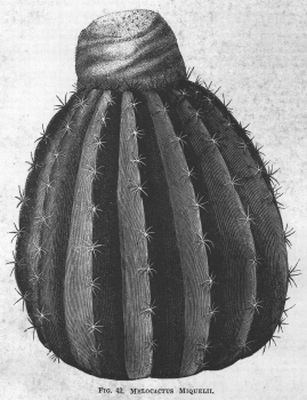
l., radical ones 6in. to 10in. long, narrow-lanceolate, hirsute; cauline ones many, smaller, sessile, linear-lanceolate, acute. h. 1ft. to 3ft. Western Himalaya, 1884. Hardy. (B.M. 7003.) MAMMILLARIA. To the species described on pp. 320-2, Vol. II., the following should now be added:
M. barbata (bearded). fr. green, oblong, crowned with rudimentary flowers. Stem simple, depressed-globose; axils of the tubercles naked; prickles radiating in several series, very numerous, about forty white, piliform outer ones, and ten to fifteen more robust inner ones, the central ones singularly robust, uncinate, fuscous, erect. New Mexico, 1885. (R. G.1208, a-c.) M. cornimamma (horny-nippled). fl. light yellow, with a purplish stripe on the back of all but the innermost segments, 3in. broad. Summer. Stem sub-globose, about 2 1/2in. in diameter, greyish-green, the axils and areolae of the younger tubercles densely white-woolly; tubercles large, conical, grooved down the upper face; outer spines 10in. to 13 1/2in. long, tipped brown, the inner ones one to three, dark brown, stouter and longer. Native country unknown. 1887.
M. echinata (prickly). Stem often multiplex, cylindrical, elongated; tubercles naked, broad at base, very short, obtuse at apex; young areolae slightly tomentose; prickles bristle-like, sixteen to eighteen, radiating, spreading-recurved, yellow, much longer than the tubercles, the two central ones rigid, slightly fuscous. Mexico, 1885. (R. G. 1208, d-e.) M. echinus (hedgehog-like). fl. yellow, nearly 2in. long, cup-shaped, produced two or three together at the top of the stem. June. Stem about the size and shape of a small hen's-egg, completely hidden by the spines; tubercles 1/2in. long, arranged in thirteen spiral rows; spines white, radiating, with a central, spike-like one. Mexico. Warm house. See Fig. 32. M. elephantidens (elephant's-tooth). fl. 3in. wide; sepals violet, with white margins; petals bright rose, purple at base, a line of purple extending down the middle; stamens numerous, with purple filaments and yellow anthers. Autumn. Stem globose-depressed, 6in. to 8in. in diameter, bright, shining green; tubercles smooth, round, 1 1/2in. long, furrowed across the top (which at first is filled with wool, but when old is naked), the base furnished with a dense tuft of white wool; spines recurved, radiating in groups of eight, springing from the furrows. Paraguay.
M. fissurata (fissured). fl. rose-coloured, 1 1/2in. wide, growing from the middle of the stem. September and October. Stem and rootstock shaped like a whiptop, the rootstock being thick and woody; tubercles arranged in a thick layer, spreading from the centre, rosette-like. Mexico, 1885. This species resembles some of the Gasterias.
M. longimamma (long-nippled). fl. citron-yellow, large and handsome, the short tube hidden in the tubercles; petals 1 1/2in. long, narrow, pointed, all directed upwards; stamens short, numerous. Early summer. Stem seldom more than 4in. high, branching at the base when old; tubercles 1in. long, 1/3in. in diameter, terete, slightly curved, narrowed to the apex, each crowned with a tuft of about a dozen spines. Mexico.
M. macromeris (large-parted). fl. about 3in. long and wide, arising from the centre of the stem; petals carmine, almost purple just before fading, regular and spreading as in the Oxeye Daisy. August. Stem about 4in. high, naked t base, woody and wrinkled when old; tubercles as in M. longimamma, but with long, curving, radial spines, like needles, often 2in. long, white or rose-tinted when young, almost black when old. Mexico. Owing to the woody nature of the rootstock, and the long, tap-like habit of the stouter roots, this should be planted in pans instead of pots.
M. phellosperma (corky-seeded). Stems simple, sometimes proliferous at the base, globose when young, afterwards almost cylindrical or pear-shaped, 5in. high, 2in. in diameter; tubercles 1/2in. long, arranged in twelve spiral rows, slightly woolly in the axils; spines radiating in two rows, about fifty on each tubercle, the three or four central ones hooked at the tip or sometimes straight, and almost black, while the remainder are almost white. This plant has not been known to flower under cultivation.
M. Scheerii (Scheer's). fl. terminal, erect, with several whorls of spreading, recurved petals, the lower ones tinged crimson, the upper ones pale yellow, forming a shallow cup 2in. across. Stem 7in. high and 5in. in diameter at base; tubercles large, swollen, somewhat flattened, the apices crowned with about a dozen brown spines. Mexico.
M. Schelhasii (Schelhas'). fl. white, with a line of rose down each petal, 3/4in. across. Early summer. Stem producing offsets freely at the base, which grow into full-sized stems, and develop young ones till a compact cushion is formed; tubercles closely arranged, cylindrical, shining green, with fifteen to twenty radial, white, hair-like spines, 1/2in. long, and three inner, thicker ones, usually only one being hooked. Mexico. M. semperviva (ever-living). fl. inconspicuous, scantily developed near the outside of the top of the stem. Stem pear-shaped, 3in. wide, the top slightly depressed; tubercles conical, 1/4in. long, their bases set in a cushion of white wool, their tips bearing tiny tufts of wool, and four small spines, which fall away on the tubercles becoming ripe, leaving two short, diverging, central spines. Near Zimapan, Mexico (at an elevation of 5000ft.) M. sub-polyhedra (often many-sided). fl. arranged in a zone on the tops of the old stems; sepals greenish-yellow; petals bright red. May. fr. scarlet, 1in. long, pear-shaped. Stem simple (till it becomes old, when it develops offsets at the base), broadly cylindrical, 8in. high, 5in. in diameter; tubercles four-sided at base, prism-shaped, bearing pads of white wool in the corners at the base, and crowned with tufts of four to seven spines, usually all radial, sometimes one central. South Mexico.
M. sulcolanata (woolly-grooved). fl. bright yellow, Poppy-scented, nearly 2in. across, the spread of the petals suggesting Paris Daisies. June to August. fr. glaucous-green, egg-shaped. Stem simple when young, proliferous at sides when old, the young plants developing from the apices of the tubercles, not in the axils, as is usual; tubercles nut-shaped, large, the bases surrounded by white wool, the points bearing eight to ten rigid, brown spines, all radiating from a little pad of wool. South Mexico, 1836.
M. vivipara (stem-sprouting). fl. in the apex of the stem, 1 1/2in. long and broad; petals about thirty, bright purple, fimbriated. May and June. fr. pale green, 1/2in. long. Stems produced in profusion, sometimes forming a cluster 3ft. in diameter; tubercles small, hidden by the spines; spines radial, about twenty to each tubercle, white, hair-like, stiff, about 1/2in. long, the central four or six a little longer than the others. Louisiana. M. v. radiosa (radiate). This is distinguished by its large flowers and shorter spines.
MAPANIA (probably a native name). SYN. Lepironia (in part). Including Pandanophyllum. ORD. Cyperaceae. A genus embracing about thirty species of stove, perennial, sometimes very tall herbs, dispersed over the tropics. Spikelets many-flowered, borne on the stem or terminating a leafless scape, solitary or few in a sessile head, or rarely numerous and corymbosely paniculate. Leaves fascicled at the base of the stem or on the rhizome, long and rather broad, or ovate-lanceolate, on long petioles. Two species have been introduced. For culture, see Cyperus, on p. 422, Vol. I. M. lucida (clear). fl., spikelet castaneous, solitary, trigonal-ovoid, 1/2in. to 3/4in. long; scape dark purple, leafless, 2in. to 3in. long. l. trifarious, 6in. to 10in. long, 1 1/4in. to 1 3/4in. broad, three-nerved, narrow-oblong, rounded-cuneate at base, with a cusp 1 1/2in. long at apex; petioles 4in. to 9in. long, channelled, complicate-sheathing at base. Borneo, 1885. (I. H. 1885, 557.) M. Wendlandi (Wendland's). l. arranged in three series, oblong, acuminate, dark green on the upper surface, bronzy-green beneath; petioles blackish-green, deeply channelled. 1885. An ornamental foliage plant. SYN. Pandanophyllum Wendlandi.
MARANTA. To the species and varieties described on pp. 326-7, Vol. II., the following should now be added:
M. argentea (silvery). l. large, oblong, acute, silvery-grey, marked with narrow, curving lines of a deep green. Brazil, 1884. M. conspicua (conspicuous). l. oblong-ovate, dark green above, pinnately marked with broken, distant bands of pale yellow-green, purplish beneath. Brazil, 1885. A small species.
M. gratiosa (favoured). l. broadly oblong, sub-cordate, silvery-grey, the midrib and five or six tapering, curved bands on each side of it of a bright green. Brazil, 1884.
M. iconifera (picture-bearing). l. about 6in. long, obliquely ovate, yellowish-green, marked with oblong, deep green blotches. Brazil, 1887. M. musaica (mosaic). l. obliquely cordate, 7in. long, 3 1/2in. broad, bright. glossy green, marked with numerous close-set, transverse veins. Brazil, 1884. M. nitida (shining). l. oblong, acute, 6in. long, 3in. broad, pale, bright, shining green, with four or five oblong, green patches on each side of the midrib. Brazil, 1884.
M. polita (neat). l. 4in. to 5in. long, 2in. broad, glossy green, elegantly marked with stipitate, oblong, dark green blotches. Brazil, 1884. M. speciosa (showy). l. obliquely elliptic-oblong, acute, bright green, pinnately banded with greenish-white. Brazil, 1884.
MARCGRAVIA INDICA. The plant catalogued by nurserymen under this name is probably a Pothos.
MASDEVALLIA. M. Dayana, M. gracilenta, and M. hypodiscus are now referred to Cryptophoranthus (which see). To the species, varieties, and hybrids described on pp. 332-5, Vol. II., the following should now be added: M. acrochordonia (belted above). fl. much as in M. ephippium, six to fifteen to a peduncle; sepals having numerous warts on the upper surface; petals acuminate; lip much narrower than in M. ephippium, with an undulated, median keel on the upper part, and an acuminate top. Ecuador, 1885. M. astuta (cunning). fl., sepals brown outside, with the centre and apex yellow, internally ochreous, spotted brown, hispid, triangular, the tails brown; lip pale yellowish, saccate, with three keels; peduncle about as long as the leaves. l. oblong, acute, 6in. to 8in. long. Costa Rica, 1886. Allied to M. Gaskelliana.
M. Boddaertii (Dr. Boddaert's). fl. solitary, about 2 1/2in. long and 2in. to 2 1/4in. broad, very flat, on tall peduncles; sepals yellow, gradually passing to bright crimson-scarlet mottled with yellow, the dorsal one decurved, filiform, the lateral ones ovate, acute, not tailed. April and May. l. leathery, lanceolate-obovate, with sheathing, truncate scales at base. New Grenada. SYN. M. ignea Boddaertii (I. H. ser. iii. 357). M. candida (white). A synonym of M. tovarensis.
M. Carderi (Carder's). fl. remarkably fleshy and soft; tails yellow, spotted blackish-purple, long; perianth short, cup-shaped, whitish inside, ochre-orange at base, bearing a blackish-mauve-purple zone between the two areas, the free, triangular portions short, the inside covered with rusty hairs. 1883. (G. C. n. s., xx., p. 181.) M. Colibri (humming-bird). A synonym of M. ephippium. M. demissa (depressed). fl., free lacinia of the upper sepal triangular and very short, the tail dark yellow, the lateral sepals brownish-purple, connate, rounded outside, with two strong, yellow tails; petals brown, small; lip brown, narrow, cordate-triangular, acute; column white; peduncle one-flowered, much shorter than the leaf. l. very thick, cuneate-spathulate. Costa Rica, 1887.
M. elephanticeps (elephant's-head). fl. solitary, horizontal, 3in. to 4in. long, somewhat resembling an elephant's head, the tubular portion of the perianth produced into a chin at the lower base, and, as well as the lower sepals, dark crimson-purple, pale purple outside, united for one-third their length, the tails yellow inside; upper sepal bright yellow, the three-cornered basal part gradually narrowing into the yellow tail; peduncles 1ft. high. l. tufted, cuneate-spathulate, acute. New Grenada. (F. d. S. 997; R. X. O. i. 3.) The variety pachyscpala (R. X. O. 74, f. 3-4) has the tails of the sepals broader.
M. Gairiana (Gair's). fl. bright yellow, studded with crimson papillae. A hybrid between M. Davisii and M. Veitchiana. 1887.
M. Geleniana (Baron Hruby von Geleneye's). fl., upper sepal orange, at first dotted purple, the lateral ones much lighter, with sulphur borders; tails sulphur, very long; petals sulphur, ligulate, three-toothed; lip thickly purple-spotted, rather large, membranous, oblong, slightly lobed on each side; column whitish, dotted purple, stout. l. 1 3/4in. long, 1 1/3in. broad, very stiff, petiolate. 1887. A hybrid between M. xanthina and M. Shuttleworthii. M. glaphyrantha (hollow-flowered). fl., tube pale outside, short, bordered by the overlapping margins of the purple free laciniae, the tails yellow; petals ligulate, emarginate, retuse; lip purple at base, with two purple stripes in front, ligulate. 1886. Hybrid.
M. Hincksiana (Capt. Hincks'). fl., tube white, short, slender; middle sepal light ochre, orange at top, running out in a declined, ochre tail, the lateral ones light ochre, with short, orange tails; petals ligulate; lip ligulate, acute, with two short keels. 1887. A hybrid between M. ignea and M. tovarensis.
M. ignea aurantiaca (orange). fl. bright orange, veined vermilion. New Grenada.
M. i. Boddaertii (Boddaert's). A synonym of M. Boddaertii. M. i. grandiflora (large-flowered). fl. circular, of great substance; lateral sepals bright vermilion, lined crimson and suffused purple. New Grenada. M. i. Massangeana (Massange's). fl. bright orange-vermilion, flushed rosy-purple, large. New Grenada.
M. Lindeni armeniaca (apricot-colour). fl. of a rich, deep apricot-colour, veined flame-red, and having a yellow mouth to the tube. Columbia, 1886. (W. O. A. 224.) M. L. atrosanguinea (dark bloody). fl. large; lateral sepals crimson, flushed magenta, nearly 1in. wide, the points falcate-lanceolate, nearly meeting. New Grenada. (W. O. A. iii. 105.) M. L. coerulescens (bluish). fl. large; lateral sepals magenta-crimson, flushed bluish-purple, broadly semi-ovate, apiculate. New Grenada. (W. O. A. i. 24.) M. L. grandiflora (large-flowered). A variety with large, rich rosy-purple flowers. Columbia, 1886. (L. 34.) M. L. imperialis (imperial). fl. nearly 3in. across; sepals glowing crimson-magenta, deepening towards the tails, broad and spreading. 1882. M. L. laeta (pleasing). fl. bright rosy-purple, distinctly striped, large, much narrowed at the upper part, and having the margins slightly undulated. New Grenada.
M. L. lilacina (lilac). fl. bright rosy-lilac, broad, almost circular. New Grenada.
M. L. miniata (scarlet). fl., lateral sepals bright vermilion, flushed scarlet, with a distinct, yellow eye, the principal ribs marked out with crimson lines. New Grenada, 1883. (W. O. A. iii. 110.) M. L. sanguinea (bloody). fl. brilliant reddish-crimson, flushed orange, large. New Grenada.
M. L. splendens (splendid). fl. intense mauve-magenta, with crimson veins, broad. New Grenada.
M. L. versicolor (various-coloured). fl. rich magenta, margined or otherwise irregularly marked with rich maroon-crimson, freely produced. 1882. Also known as striata.
M. militaris (military). This is distinguished from M. ignea "by its exceedingly stiff, dark green leaf, of great substance, standing on a petiole shorter than the blade, by a thicker peduncle, a much wider flower tube, and a wider limb, the first yellow, the limb cinnabarine, now partly yellow; the lip much broader and shorter" (Reichenbach). New Grenada M. pusiola (rather dwarf). fl. light sulphur, small, deeply slit; free part of the sepals equal in length to that of their tails; petals bilobed at apex, one lobe being bent forwards; lip unguiculate, auricled on each side at the base, the anterior blade oblong-sagittate. l. tufted, lanceolate, 1in. long. United States of Columbia, 1887. The smallest Masdevallia yet known. M. Roezlii rubra (red). fl. creamy-yellow, transversely mottled inside with dark chocolate-red, large, having chocolate tails 3in. to 4in. long. Columbia, 1886. (W. O. A. 243.) M. senilis (senile). fl. reddish-brown, covered inside with short, yellow hairs, comparatively small; petals white, with mauve-brown spots; lip pale purple and white. 1885. Allied to M. Chimaera.
M. sororcula (little sister). fl. greenish outside; middle sepal pale, lined purple, the lateral ones purple, with greenish tails; petals white, with a purple mid-line, the purple side lobes and disk with a red mid-line and white adjacent areas; peduncle one-flowered. l. ligulate, acute, leathery. 1887. M. striatella (slightly striated). fl. small; perianth white, striped cinnamon, going off into three short tails; petals with a brown mid-line, lanceolate, with an angle on the lower side; lip yellow at base and apex, and with three purple nerves, lanceolate, acute, angular at base. l. about 5in. long, rather thick, cuneate-oblong, blunt. 1886.
M. velifera (sail-bearing). fl. greenish-yellow, shaded brown, the tails clear, dark yellow; odour unpleasant. Habit and growth as in M. coriacea. (G. C. ser. iii., vol. i., p. 744.) M. Wallisii stupenda (stupendous). fl. light sulphur, spotted with chocolate, very large, having chocolate tails. 1885. A grand variety. (G. C. n. s., xxiii., p. 473.) M. Wendlandiana (Wendland's). fl. white, tubular, solitary, 2/3in. long, the tails equal to the free, triangular bodies; chin short; lip having an orange area before the apex, and very numerous small, dark purple spots; column white, with three mauve stripes. l. densely massed, spathulate, minutely bilobed. New Grenada, 1887.
MATRICARIA. To the variety described on p. 337, Vol. II., the following should now be added:
M. eximia pyramidalis (choice, pyramidal). A garden form, of compact and somewhat pyramidal habit. 1886. Hardy annual or perennial. (R. H. 1886, p. 557, f. 131.) MAXILLARIA. To the species described on pp. 338-9, Vol. II., the following should now be added:
M. Endresii (Endres'). fl., sepals and petals light ochreous, triangular-ligulate, acuminate, aristate; lip ochre, with a yellow disk, and purple borders and veins on the side lobes; callus triangular, depressed; peduncle rather short. l. cuneate-ligulate, blunt-acute. Pseudo-bulbs very broad, elliptic. 1886.
M. fucata (painted). fl., sepals and petals white outside, white inside at base, purple in the middle, yellow at apex, the sepals spotted red at apex, triangular, the lateral ones broadest, with reflexed tips, the petals rhomboid, blunt-angled at the sides; lip ochreous, striped brown, oblong-elliptic, trifid in front, the side lobes rounded, margined brown, the mid-lobe small, semi-oblong, emarginate; peduncles 9in. long, with many sheaths. l. oblong-lanceolate, acuminate, 8in. to 9in. long; petioles 5in. to 7in. long. 1886. Allied to M. irrorata.
M. Harrisoniae (Mrs. Harrison's). A synonym of Bifrenaria Harrisoniae. M. Hubschii (Hubsch's). fl. white; lateral sepals much rounded, like a goitre; petals linear-rhombic, acute; lip transverse, rhombic, with a yellow, emarginate callus on the disk, a mauve-purple margin inside, and a few dots and blotches at the base outside; column white, with mauve stripes in front. 1888. Allied to M. fucata.
M. Kalbreyeri (Kalbreyer's). fl., sepals and petals greenish-white, the upper sepal and petals ligulate, the lateral sepals triangular, acute; lip greenish-white, marked mauve-purple on the outer margins, oblong-ligulate, blunt, toothleted on the anterior margins, a little broader towards the base. l. oblong-ligulate, 9in. high, 1in. broad. Pseudo-bulbs about 2in. long and 1in. broad. New Grenada, 1885.
M. Lehmanni (Lehmann's). fl. white; side lobes of the lip light reddish-brown and covered with fragile hairs inside, pale ochre with dark chestnut veins outside, the front lobe sulphur, triangular, wavy. 1886. A showy species. M. macrophylla (large-leaved). A synonym of Lycaste macrophylla. M. molitor (producer). fl. dingy yellow; sepals tinged brown, acute, the lateral ones narrower; petals smaller, oblong-lanceolate, often reflexed at top lip marked brown, trifid, the mid-lacinia triangular, blunt, wavy, the side ones rounded; column yellow, with red spots in front. l. and pseudo-bulbs as in M. grandiflora.
M. praestans (excelling). fl., sepals and petals honey-yellow, the former ligulate, acute, the latter narrow, shorter, acuminate or blunt-acute; lip trifid, the basilar laciniae whitish, with purple spots, the mid-lacinia brownish-yellow, very thick, cuneate-ligulate, blunt-acute. Pseudo-bulbs oblong, ancipitous, with convex sides. Guatemala, 1884. M. Sanderiana (Sander's). fl. ivory-white, 4in. to 5in. across, the bases of the sepals and petals and the outside of the lip dark vinous-crimson, the inside of the lip yellowish, with vinous-crimson spots. l. stalked, broadly oblong, obtuse, apiculate. Pseudo-bulbs compressed, one-leaved. Peru, 1887.