Ophioglossum
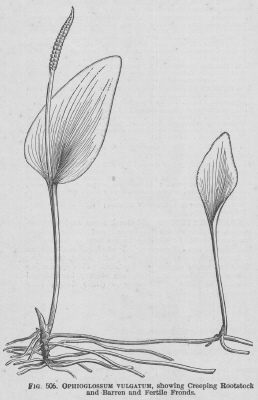
(from ophios, a snake, and glossa, a tongue; referring to the shape of the spike of fructification). Adder's Tongue. Including Cheiroglossa and Ophioderma. ORD. Filices. A small genus (about ten species) of pretty, stove, greenhouse, or hardy Ferns. Sporangia sessile, arranged in two rows, so as to form a flattened spike, which forms a branch of the barren frond, or is entirely distinct from it. About five species have been introduced. For general culture, see Ferns.
O. bulbosum (bulbous). Rootstock tuberous. fronds 2in. to 4in. long, the sterile division placed considerably below the middle, 1/2in. to 1in. long, 1/2in. broad. fertile spike 1/4in. to 1/2in. long peduncle 1 1/2in. to 2in. long when fully developed. North America, &c. Half-hardy.
O. lusitanicum (Portuguese). Rootstock slightly tuberous. fronds 1in. to 3in. long, the sterile division placed below the centre, 1/2in. to 1in. long, about 1/6in. broad, linear-lanceolate, the point bluntish, the base narrowed. fertile spike 1/4in. to 1/2in. long; peduncle firm, 1/2in. to 1 1/2in. long when mature. Mediterranean region, &c., 1816. Hardy.
O. palmatum (Palm-like). sti. 6in. to 12in. long, fleshy, flaccid. fronds like the letter V, 6in. to 12in. long, 4in. to 8in. broad, more or less cut from the circumference towards the centre into deep, blunt lobes. fertile spikes two to twelve, 1in. to 2in. long, arising from the stem or edge on the lower part of the frond, on short, nodding or spreading peduncles. Cuba, &c. Stove.
O. pendulum (pendulous). fronds pendulous, ribbon-like, without a distinct stem, 1ft. to 15ft. long, 1in. to 3in. broad, simple or forked. fertile spike usually low down, 2in. to 6in. long, on a peduncle shorter than itself, usually solitary. Polynesian Isles, &c. Stove. (H. G. F. 33.) O. furcatum is probably a variety of this species.
O. reticulatum (netted). Rootstock not tuberous. fronds 6in. to 12in. long, the sterile division placed about the middle, 2in. to 3in. long, 1 1/2in. to 2in. broad, with a distinct haft and distinctly cordate basal lobes; veins distinct. fertile spike 1in. or more long, on a slender peduncle 2in. to 4in. long, much overtopping the sterile segment. Tropical America, 1793. Stove.
O. scandens (climbing). A synonym of Lygodium scandens.
O. vulgatum (common). Common Adder's Tongue. Rootstock not tuberous. fronds 6in. to 9in. long, the sterile division generally placed about the middle, 2in. to 4in. long, 3/4in. to 2in. broad, ovate or ovate-oblong, without a distinct haft. fertile spike 1in. or more long, upon a peduncle 2in. to 4in. long, and considerably overtopping the sterile division when the plant is fully mature. Britain, &c.
O. v. ambiguum (ambiguous). A smaller form, with linear-oblong blade, and a spike 1in. to 2in. in length. Orkney, Wales, &c.
O. v. pedunculosum (pedunculose). fronds, barren division like that of the type in form and size, but thinner in texture, and with a distinct haft. India, &c. Stove.