Osmunda
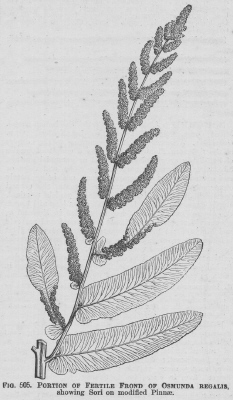
(from Osmunder, another name of the Scandinavian god Thor). ORD. Filices. A small genus (about half-a-dozen species) of handsome, greenhouse or hardy ferns, hardly at all tropical. Sori quite distinct from the leafy part of the frond, forming a panicle made up of copious, thyrsoid clusters. The species in cultivation are generally known as Flowering Ferns, and, with the exception of O. javanica, are particularly suitable for the hardy fernery. They thrive best in a compost of turfy loam and peat, to which some river sand may be added. See also Ferns.
O. cinnamomea (cinnamon).* sti. densely tufted, the barren and fertile ones distinct. barren fronds simply pinnate, 2ft. to 3ft. long, 6in. to 8in. broad, having stipes from 1ft. to 1 1/2ft. long; pinnae close, ligulate-lanceolate, 3in. to 4in. long, 3/4in. to 1in. broad, cut down nearly to the rachis. fertile fronds much smaller; pinnae lanceolate. Canada to Oregon Mountains, Japan, &c., 1772. Young plants densely clothed with ferruginous tomentum. Of this handsome species, there is a variety, known as angustata, which is smaller in all its parts, and with darker fronds, than the type. O. Claytoniana (Clayton's).* sti. tufted, 1ft. or more long, tomentose when young. fronds 1ft. to 2ft. long, 8in. to 12in. broad, the upper, central, or lower pinnae fertile; barren pinnae lanceolate, 4in. to 6in. long, 1in. or more broad, cut down nearly to the rachis; fertile pinnae similar, but shorter; pinnules dense, cylindrical. North America and Himalayas, 1772. A very beautiful species. SYN. O. interrupta.
O. interrupta (interrupted). A synonym of O. Claytoniana.
O. javanica (Java).* sti. tufted, 6in. to 12in. long, firm, erect, naked. fronds 1ft. to 3ft. long, 8in. to 12in. broad, simply pinnate, the lower or central pinnae fertile; barren pinnae 4in. to 8in. long, 3/8in. to 3/4in. broad, cuneate at the base, and often slightly stalked, the edge entire or sharply toothed; fertile pinnae shorter, made up of numerous close, but distinct, oblong, sessile clusters. Kamschatka to Java and Ceylon. Greenhouse. SYNS. O. Presliana and O. Vachellii.
O. lancea (lance-like). fronds, barren and fertile ones distinct, the former about 1ft. long, oblong, shortly acuminate; pinnae oblong, acuminate, about 5in. long, stalked, the lowest rather reduced; pinnules narrow-lanceolate, 1 3/4in. long, 1/4in. broad, narrowed at both ends, sessile, distinct, slightly toothed upwards. fertile fronds ternate-decompound. Japan.
O. Presliana (Presl's). A synonym of O. javanica.
O. regalis (royal).* Royal Fern. sti. tufted, 12in. to 18in. long, firm, erect, naked. fronds 2ft. to 6ft. long, 1ft. or more broad, bipinnate, the apex fertile; barren pinnae 6in. to 12in. long, 2in. to 4in. broad; pinnules sessile or slightly stalked, 1in. to 2in. long, 1/2in. to 3/4in. broad, oblong, blunt, often unequal at the base, the edge finely serrulate; fertile pinnules cylindrical, forming a copious panicle. Britain. This really noble fern is too well known to require any eulogy. The form called cristata is very desirable, and differs from the type in having the ends of the fronds and all the pinnae finely crested. Another, corymbifera has, also, curiously forked and crested fronds. O. palustris is a slender, small-growing form, in which the young fronds are reddish in colour.
O. Vachellii (Vachell's). A synonym of O. javanica.