Pentas
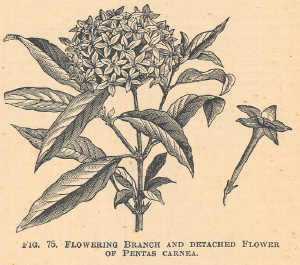
(from pente, five; referring to the generally pentamerous arrangement of the flowers). SYNS. Orthostemma, Vignaldia. ORD. Rubiaceae. A genus comprising six or eight species of stove, erect or prostrate, hispid-pilose or tomentose, herbs or sub-shrubs, with terete branches, natives of tropical and South sub-tropical Africa, and Madagascar. Flowers lilac, bracteate, disposed in short or elongated, terminal, corymbose cymes, sometimes sub-capitate; calyx four to six-lobed; corolla funnel-shaped, with an elongated tube and four to six ovate-oblong, spreading, valvate lobes. Leaves opposite, petiolate, ovate or ovate-lanceolate; stipules much cut or bristly. The species, only two of which have been introduced, are of easy culture, in a compost of loam and leaf mould, with a little sand added. Propagated, in spring or at almost any season, by cuttings of the young shoots, inserted in sandy soil, and placed under a propagating glass, in gentle heat. The plants should be occasionally pinched as they grow, to encourage a more compact habit.
P. carnea (flesh-coloured).* fl. disposed in numerous, large, cymose heads. Winter, and almost all the year round. l. soft, opposite, bright green. h. 1 1/2ft. South Africa, 1842. A handsome, compact-growing, soft-wooded sub-shrub.(B. M. 4086; B. R. 1844, 32.)
P. c. kermesina (carmine).* A showy plant, differing from the type chiefly in having flowers of a lively carmine-rose, tinted with violet in the throat. (R. H. 1870, 130.)
P. parviflora (small-flowered). fl. flame-colour; corolla tube twice or thrice as long as the calyx. April. l. ovate or oval-oblong, acuminate, narrowed at base, scarcely puberulous on the veins. h. 2ft. Western tropical Africa, 1846. Sub-shrub.