Peziza
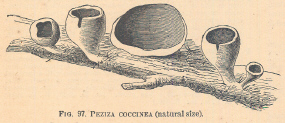
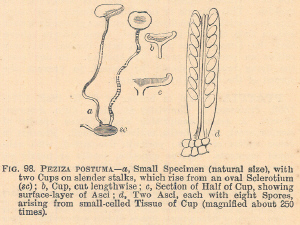
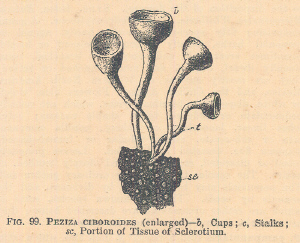
A large genus of Fungi, of which by far the greater number live on decaying remains of animals or of plants, or on dung or earth in which there is abundance of decaying organic matter. A few grow upon and injure living plants, both wild and cultivated. The vegetative system of the Fungus consists of mycelium hidden in the substance on which it grows. The conspicuous part, by means of which the species are identified by mycologists, is that specialised for reproduction. This is in the form of a cup, rather shallow in some, deep in others (see Figs. 97, 98, and 99). This large genus has been broken up into sections, treated by some mycologists as genera, characterised by consistence, presence or absence of a stalk, of hairs externally, of a membrane closing the young cups, &c.; but the assemblage of species, as a whole, is a very natural one. They vary in size of cups from several inches across to a size too small to be seen without a lens. The inner surface of the cup is lined with a layer of large cells, of cylindrical or club-shaped form (asci), standing erect (see Fig. 98, d), in each of which lie eight small, oval, smooth, or, less often, warty cells (spores), which are set free by the asci bursting at the end next the surface. Sometimes the spores are emitted in a thin cloud, when the Fungus is exposed to dry air. While many of the species produce the cups on a mycelium of loosely-woven hyphae, or filaments, formed in the substance from which the Fungus is drawing its nourishment, other species form a sclerotium, i.e., a mass composed of densely interwoven hyphae grown together, so as to resemble a true tissue (see Fig. 99, sc). This body is usually black and hard outside, but pale and soft inside. It is fitted to resist changes of temperature during winter; and in spring it aids in reproduction by producing one or more cups, of the structure described above. A very common and well-known example is the sclerotium, so common in winter on dead herbaceous stems, called S. durum. In spring, there is a grey mould, formed largely on it (Polyactis cinerea), which produces myriads of round conidia or spores. Later on, long-stalked cups of a Peziza (P. Fuckeliana) grow out from the same sclerotium.
These remarks must be restricted to the species of Peziza that give rise to disease in cultivated plants, and therefore the other kinds will not be again referred to. The most hurtful recorded in Britain is one that has proved destructive to Potatoes in Ireland and in Scotland; and it has also been injurious in Norway. The plants become covered with a thick felt of mycelium all over the diseased parts; and amidst this are formed masses of compact tissue (sclerotia), at first pale, then becoming dark. Some of these masses are as large as a small bean, but few exceed a small pea in size. In a short time, the host-plant perishes, but the Fungus goes on to perfect its sclerotia. From each of these, in the summer, there grow two or three cups. When fully grown, these are nearly flat, and about 1/3in. or 1/2in. across, and they are supported on a slender, wavy stalk, from 2in. to 4in. long. Messrs. Berkeley and A. S. Wilson have named it P. postuma, but it seems very closely allied to P. sclerotiorum, Lib., and P. ciboroides, Fr. (see Fig. 99); and it is doubtful whether they are really distinct species. P. sclerotiorum causes disease in Turnips and Cabbages in Germany, forming sclerotia in the stems between the surface-layer and the wood. The infested plants ought to be burned, to prevent the spread of the disease, and this should be done early in the season, before the sclerotia have fallen to the soil. The structure of P. postuma is shown in Fig. 98.
Another Peziza of some importance is P. Willkommii, which grows on resinous swellings upon the branches of Larch. The cups are sessile, or shortly stalked, hairy, and pale outside, orange inside, and are about 1/12in. in breadth. This Fungus is sometimes referred to P. calycina as a variety. The diseased branches gradually wither and, in time, the tree is destroyed. Some writers believe that the Fungus does not originate disease, but only settles on punctures made by Aphides. In any case, the dying branches should be burned, to prevent the spread of the disease to other trees.