Philadelphus
(an ancient Greek name, meaning brotherly love, applied, by Athenaeas, to a different plant). Mock Orange; Syringa. ORD. Saxifrageae. A genus comprising about twelve species of hardy, ornamental shrubs, natives of central Europe, temperate North America, Japan, and the Himalayan Mountains. Flowers white or straw-coloured, often sweet-smelling, axillary, solitary or corymbose, bracteate; calyx tube turbinate, adnate to the ovary; lobes four, rarely five, valvate; petals four, rarely five, rotund or obovate, convolute; stamens twenty to forty. Leaves opposite, deciduous, entire or serrate, often covered with stellate down; stipules wanting. Branches rather terete, opposite. The species are of easy culture in any fairly good soil. The plants flower on the wood of the previous year; this may be cut away when flowering is over, and the new growths encouraged to take its place for the year immediately following. In this way, the shrubs, though large, may be kept within limited bounds, and encouraged to flower more freely because of the wood becoming better ripened. Propagated, in spring, by suckers, by layers, or by cuttings of the young shoots, struck under glass, either in heat, or in a moist, cold frame.
P. chinensis (Chinese). A synonym of P. Satzumi.
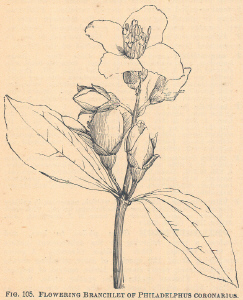
P. coronarius (garland).* Common Mock Orange or Syringa. fl. white, with a strong, orange-like scent, racemose. May. l. ovate, acuminated, serrately denticulated, smoothish, having the odour and taste of cucumbers, when crushed. Stems stiff, straight. h. 2ft. to 10ft. South Europe, &c., 1596. A handsome species. See Fig. 105. (B. M. 391.) There are several forms, including some with double flowers, one of which (primulae-florus) is shown in Fig. 106; another, in which the leaves are edged with white or yellow; and a third, with golden-yellow leaves. nanus, a dwarf form, is sometimes seen in cultivation.
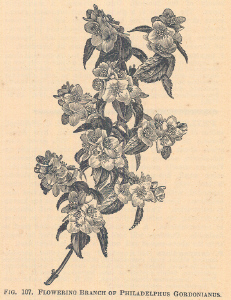
P. Gordonianus (Gordon's).* fl. white, scentless, and produced in great abundance; racemes terminal, compact, five to nine-flowered. July. l. ovate, acuminate, serrulate. h. 10ft. North-west America. See Fig. 107. (B. R. 1839, 32.) P. grandiflorus (large-flowered).* fl. white, large, sweet-scented June. l. pubescent when young, ovate-acuminate or nearly rotundate, irregularly toothed. Stems rather slender, twiggy. h. 6ft. to 10ft. South United States, 1811. SYN. P. speciosus. (S. B. F. G. ser. ii. 8.)
P. g. laxus (loose). fl. white, solitary and in threes. June. l. ovate, long-acuminated, toothed, clothed with hairy pubescence beneath. h. 4ft. to 6ft. North America, 1830. (B. R. 1839, 39.)
P. hirsutus (hairy).* fl. white, solitary and in threes. June. l. oblong-ovate, acute, toothed, hairy on both surfaces, white beneath. h. 3ft. North America, 1820. (B. M. 5334; S. B. F. G. ser. ii. 119.)
P. inodorous (scentless).* fl. white, large, scentless, solitary and in threes. June. l. broad-ovate, acuminate, entire. h. 4ft. to 6ft. Mountains of Virginia and southward, 1738. (B. M. 1478.)
P. Lewisii (Lewis'). fl. white, smaller than those of P. hirsutus, solitary and in threes. June. l. ovate, acute, almost entire, with ciliated margins. h. 6ft. to 8ft. North America, 1739.
P. microphyllus (small-leaved). fl. terminal, solitary or in threes. Summer. l. 1/2in. to 3/4in. long, ovate-lanceolate or oblong, entire, slightly obtuse, obsoletely triplinerved, minutely pilose beneath. Branches slender, erect. New Mexico, 1883.
P. Satzumi (Satsum's). fl. white, about 1 1/2in. across, produced in pairs at the ends of the shoots. July. l. long, narrow. h. 5ft. Japan, 1851. A slender-growing plant. SYN. P. chinensis.
P. speciosus (showy). A synonym of P. grandiflorus.