Philodendron
(from phileo, to love, and dendron, a tree; referring to the arborescent nature of some species). ORD. Aroideae (Araceae). A genus comprising about 120 species of stove, climbing shrubs and small trees, rarely stemless herbs, natives of tropical America. Flowers spathaceous; spathe white, red, or yellow, thick, wholly persistent, the tube convolute, at length opening; spadix almost equalling, or shorter than, the spathe, sessile or shortly stipitate, dense-flowered, the females shorter than the males; peduncles terminal and axillary, usually short, generally fascicled. Leaves sheathed, opposite, coriaceous, oblong, ovate, cordate, or sagittate-hastate, entire, lobed, pinnatifid, or once or twice pinnatisect. Philodendrons are easily grown in a house where a high temperature and a moist atmosphere are maintained. They appear to the best advantage when trained to cover a back wall or a pillar. For this purpose, in a large house, they may be planted out at the base of the wall or pillar, or they may be grown in pots. An open compost of loam and peat, or leaf mould, to which some coarse sand should be added, is best; the plants are not, however, very fastidious regarding soil. Plenty of water and frequent syringings are essential in the summer or growing season; and no more shade should be applied than is requisite to keep the leaves from scorching. Propagated easily by dividing the stems into lengths consisting of about three joints, and inserting them in pots, in a brisk heat. They soon become established, and make new growth at the top. Any old plants which get too high for the house they occupy may have their tops cut off and inserted as large cuttings. These soon re-establish themselves. The best-known species are described below.
P. bipinnatifidum (bipinnatifid). fl., spathe reddish-brown outside, greenish inside; spadix whitish. l. about 2ft. long and 1 1/2ft. broad, bright green, bipinnatifid. Brazil. An ornamental, short-stemmed species, requiring only a cool stove or intermediate house.
P. brevilaminatum (short-bladed). fl., tube of spathe oblong-ovoid, blood-colour on both sides, the limb pale green outside, yellowish-white within; spadix white, shorter than the spathe, stipitate. l. as long as the petioles; young ones cordate-ovate, very shortly rotundate; adult ones sub-triangular, the posterior lobes broadly rotundate, the anterior one broadly triangular, Bahia, 1860. Climber.
P. calophyllum (beautiful-leaved). fl., spathe creamy outside, crimson within; spadix white. Brazil, 1872. A very handsome, short-stemmed plant, the foliage of which resembles that of Cochliostema Jacobianum. (I. H. n. s. 76.)
P. cannaefolium (Canna-leaved). fl., spathe greenish. l. ovate-lanceolate, deep shining green, about 1ft. long; petioles very stout, 1ft. long. Brazil, 1831. A desirable, short-stemmed perennial, particularly suitable for sub-tropical gardening.
P. Carderi (Carder's). A synonym of P. verrucosum.
P. crassinervium (thick-nerved).* fl., spathe pale yellow-green, spotted with red, bright red within at the base, cucullate, contracted in the middle; spadix as long as the spathe, cylindrical. May. l. 1ft. to 2ft. long, broadly lanceolate, margined with red, the costa exceedingly thick and inflated; petioles 3in. to 4in. long, purplish-green. Stem running to a considerable length. A singular climber. (B. M. 3621; B. R. 1958.)
P. daguense (River Dagua). A synonym of P. verrucosum.
P. erubescens (blushing).* fl., spathe blackish-purple outside, scarlet within, large, boat-shaped, contracted above the middle; spadix white or cream-colour, as long as the spathe, stout, obtuse. l. distant, alternate, large, between cordate and sagittate, coppery beneath, glossy, 1ft. or more long, on terete pedicels of about the same length, with purple sheaths at the base. Stem stout, climbing, rooting at almost every joint. A handsome species. (B. M. 5071.) P. fragrantissimum (highly fragrant).* fl. powerfully and durably fragrant; spathe delicate cream-colour, with the swollen base red, nearly 9in. long, convolute and somewhat cucullate; spadix acute, nearly as long as the spathe, broadest at base. January. l. 1 1/2ft. to 2ft. long, oblong-cordate, acute, inclining to sagittate, deeply two-lobed at base; petioles 2ft. or more long, quite flat above. Stem elongated, rooting. Demerara. (B. M. 3314, under name of Caladium fragrantissimum.)
P. giganteum (gigantic). fl., tube of spathe oblong, purplish outside; spadix white, thick, sessile; peduncle very short and thick. l. broadly cordate-ovate, with the posterior lobes broadly semi-ovate or obliquely semi-orbiculate; petiole thick, slightly terete, twice as long as the costa. 1857. Climber.
P. Glaziovii (Glaziou's). fl. solitary, axillary; spathe pale yellowish, crimson on the inside of the tube. l. oblong, acute, deep green, 1ft. to 1 1/2ft. long, 3in. to 5in. broad. Brazil, 1885. An ornamental climber, resembling P. crassinervium. (B. M. 6813.)
P. gloriosum (glorious). l. large, cordate-ovate, acute, deep rich green, the midrib and secondary nerves snow-white, the margins bordered with a thin edging of a pink colour; the young ones, on opening, have a silky reflection. Stem climbing. Columbia, 1877. A magnificent foliage plant. (I. H. n. s. 262.)
P. grandifolium (large-leaved).* fl. from a fissure at the base of the petiole; spathe at first pale green, afterwards pale buff, green at base on the outside, pinkish within, marked at the back with a purple hue, cucullate at the extremity; spadix green below, white above, as long as the spathe, slightly club-shaped, bursting two or three together. April. l. 2ft. or more long, cordate-sagittate, opaque above; petioles rounded, spotted with purple. Stem climbing, dingy-green, spotted with purple. Demerara. (B. M. 3345, under name of Caladium grandifolium.) P. Holtonianum (Holton's). fl., tube of spathe oblong; spadix very shortly stipitate, slender, cylindrical. l. ornamental, three-parted almost to the base, about 1 1/2ft. long and rather less in width; middle lobe acute, one-nerved; lateral lobes obtuse, three-nerved; all shining green above, paler beneath. Columbia, 1876. Dwarf, almost stemless, herb. The correct name of this plant is Anthurium insigne.
P. laciniatum (jagged). fl., tube of spathe greenish without, reddish-purple within, the blade dirty-white; spadix sessile; peduncles three or four in the same axil. l. membranous, tripartite, less than half as long as the slightly terete petioles. Stem rather thick, climbing. Brazil, 1824. SYN. Caladium pedatum (H. E. F. 206).
P. Lindeni (Linden's). A garden synonym of P. verrucosum.
P. longilaminatum (long-bladed). fl., females twice as short as the males; spathe shorter than, and peduncle about as long as, the petiole. l. green above, slightly glaucous below, with the apex long-acuminate; petioles thick, semi-terete, sulcate. Stem elongated, somewhat climbing; internodes elongated. Bahia, 1860.
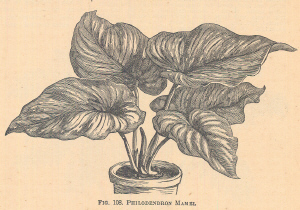
P. Mamei (Mons. Mame's).* l. large, cordate, acute, handsomely marked with whitish variegations. Ecuador, 1883. A fine-leaved, stemless herb. See Fig. 108. (R. H. 1883, 492.)
P. melanochrysum (golden-black).* l. dull, dark green in colour, covered with a shining varnish, as though washed over with gold, appearing very brilliant in the sunshine. Columbia, 1874. A lovely species, of moderate growth and climbing habit. (L. H. n. s. 149.)
P. Melinoni (Melinon's). fl., spathe cylindrical, rufescent outside, yellow within; spadix cylindrical, shorter than the spathe. l. long-stalked, ovate, oblong, acuminate, sagittate-hastate at base. Stem, short, thick, shaggy. Guiana, 1874. (R. G. 789.) P. pertusum (perforated). A synonym of Monstera deliciosa.
P. pinnatifidum rubro-punctatum (pinnatifid, red-dotted).* fl. crowded; spathe white, sprinkled with blood-red, almost sessile, the same length as the spadix, the tube narrowly ovoid, the blade boat-shaped; spadix pale dirty-yellow, about 9in. long. May. l. 2ft. long, broadly sagittate-ovate, glossy, pinnatifid halfway to the middle, with regular, upcurved lobes; petioles 2 1/2ft. to 3ft. long, swollen at base. Stem none, or short and thick, clothed with brown sheaths. South Brazil, 1868. (B. M. 5948, under name of P. rubro-punctatum.)
P. recurvifolium (recurved-leaved). fl., spathe green without, the tube scarlet within, ellipsoid. l. all on petioles, which are shorter than the blade, green, margined with purple, somewhat oblong-cordate-sagittate. Bahia, 1860. Climber. The whole plant, especially the leaves, is irregularly spotted with blood-colour.
P. rubens (reddish). fl., spathe 6in. to 8in. long, whitish-green without, purplish-red within, on a short peduncle; spadix white, cylindrical, slightly shorter than the spathe; inflorescence sessile. l. cordate-ovate, acuminate, the length of the petioles. Stem robust, somewhat erect, rather densely leafy. Venezuela, 1873. Climber. (B. M. 6021.)
P. sanguineum (bloody).* fl., spathe green, convolute above the middle; spadix shortly stipitate, cylindrical; peduncles half as long as the spathe. l. rather thick, green above, often purplish beneath, elongated, cordate-oblong, trilobed; petioles shorter than, or about equalling, the leaves. Mexico, 1869. Climber. (R. G. 621.)
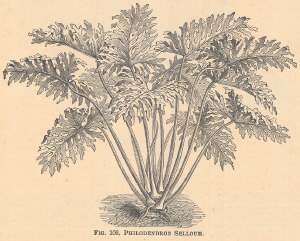
P. Selloum (Sello's).* fl., spathe deep green, bordered with white outside, whitish within, large, conical, terminating in a sort of hood. l. large, long-stalked, oval-oblong, deep green, forming a broad head, bipinnatifid, with the two basal lobes themselves pinnatifid. Stem stout, emitting thick, flexible roots. A beautiful (arborescent when old) perennial. See Fig. 109. (B. M. 6773; R. H. 1869, 252, under name of P. Sellowianum.) P. serpens (serpent). fl., spathe pinkish and yellowish outside, cream and crimson inside, 5in. long; spadix cream-coloured. l. oblong-cordate, 1ft. to 1 1/2ft. long. Stem scandent, rooting at the nodes, leafy at the summit, clothed between the leaves with dense masses of fibry scales. New Grenada, 1877. A handsome species. (B. M. 6375.)
P. Simsii (Sims').* fl., spathe crimson, and inflated at base, contracted in the middle, and expanded in the upper part into a white, oval hood, about 8in. long, rather exceeding the spadix, nearly sessile. March. l. cordate-sagittate, above 2ft. long and 1 1/4ft. across, with large, raised, purple veins beneath; petioles rounded, 1 1/2ft. long. Stem stout, erect. Caraccas and Guiana, about 1825. (B. M. 2643, under name of Caladium grandifolium.)
P. Sodiroi (Sodiro's). l. elongated cordate-ovate, with a very obtuse sinus, short auricles, and a long-pointed apex, soft and twisted, bright green, with large, interrupted, silvery spots; nerves prominent and violaceous beneath; petioles depressed above, violaceous, dotted with white. Tropical America, 1884. An ornamental climber.
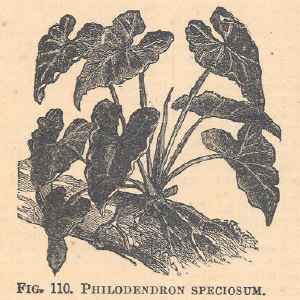
P. speciosum (showy). fl., spathe thick, purplish-green outside, carmine within. l. triangular, oblong-ovate, deeply sagittate, light green. Stem tall, arborescent (when mature). South Brazil. See Fig. 110.
P. verrucosum (warted).* l. cordate, of a delicate satiny-green, shaded with metallic olive-colour on the upper surface, the under part pale green, ornamented with bands of maroon; the young ones are of a bright chamois-colour, and the maroon bands of the under parts penetrate through to the upper. Ecuador, 1866. One of the most brilliant species grown. See Fig. 111. SYNS. P. Carderi, P. daguense (I. H. n. s. 79), P. Lindeni (of gardens, in part).
P. Williamsii (Williams').* fl., spathes green, yellowish within, thick, obtuse, apiculate, 1ft. long, surrounding a stout, cylindric, cream-coloured spadix. l. long-stalked, sagittate-acute, 1ft. to 2 1/2ft. in length. Trunk thick, erect, rooting. Bahia, 1871. A noble plant. (B. M. 5899.)