Photinia
(from photeinos, shining; in reference to the leaves). Including Eriobotrya. ORD. Rosaceae. A genus comprising about a score species of half-hardy, evergreen shrubs or trees, natives of the mountains of India, China, and California. Flowers frequently white, disposed in terminal corymbs or panicles; calyx with a campanulate or turbinate tube and five ovate, obtuse lobes; petals five, spreading; stamens about twenty. Drupe or berry ovoid, in some species edible, one to five-celled, the cells one or two-seeded. Leaves alternate, short or long-stalked, coriaceous, simple, entire or serrate; stipules sometimes almost leaf-like. Photinias are very handsome-leaved shrubs for sheltered situations, and for culture against walls. In cold parts of the country, and during severe weather, some protection is essential. They prefer a rather light, loamy soil, and do not succeed well if it is very stiff. Propagated by cuttings of side shoots, 2in. or 3in. long, inserted in sandy soil, under a bell glass; also, in the open air, in April, by cleft-grafting, close to the ground, on stocks of common Quince. These may be procured from cuttings or layers. P. japonica is most commonly seen in cultivation. P. arbutifolia (Arbutus-leaved). Californian Maybush. fl. white, disposed in an elongated panicle; petioles and young branches bright red. July. l. oblong-lanceolate, acute, distinctly serrated. h. 10ft. to 20ft. California, 1796. Tree. SYN. Crataegus arbutifolia. (B. R. 491.)
P. elliptica (elliptic). fl. white; thyrse compound, terminal, clothed with fulvous tomentum. fr. yellow, downy. l. flat, elliptic, toothed, tomentose beneath. h. 30ft. Nepaul, 1823. Tree.
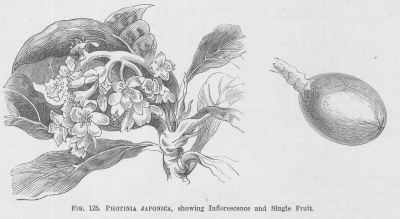
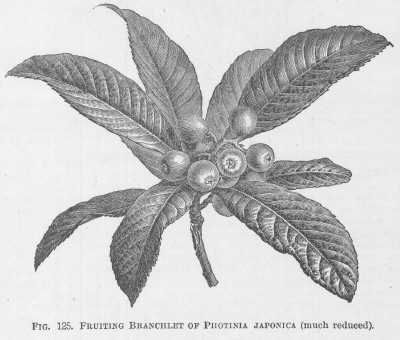
P. japonica (Japanese).* Japan Medlar; Japan Quince; Loquat. fl. white, in pendulous racemes. Autumn. fr. about the size of a small apple, pale orange-red, downy, in large bunches. l. large, oblong, rugose, downy beneath. h. 10ft. to 20ft. Japan, 1787. A handsome shrub or tree, producing edible fruit when grown under cover. It is sufficiently hardy to withstand the cold of an ordinary English winter, but an unusually severe frost is fatal to it. From the late period of its flowering, the fruits are scarcely ever produced here in the open air, although, in the South of France, considerable quantities are annually secured. This species, like its congeners, is peculiarly well adapted for wall culture as an ornamental, flowering shrub.(B. R. 365.)
P. serrulata (toothed).* Chinese Hawthorn. fl. white, small, in terminal, flat corymbs. April to July. l. large, Laurel-like, coriaceous, oblong, acute, serrulated. h. 10ft. to 20ft. Japan and China, 1804. A handsome shrub. SYN. Crataegus glabra. (B. M. 2105; L. B. C. 248.)