Phyllanthus
(from phyllon, a leaf, and anthos, a flower; because the flowers, in some species, are produced on the edges of the leaf-like branches). Including Bradleia, Cicca, Kirganelia, Xylophylla, and many others formerly regarded as distinct genera. ORD. Euphorbiaceoe. A vast genus (about 450 species have been enumerated) of mostly stove herbs, shrubs, or trees, of various habit, broadly dispersed over the tropics, but rare in temperate regions. Flowers small, monoecious, very rarely dioecious, apetalous, axillary or rarely in the nodes of leafy branchlets; sepals six, five, or rarely four, distinct or rarely shortly connate at base, imbricate, more or less distinctly biseriate. Leaves entire, alternate or rarely opposite, generally distichous, and so arranged in opposite rows along the smaller branches as to give them the appearance of pinnate leaves. This genus contains but few species of any horticultural value, those undermentioned being exceptional. A compost of sandy loam and fibry peat, to which is added a small quantity of broken bricks, charcoal, and dried cow-dung, is most suitable for their culture. Propagated by cuttings of the hard shoots, inserted in a sandy soil, in heat. The species described below require stove treatment, except where otherwise stated.
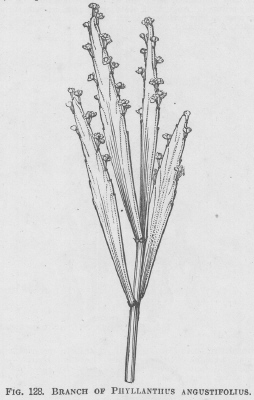
P. angustifolius (narrow-leaved). fl. fasciculate, as long as the pedicels; calyx red. July. Stem 2ft. high. Branches deciduous, compressed; branchlets distichous, lanceolate-linear or lanceolate, serrulated from above the base, striate-veined. Jamaica, 1789. Shrub.(B. M. 2652, under name of Xylophylla montana; L. B. C. 1091, under name of Xylophylla elongata.)
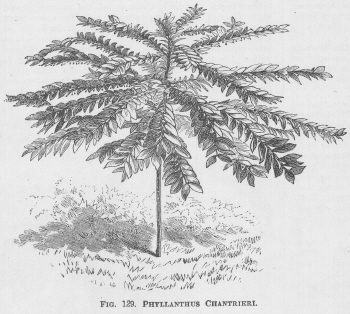
P. atropurpureus (dark purple). l. rich dark purple, bluntly ovate. Stems terete. South Sea Islands, 1876. Shrub. In habit and aspect, this species is the counterpart of P. nivosus; it is deciduous during the resting season, and puts forth its new leaves, which, at first, are of a dark green colour, but the purple hue is soon developed under the influence of light, in which rich colour the plant becomes robed. It forms a slender-growing subject. P. Chantrieri (Chantrier's). * fl., males in clusters of two or three, sometimes solitary, brick-red, fringed with pale yellow hairs; females larger than the males, solitary towards the tips of the branches. Summer. Branches forming a right angle with the stem, and having the aspect of pinnate leaves, glossy green. Cochin China, 1882. An elegant shrub, of symmetrical habit.(R. H. 1883, p. 557.)
P. falcatus (sickle-shaped). fl. glomerate; calyx red. July. Stem 6ft. high. Branches deciduous, cylindrical; branchlets falcate or linear-falcate, serrated above, striate-veined, 4in. to 5in. long. West Indies, 1699. Shrub. (B. R. 373, under name of Xylophylla falcata.)
P. nivosus (snowy). l. ovate, alternate, frequently entirely covered with a mottling of white, but, in some cases, partially veined with green. Stem terete. South Sea Islands, 1873. A very desirable shrub, of a free-branching habit; when well developed, it has the appearance of a sheet of snow. (F. M. n. s. 120; I. H. 332.)
P. pallidifolius (pale-leaved).* fl. yellow, red at the base; peduncles bright red, those of the males on the lower axils, solitary or few together, those of the females towards the ends of the branches, stouter, solitary. Summer. l. broadly oblong, blunt at both ends, apiculate, glabrous, glaucous beneath; petioles very short. Java. A small and very ornamental shrub. SYN. Reidia glaucescens (B. M. 5437).
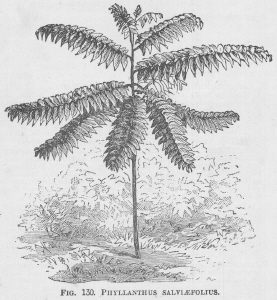
P. salviaefolius (Salvia-leaved). fl., males greenish, small, on long, filiform pedicels; females tinted with red, larger, on short pedicels. Summer. l. close-set, distichous, sub-sessile, ovate-oblong, pubescent above, tomentose beneath. Branches much spreading. New Grenada, 1883. Greenhouse shrub.(R. H. 1883, 34-36.)
P. Seemannianus (Seemann's). fl. whitish, inconspicuous but curious, axillary. Branches long, leaf-like, bearing shortly-stalked, alternate leaves. h. 2ft. New Hebrides, 1879. An interesting, erect shrub.
P. speciosus (showy). fl. fasciculate; calyx whitish; pedicels three or four times as long as the flowers. September. Stem 6ft. to 8ft. high. Branches deciduous, cylindrical or sub-compressed; branchlets 2in. to 3in. long, distichous, lanceolate, striated only by the principal, somewhat distant veins. Jamaica, 1818. Shrub. (B. M. 1021, under name of Xylophylla latifolia).