Phyllocactus
(from phyllon, a leaf, and Cactus; in reference to the leaf-like stems). SYN. Phyllocereus. Including Disocactus. ORD. Cacteae. A genus comprising about thirteen species of stove, epiphytal, succulent shrubs, natives of tropical America, from Mexico to Peru. Flowers rose, white, or red, axillary from the base of the rounded sinuses of the flattened, leaf-like branches; calyx tube generally long, slender, smooth; lobes remotely scattered, coloured; petals numerous, very rarely few, spreading; stamens numerous; stigma many-rayed. Fruit baccate, angular, smooth, ribbed; seeds kidney-shaped; cotyledons connate, sub-foliar. The botanical characteristics of a flower of Phyllocatcus are shown in Fig. 132, where a represents the calyx tube; b, calyx lobes; c, petaloid calyx lobe; d, petals; e, style; f, ovary.
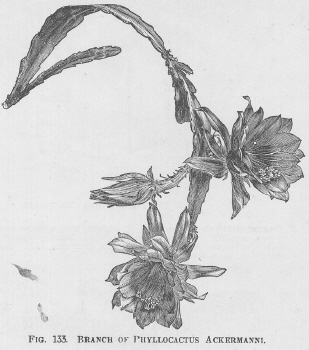
The species of Phyllocactus are of easy culture; they prefer a rather dry stove or warm greenhouse temperature, but will succeed in a frame, or even a window, after being once established. The most suitable soil is a light, porous loam, with some leaf mould and brick rubble intermixed. Drainage to the extent of one-fourth should be given, and rather small pots used in proportion to the size of plant. When plants have attained a good size, and their pots are filled with roots, an annual top-dressing of soil and cow-manure should be given, and during the growing season a little liquid manure may also be applied. Watering must be rather carefully conducted, especially in winter: the roots soon die if kept too wet, or in too great a bulk of soil. Phyllocacti do not require any shade from sunshine, and they may be placed under a sunny south wall outside from about the end of June until the end of August; this greatly assists the ripening. They should be kept rather dry in winter. Cuttings of the mature shoots, about 6in. in length, taken before growth has commenced, in spring, and inserted singly in well-drained 3in. or 4in. pots, will root in a short time, if placed in a temperature of about 60 deg. They should not be covered with a glass or watered, beyond the slightest syringing, to prevent the soil becoming very dry. Seeds ripen freely on healthy plants; they should be sown in spring, and placed in about the same temperature as cuttings. When the seedlings appear, a light position must be afforded them until they are large enough to pot off singly. P. Ackermanni (Ackermann's).* fl. with rich crimson, shining petals, the outer ones lighter in colour, from 6in. to 8in. in diameter, freely produced in the depressions of the stems. Summer. Stems flat, deeply crenated or notched, seldom with any spines in the notches except when young. Mexico, 1829. One of the handsomest species grown; from it a number of beautiful varieties have been raised. See Fig. 133. (B. M. 3598; B. R. 1331, under name of Cactus (Epiphyllum) Ackermanni.)
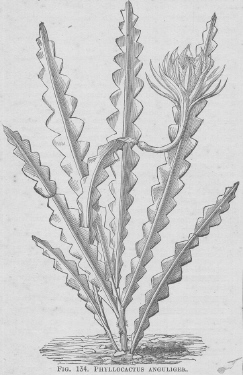
P. anguliger (angle-bearing).* fl. from 3in. to 5in. in diameter; petals white; sepals orange or yellowish, narrow, and spreading, open during the day, and emitting a powerful fragrance. October. Stems deeply angled, 2in. to 3in. in diameter, indented on the margin somewhat like a large saw with the teeth turned upwards, forming blunt, triangular lobes. Mexico. A very distinct species. See Fig. 134. (B. M. 5100; L. & P. F. G. 34.)
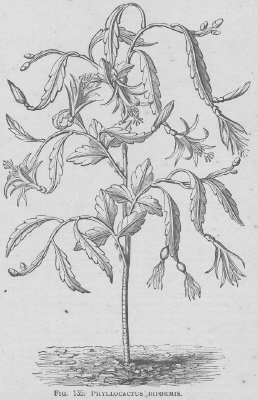
P. biformis (two-formed). fl. somewhat ephemeral, terminal at the points of the branches; petals narrow, 2in. to 3in. long, partially combined into a kind of tube of a pale rosy-pink colour. Branches narrow, flattened and leaf-like, reddish on the margins. Plant branching freely, forming a rather graceful, fleshy shrub. h. 3ft. Honduras, 1839. Not a very showy species. See Fig. 135. (B. M. 6156.) SYN. Disocactus biformis (B. R. 1845, 9).
P. crenatus (crenated).* fl. creamy-white in the centre; outer petals narrow and more orange-coloured, very fragrant, and from 6in. to 8in. in diameter. Stems flat, slightly crenated. Honduras, 1839. A handsome species, from which a great number of lovely hybrids have been raised. (B. R. 1844, 31, under name of Cereus crenatus.) The variety known as coccineus has large, scarlet flowers, which open widely. Mr. C. M. Hovey, Boston, U.S., has produced a race of hybrids between Phyllocactus crenatus and what he terms Epiphyllum splendidus, but which is presumably some scarlet form of Phyllocactus. They were raised about the year 1870; their flowers, which often measure from 8in. to 12in. across, are very profusely produced. The best are as follows: ALICE WILSON, orange-scarlet; MAUVE QUEEN, purplish-pink; ORANGE GEM, shining orange; PINK QUEEN, mauve-pink; REFULGENCE, dark scarlet; and SUNSET, rich crimson.
P. Hookeri (Hooker's). fl. agreeably fragrant, produced on the margin of the stems; tube long, narrow; petals white, tapering, 2in. to 3in. long, and about 1/4in. broad. July to September. Branches and stems flat, and deeply crenated, 2ft. to 3ft. high. South America. SYN. Cactus Phyllanthus (under which name it is figured in B. M. 2692).
P. latifrons (broad-stemmed).* fl. very large, 7in. to 8in. long, about 6in. in diameter; petals of a delicate creamy-white; sepals and tube of a reddish hue. Stems stout, flattened, 4in. to 5in. broad, deeply crenated, 8ft. to 10ft. high. Mexico. A very strong-growing species. SYNS. Cereus latifrons (B. M. 3813), C. oxypetalus.
P. phyllanthoides (Phyllanthus-like).* fl. 2in. to 3in. long, 3in. to 4in. across at the mouth; petals ovate or lanceolate, and coloured rose and white, in irregular streaks. June. Stem flat, the margin crenated, and the centre reddish. h. 1ft. to 3ft. Mexico, 1810. A very beautiful species, and one of the most floriferous of the family. SYNS. Cactus phyllanthoides (B. M. 2092), C. speciosus (B. R. 304).
P. Phyllanthus (leaf-flowering). fl. white or creamy-white, 9in. to 12in. long, tubular, opening at night and exhaling a peculiar odour. June. Branches flattened and crenated. h. 1ft. to 3ft. South America, 1710. This species is inferior to many others of the genus. SYNS. Cereus Phyllanthus, Epiphyllum Phyllanthus.
The following forms are also worth growing: P. caulorrhizus, flowers handsome, 6in. in diameter, the petals white and the sepals pale green; P. Jenkinsoni, a hybrid, or seedling, with large, handsome, brilliant crimson flowers; P. multiflorus, flowers reddish-crimson, the surface of the petals having a peculiar, satin-like lustre.