Physalis
(from physa, or physalis, a bladder; alluding to the inflated calyx). Ground or Winter Cherry. SYN. Pentaphiltrum. ORD. Solanaceae. A genus comprising not more than thirty species of greenhouse or hardy, mostly annual or perennial herbs, clothed with simple or stellate hairs; the majority of the species are American, being most frequent in Mexico and North America, but a few are broadly dispersed over the warmer regions of the globe. Flowers violet, yellowish, or white, often purple at maturity, frequently small, solitary in the axils, pedicellate; calyx campanulate or pyramidal, five-fid, inflated during fructescence; corolla broadly campanulate or almost rotate; limb five-angled or shortly five-lobed. Berry globose, included in the inflated calyx. Leaves entire, sinuated, or rarely pinnatifid. Very few of the species are of any horticultural value.
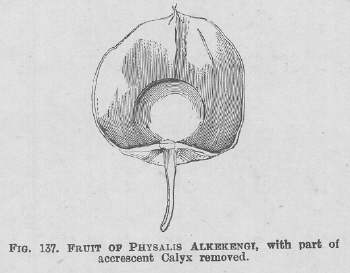
P. Alkekengi is ornamental, in autumn and winter, when its fruits are ripe, on account of the highly-coloured, inflated calyx. This becomes skeletonised in due course, if left on the plant. P. perruviana edulis is occasionally grown as a dessert fruit, some people liking its peculiar flavour. The species described below are all herbaceous perennials, and will thrive in any common garden soil. Propagation of the annual species may be effected by seeds, and of the perennials by seeds and by division.
P. Alkekengi (Alkekengi).* Winter Cherry. fl. white, with yellow anthers; mature calyx blood colour; corolla not spotted. July. fr. scarlet, edible. l. deltoid-ovate, acuminate, repand, long-stalked, attenuated into the petioles, including which they are 3in. to 4in. long, and 1 1/2in. to 2in. broad. Stem almost simple. Roots creeping. h. 1ft. Caucasus, China (naturalised in North America), 1548. Hardy.(S. F. G. 234)
P. peruviana (Peruvian). Cape Gooseberry. fl. whitish, with violet anthers; mature calyx pale, ovate; corolla spotted. July. fr. purplish. l. cordate, acuminate, entire or sinuatetoothed, slightly tomentose. Stem erect, somewhat branched. h. 3ft. South America, 1772 (naturalised in many warm countries). Greenhouse. Plant densely villous-pubescent.
P. p. edulis (edible).* fr. yellow, edible. l. almost entire. (B. M. 1068, under name of P. edulis.)
P. p. violacea (violet-fruited).* fl. yellow, with a dark purple spot at the base of each lobe. fr. dark violet, large, globose. l. cordate, acute. h. 3ft. Mexico, 1883. This is probably an improved cultivated from, with larger fruits than the type. (R. H. 1882, p. 216, under name of P. violacea.)