Phyteuma
(an old Greek name, meaning simply "the plant," used by Dioscorides, for a kind of Reseda). Horned Rampion. SYN. Rapunculus. Including Petromarula. ORD. Campanulaceae. To this well-known genus about fifty plants have been referred as species, but this number may be reduced. They are mostly hardy perennial herbs, natives of Europe, the Mediterranean region, and temperate Asia. Flowers often sessile, variously disposed; calyx tube adnate, hemispherical or oblong-obconical, with a five-parted limb; corolla five-parted almost to the base, the lobes linear and cohering a long time. Radical leaves long-stalked; cauline ones alternate, smaller. The species are very pretty plants for rockwork and borders; they thrive in any moderately good garden soil. Propagation is easily effected by seeds, or by divisions, in spring. The dwarf-growing mountain species, such as P. comosum, like a well-drained spot in the rockery. The following are the best known; they are all hardy perennial herbs.
P. betonicaefolium (Betony-leaved). fl. blue; spikes ovoid, almost bractless. June. l. glabrous or pilose, lower ones oblong, acuminated, simply serrulated; upper ones linear-lanceolate, nearly entire. Stems glabrous. h. 6in. to 12in. Pyrenees, &c., 1818.
P. campanuloides (Campanula-like). fl. deep violaceous-blue, disposed in a spike 2in. to 3in. long, one to three together, from the axils of the bracts. June to August. l., lower ones petiolate, ovate, bluntish, crenated; middle ones broad, sessile, ovate, acute, crenated; upper ones lanceolate, serrated. h. 1ft. to 2ft. Caucasus, 1804. (B. M. 1015.)
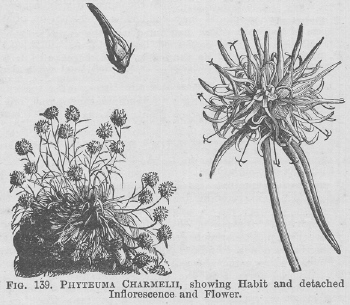
P. Charmelii (Dr. Charmeil's). fl. blue, in spherical heads. May to August. l. of various forms; radical ones on long petioles, cordate-ovate, acute, coarsely serrate-toothed; lower cauline ones petiolate, lanceolate, irregularly serrate-toothed. h. 6in. to 12in. Apennines, &c., 1823. See Fig. 139.
P. comosum (tufted).* fl. on short peduncles, disposed in loose, umbel-formed fascicles; corolla purple or blue, inflated at the base, tube-formed. July. l. coarsely and acutely toothed; radical ones on long petioles, cordate-ovate-roundish; cauline ones on short petioles, ovate-lanceolate, acute. h. 3in. to 6in. Dalmatia, Carniola, South of Tyrol, &c., 1752. (B. M. 6478; J. F. A. app. 50.)
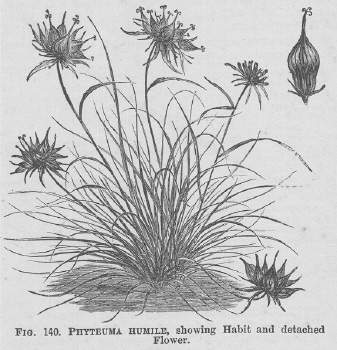
P. humile (dwarf).* fl. blue, in globose heads. July. l., radical ones crowded, linear-lanceolate, narrow at the base, nearly entire; cauline ones few, linear, entire. h. 3in. Switzerland, &c., 1825. See Fig. 140.
P. limoniifolium (Limonium-leaved). fl. blue, sessile; spikes long, interrupted. June and July. l., radical ones on long petioles, quite glabrous, lanceolate, a little toothed. Stems branched. h. 2ft. to 3ft. South Europe, &c., 1819. (B. M. 2145, under name of P. stricta; L. B. C. 667, under name of P. virgata; S. F. G. 2183.)
P. Michelii (Micheli's). fl. pale or deep blue; spikes ovate; bracts reflexed. July and August. l. of various forms; radical ones petiolate, ovate-cordate or ovate; cauline ones linear-lanceolate. Stems simple. h. 1ft. to 2ft. South Europe, 1819. (B. M. 2271; B. M. 2066, under name of P. betonicaefolium). SYN. P. scorzonerijolium.
P. orbiculare (orbicular). fl. deep blue, in round heads. June to August. l., radical ones petiolate, lanceolate, sub-cordate, crenated; cauline ones sessile, linear-lanceolate. h. 6in. to 18in. Europe, &c. (in pastures and by roadsides, on a--chalky soil). (B. M. 1466; Sy. En. B. 864.)
P. pinnatum (pinnate). fl. blue or white, pedicellate, disposed in loose racemes. August. l., first radical ones petiolate, ovate, acute; the later ones pinnate, with the petioles margined and lobed. h. 3ft. to 6ft. Crete, 1640. (S. B. F. G. ser. ii. 224.)
P. Scheuchzeri (Scheuchzer's). fl. deep blue, in spherical heads. May. l. petiolate, ovate-lanceolate, bluntly serrated; lower cauline ones linear-lanceolate, acutely serrulated; upper ones linear, nearly entire. h. 1ft. European Alps, 1813. (B. M. 1797.)
P. scorzonerifolium (Salsify-leaved). A synonym of P. Michelii.
P. Sieberi (Sieber's). fl. deep blue, in spherical heads. May. l., radical ones petiolate, ovate-roundish, sub-cordate, crenated; lower cauline ones petiolate, lanceolate, coarsely toothed; upper ones stem-clasping. h. 3in. to 6in. Apennines, 1826.
P. spicatum (spiked). fl. white, cream-coloured, or blue; spikes cylindrical, elongated. July. l., lower ones on long petioles, cordate, ovate-acute, bi-serrated; upper ones ovate-lanceolate. h. 1ft. to 3ft. Temperate parts of Europe (Britain), 1597. (B. M. 2347; Sy. En. B. 865.)