Pilocereus
(from pilos, wool, and Cereus; referring to the long hairs upon the spine-cushions). ORD. Cacteae. A small genus of greenhouse succulents, now included, by Bentham and Hooker, under Cereus; the principal differences consist in the flower-bearing portion of the plant being unlike the rest, usually forming a dense, woolly head at the summit of the stem, and having more numerous, longer and thinner, often hair-like spines, and the flowers themselves being smaller, and having fewer divisions, with the stamens attached to the whole surface of the tube. The species very rarely produce flowers in cultivation. For culture, see Cactus.
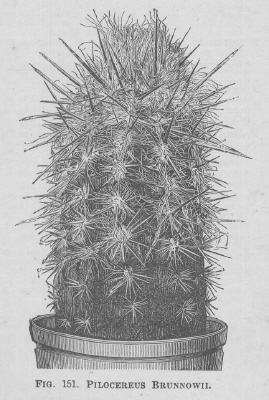
P. Brunnowii (Brunnow's). fl. unknown. Stem erect, cylindrical, many ribbed, bright green, thickly beset with shining spots; ribs nine to twelve, vertical, rounded, uneven when young, later on pretty smooth. Prickles about thirteen, central one much the longest, surrounded in the younger parts of the plant by long white hairs. Bolivia, 1870.(for which, as well as, we are indebted to Herr Fr. Ad. Haage, jun., of Erfurt).
P. Curtisii (Curtis'). fl., tube olive-green, 2in. long, 3/4in, thick, expanding with many imbricating segments; within this is a series of pale rose-coloured, ovate petals; style deep rose-colour; stigma of seven or eight rays. Spring and summer. Plant 3ft. or more high, 1 1/2in. to 2in. in diameter, erect, straight or somewhat flexuous, eight to ten-angled, beset with little tufts of wool; from these arise a spreading cluster of aculei, and from a tuft of this description springs the flower. Grenada. SYN. Cereus Royeni. (B. M. 3125.)
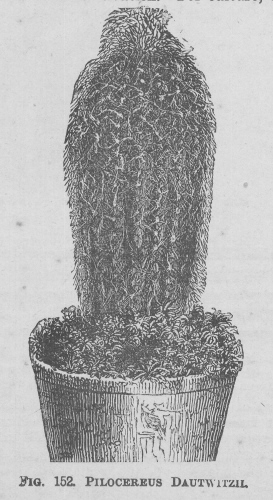
P. Dautwitzii (Dautwitz's).* Stem oblong or fusiform, bright green; traversed from base to apex by twenty-one shallow ribs, bearing closely-set tufts of small, white, spreading straight spines, and covered throughout, but more especially at the top, with a dense coating of long, white, cottony hair. Northern Peru, 1870.
P. fossulatus (grooved). Stem erect, club-shaped, with ten to twelve obtuse angles; sutures undulated, with a depression above each areole; spines pale brown, the central one very strong, 1in. long, the outer ones ten to twelve, depressed; hairs white, very strong, with a tuft on the apex. h. probably 20ft. A noble and very distinct, but scarce species. Peru (?). (G. C. 1873, 197.)
P. Houlletii (Houllet's).* fl. a kind of violet, with a suspicion of rose and yellow; segments very small, numerous, lanceolate, recurved; tube short, smooth, with a few pointed, reddish-green scales. Stem strong, grey-green; ribs seven or eight; prickles nine, straw-coloured, central one longest. The younger parts of the plant are covered with a white felt.(R. H. 1862, 427.) P. senilis (aged).* Old Man Cactus. "A cylindrical-stemmed plant, 1ft. or more in height; but in Mexico, its native country, it attains a height of 20ft. to 25ft., with a diameter of 9in. or 10in., and its fluted character gives it somewhat the appearance of an architectural column. The stem is divided into thirty or forty narrow furrows, with corresponding ridges, which are furnished, at very short distances, with tufts of white spines, surrounded by numerous long, flexible, white hairs, resembling the grey hairs of an old man's head..... When young, the stems are fleshy and succulent, but, as they get old, their tissue becomes filled with an extraordinary quantity of small, sand-like grains, composed of oxalate of lime, not less than from 60 to 80 per cent. having been found in individual stems" ("Treasury of Botany"). Mexico and Guatemala.