Pimelea
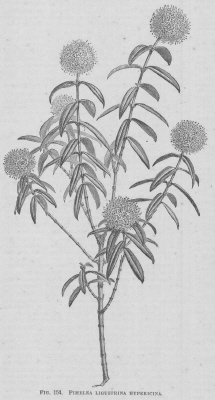
(from pimele, fat; alluding to the oily seeds). Rice Flower. SYNS. Banksia (of Forster), Cookia. ORD. Thymelaeaceae. A large genus (seventy-six species have been described) of beautiful, greenhouse trees, shrubs, or rarely herbs, natives of Australia and New Zealand. Flowers hermaphrodite or rarely diaecious, capitate-spicate or fascicled, terminal or axillary, very rarely solitary; perianth with a cylindrical tube, and four spreading or rarely erect lobes; stamens two, affixed to the throat. Leaves opposite or scattered, usually rather small. Most of the species which have been introduced are described below; except where otherwise stated, they are shurbs, and inhabitants of Australia.
Pimeleas are compact, free-growing, and very desirable greenhouse plants, especially as they flower when most of the other hard-wooded representatives are past. Their flower-heads are borne in the greatest profusion on the points of shoots that are made annually, those of one season flowering in that next following. The plants succeed in good fibrous peat and silver sand, or they may be grown as stronger specimens with loam instead of peat, if it is of good quality, and contains plenty of fibre. Cuttings, made of the young shoots, when they are about 2in. long, will root, if inserted, in spring, in a compost of one part peat to two of silver sand, and covered with a bell glass. They should be placed in an intermediate house, kept moist, and shaded from sunshine. When roots are formed, gradually admit air, and, in due course, pot off singly, and grow the plants on in a close, moist atmosphere until established, when a more airy situation will be best. Established flowering plants of Pimeleas may be treated somewhat like others of a hard-wooded description, except that they require rather more water and syringing. They are more than usually susceptible to the attacks of Red Spider, and, if this is allowed a footing, much injury will ensue. Pimelias may also be raised from imported seeds, when these are obtainable; young plants flower when they are very small, if allowed, but this is not advisable, as it tends to unduly weaken them. The habit assumed is such as to require but little training beyond stopping shoots on young plants that are inclined to take a lead. Each year, after flowering, all the heads should be cut over, and any necessary repotting attended to so soon as the new growth has commenced. The most beautiful species is P. spectabilis; others specially noteworthy are P. ferruginea, and P. ligustrina hypericina. The first-named and the last will grow into large specimens if desired; P. ferruginea is of a much more dwarf and compact habit.
P. arenaria (sand-loving). fl. white, villous or shaggy. May. l. close-set, but not imbricated, 1/4in. to 1/2in. long, oblong or orbicular, pilose above, silky and shining beneath. Branches stout, densely villous. h. 8in. to 24in. New Zealand, 1827. A very beautiful little shrub. (B. M. 3270.)
P. crinita (hairy). A synonym of P. imbricata piligera.
P. decussata (decussate). A synonym of P. ferruginea.
P. diosmifolia (Diosma-leaved), of Loddiges. A synonym of P. ferruginea.
P. drupacea (drupe-bearing). Victorian Bird Cherry. fl. white, tinged with pink, small, not numerous; heads terminal on young shoots, but mostly appearing axillary and sessile from the extreme shortness of the flowering branches. May. fr. a drupe, red or black when ripe. l. all opposite, ovate to oblong-elliptic or oblong-linear, 3/4in. to 2in. long, glabrous above, pale and often silky beneath. h. 2ft. to 6ft. 1817. (L. B. C. 540; S. F. A. 2.)
P. elegans (elegant). A synonym of P. ligustrina hypericina.
P. ferruginea (rusty).* fl. rose or red, in terminal, globular heads. May. l. opposite, usually crowded, sessile, ovate or oblong, obtuse, or scarcely mucronate, 1/4in. to 1/2in. h. 1ft. to 2ft. 1824. SYNS. P. decussata (B. 136; L. B. C. 1283; S. F. A. 8), P. diosmifolia (L. B. C. 1708).
P. filamentosa (thread-like). A synonym of P. linifolia.
P. glauca (glaucous). fl. white; perianth nearly 1/2in. long; heads globular; involucral bracts usually four. June. l. opposite, from ovate to oblong-lanceolate or almost linear, sometimes all under 1/2in., sometimes 1/2in. to 3/4in. or more long, flat or concave. h. 6in. to 18in. 1824. (L. B. C. 1611; T. L. S. x. 13.) SYNS. P. humilis (B. R. 1268), P. intermedia (B. 243; B. R. 1439).
P. Gnidia (Gnidia). fl. red, silky and villous. Early summer. l. crowded, shining above, petioled, 1/3in. to 2/3in. long, oblong or oblong-lanceolate, acute or obtuse. h. 1ft. to 5ft. New Zealand.
P. graciliflora (slender-flowered). A form of P. sylvestris.
P. Hendersoni (Henderson's). A synonym of P. rosea.
P. hispida (hairy).* fl. blush-colour, in terminal, globular heads; perianth four to seven lines long. May. l. opposite, varying from ovate and under 1/2in. long to oblong or oblong-lanceolate and 3/4in. or more long, sessile or scarcely petiolate. h. 2ft. to 4ft. 1830. (B. M. 3459; B. R. 1578; L. B. C. 1966.)
P. humilis (dwarf). A synonym of P. glauca.
P. hypericina (Hypericum-like). A synonym of P. ligustrina hypericina.
P. imbricata piligera (imbricated, pili-bearing). fl. usually white, rather large, in globular heads, with eight or more involucral bracts. August. l. narrow, often 1/2in. long, all or mostly clothed with long, loose, silky hairs. h. 6in. to 18in. 1837. SYNS. P. crinita, P. nana (B. M. 3833).
P. incana (hoary). A synonym of P. nivea.
P. intermedia (intermediate). A synonym of P. glauca.
P. lanata (woolly). A synonym of P. sericea.
P. ligustrina (Ligustrum-like), of Bot. Reg. A synonym of P. ligustrina hypericina.
P. ligustrina hypericina (Ligustrum-like, Hypericum-like var.).* fl. white, in globular heads; involucral bracts usually six to eight, silky-pubescent or hoary. May. l. opposite, ovate to oblong or elliptical, 1in. to 1 1/2in. long, or on luxuriant shoots twice that size. h. 5ft. to 6ft. 1823. SYNS. P. elegans (I. H. viii. 295), P. hypericina (B. M. 3330), P. ligustrina (B. R. 1827).
P. linifolia (Flax-leaved). fl. white, in terminal, globular heads; involucral bracts four. May. l. opposite, on very short petioles, linear or oblong, passing into linear-spathulate or linear-lanceolate, from less than 1/2in. to about 1in. long. Branches usually slender and twiggy. h. 1ft. to 3ft. 1793. (B. M. 891; L. B. C. 1668.) SYNS. P. filamentosa (T. L. S. x. 14), P. linoides, P. paludosa.
P. linoides (Flax-like). A synonym of P. linifolia.
P. longiflora (long-flowered). fl. white, in globular heads, with five to eight involucral bracts. June. l. mostly alternate, linear, concave, from 1/4in. to above 1/2in. long, and usually erect. h. 1ft. to 4ft. 1831. (B. M. 3281.)
P. macrocephala (large-headed). A synonym of P. suaveolens.
P. nana (dwarf). A synonym of P. imbricata piligera.
P. Neypergiana (Neyperg's). A garden synonym of P. Preissi.
P. nivea (snowy). fl. white, in terminal, globular heads; involucral bracts four to six, rather larger than the cauline leaves June. l. opposite, ovate or orbicular, rarely broadly elliptic-oblong, less than 1/2in. long, rather thick, with recurved margins, and beneath, as well as the branches, white with tomentum. h. 4ft. 1833. SYN. P. incana (B. 147; B. R. 1838, 24).
P. paludosa (marsh-loving). A synonym of P. linifolia. P. pauciflora (few-flowered). fl. white, few in the head. May. l. opposite, linear-lanceolate, acute or obtuse, mostly 1/4in. to 1in. long, or, on some luxuriant shoots, narrow, and 1 1/2in. long, flat or concave. h. 3ft. to 10ft. 1812. (L. B. C. 179.)
P. Preissii (Preiss'). fl. in globular heads, with four to six involucral bracts. April. l. opposite, linear-lanceolate or oblong-linear, slightly concave, 1/4in. to above 1/2in. long. h. 1ft. to 2ft. 1846. SYN. P. Neypergiana, of gardens.
P. rosea (rose-coloured).* fl. pink or white, similar to those of P. ferruginea, but larger. June. l. opposite, linear or linear-oblong, often above 1/2in. long, with the recurved or revolute margins of the species just named. 1800. Allied to P. ferruginea, but taller and more slender. (B. M. 1458; L. B. C. 88.) SYN. P. Hendersoni (B. M. 3721).
P. sericea (silky). fl. in terminal heads; involucral bracts four to six, rather larger than the stem leaves. May. l. opposite, crowded, ovate or oblong, less than 1/2in. long, glabrous above. h. 1ft. to 2ft. 1834. This resemble P. nivea, but it may be "readily known by the dense indumentum of the branches and under side of the leaves consisting of silvery-silky hairs" (Bentham). SYN. P. lanata (B. 61).
P. spectabilis (remarkable).* fl. white, more or less tinged with pink, in usually large, globular heads, surrounded by four to six bracts, which are often coloured on the margins. May. l. mostly opposite, rather crowded, linear-oblong or lanceolate, flat or with slightly recurved margins, 3/4in. to 1 1/2in. long; the upper one often broader and shorter. h. 3ft. to 4ft. 1840. SYN. P. Verschaffeltii. (B. M. 3950.)
P. suaveolens (sweet-smelling).* fl. yellow when fresh, in globular heads; involucral bracts four to eight, usually ciliated. April. l. opposite, from ovate-lanceolate to oblong-linear, more or less concave, mostly 1/2in. to 1in. long. h. 1ft. to 3ft. 1848. SYN. P. macrocephala (B. M. 4543; L. J. F. 76). P. sylvestris (sylvan). fl. blush-colour, in globular heads; involucre of four to six bracts. June. l. opposite, oblong or lanceolate, mostly 1/2in. to 3/4in. long, more or less concave. h. 2ft. to 3ft. 1830. (B. M. 3276; B. R. 1582; L. B. C. 1965.) P. graciliflora (B. M. 3288) is a form with broader leaves.
P. Verschaffeltii (Verschaffelt's). A synonym of P. spectabilis.