Pitcairnia
(named after W. Pitcairn, a physician, of London). SYN. Hepetis. Including Neumannia and Pepinia. ORD. Bromeliaceae. A genus comprising about seventy species of stove perennial herbs, rarely shrubs, generally stemless, with the leaves in a dense rosette; they are all natives of tropical America. Flowers red, yellow, or whitish; calyx with a short, obconical tube, adnate to the base of the ovary, and three large, lanceolate segments; corolla of three lingulate, unguiculate petals, one and a-half to three times the length of the sepals, usually with two minute scales at the base; stamens six; peduncle leafy, the proper leaves passing gradually into bracts; inflorescence generally a simple or panicled raceme, rarely a head or sub-spicate raceme. Leaves linear or ensiform, rarely oblong, lepidote on the back, or green and naked on both surfaces, often prickle-margined, especially towards the base, sessile or narrowed into a channelled petiole. All the species described below are herbaceous perennials, except where otherwise stated. For culture, see Aechmea and Billbergia. The following enumeration of species is based on Mr. Baker's synopsis of the genus, which appeared in "Trimen's Journal of Botany," 1881.
P. albiflos (white-flowered). fl. in a simple, loose raceme, 6in. to 12in. long; petals white, three times as long as the sepals; peduncle 1ft. to 2ft. long. September. l. many to a tuft, linear, 1 1/2ft. to 2ft. long, 1/2in. to 3/4in. broad at the middle, obscurely petioled, without prickles. Rio Janerio, 1826. (B. M. 2642.) SYN. P. odorata (R. G. 1855, 114).
P. alta (tall). fl., sepals and petals bright red, the latter 2in. long, 1/4in. broad; racemes several, arranged in a deltoid panicle, 2ft. long and broad; peduncle 2ft. to 3ft. long, floccose. August. l. twelve to twenty to a stem, linear, 2ft. to 3ft. long, 3/4in. to 1in. broad above the middle, spine-edged towards the base. Dominica, before 1877. (B. M. 6606.) This species is known in gardens by the following names: P. bromelioefolia, P. intermedia, and P. Skinneri.
P. Altensteinii (Altenstein's). fl. in a simple, sub-spicate raceme, 4in. to 6in. long; sepals 1in. to 1 1/4in. long; petals whitish, twice as long as the sepals; bracts bright red, 1 1/2in. to 2in. long; peduncle 1ft. to 1 1/2ft. long. May. l., produced ones about ten to a stem, 2ft. to 3ft. long, 1 1/2in. to 2in. broad, with an unarmed or minutely prickly petiole. Western Venezuela, 1840. (F. d. S. 162.) SYNS. P. undulatifolia (B. M. 4241), Puya Altensteinii.
P. A. gigantea (gigantic). A very large form, with an inflorescence 6ft. to 7ft. high, including the peduncle. (B. M. 4309; F. d. S. 253, 254.)
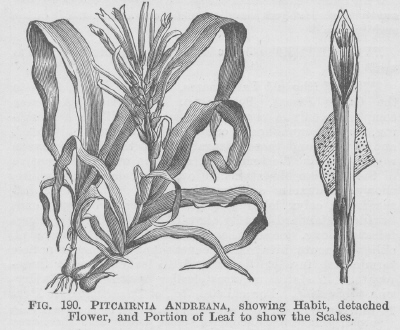
P. Andreana (Andre's).* fl. in a simple raceme, 4in. to 6in. long; petals yellow at the tip, red lower down, four times as long as the sepals; peduncle 4in. to 6in. long, densely leafy. July. l., produced ones four or five to a stem, lanceolate, not distinctly petioled, 16in. to 20in. long, 1in. to 1 1/2in. broad, white beneath, lepidoted above. New Grenada and Venezuela, 1872. See Fig. 190. (B. M. 6480; I. H. n. s. 139.) SYN. P. lepidota.
P. angustifolia (narrow-leaved). fl. in one to three racemes, the end one 6in. to 9in. long; petals 1 1/2in. to 1 3/4in. long, bright red, scaled at base; peduncle, including inflorescence, 2ft. to 3ft. long. September. l. linear, about 2ft. long, 1/4in. to 1/2in. broad, acuminate, not petioled, white-furfuraceous at back, armed down the margins with brown, horny spines. Santa Cruz, 1777. (B. M. 1547.)
P. aphelandraeflora (Aphelandra-flowered).* fl. in a dense, oblong, sub-spicate raceme, 4in. to 6in. long; sepals coral-red, 1/2in. long; petals bright red, 2 1/2in. long; lower bracts 2in. to 3in. long. Summer. l. thirty to sixty, extending over 3in. to 6in. of the stem, linear, sessile, about 6in. long, less than 1/2in. broad, minutely serrulate. Stems slender, 1ft. long below the leaves. Para, 1867. Shrub. SYN. Pepinia aphelandraeflora (I. H. n. s., xxxii. 5).
P. atrorubens (dark reddish). fl. in a simple, sub-spicate raceme, 6in. to 8in. long; petals pale yellow, lingulate, 2 1/2in. to 3in. long; bracts bright red, much imbricated; peduncle leafy, shorter than the leaves. Summer. l., produced ones with a spine-edged petiole, 3in. to 6in. long, and a lanceolate blade, 2ft. to 3ft. long and 2in. to 3in. broad. Central America. SYN. Puya Warcewiczii (B. M. 5225).
P. bracteata (large-bracted). fl. in a simple, dense raceme, 6in. to 12in. long; sepals nearly 1in. long; petals bright red, decurving, twice as long as the sepals; bracts 1in. to 1 1/2in. long; peduncle nearly 1ft. long, with numerous reduced leaves. April. l. in a dense tuft, linear, 1 1/2ft. to 2ft. long, 1in. broad, acuminate, entire or slightly prickly towards the base. St. Vincent, 1799. (B. M. 2813.) SYN. P. commutata (R. G. 1867, 557), P. sulphurea (A. B. R. 249) is regarded, by Mr. Baker, as a yellow-flowered variety of this species.
P. bromeliaefolia (Bromelia-leaved). fl. in simple or slightly compound racemes, 1ft. long; sepals and petals bright red, the latter 2in. long; peduncle about 1ft. long below the inflorescence, with several long leaves. June. l. in a dense tuft, linear, 2ft. to 3ft. long, 1/2in. to 3/4in. broad at the middle, acuminate, spine-edged towards the base, white-furfuraceous beneath. Jamaica, 1781. (B. M. 824; B. R. 1011.) P. platyphylla is regarded, by Mr. Baker, as a robust, broad-leaved variety of this species.
P. bromeliaefolia (Bromelia-leaved), of L'Heritier. A synonym of P. alta.
P. cinnabarina (cinnabar-red). fl. in dense, simple racemes, about 6in. long; sepals 3/4in. long; petals bright red, 2in. long; peduncle 1ft. long, with several reduced leaves. June. l., produced ones linear, sessile, 1 1/2ft. long, scarcely 3/4in. broad, quite without spines near the base. Brazil, 1851.
P. commutata (changeable). A synonym of P. bracteata. P. corallina (coral-red).* fl. in dense, deflected racemes, above 1ft. long; sepals bright red, 1in. long; petals bright red, edged with white, 3in. long; peduncle also bright red, 1ft. long. Spring. l., produced ones lanceolate, distinctly petioled, 4ft. to 5ft. long, about 4in. broad, spine-edged low down, plicate, white-furfuraceous at back. Choco, New Grenada, about 1874. (B. M. 6600; R. H. 1875, p. 251.)
P. corcovadensis (Corcovado). fl. red, disposed in a single, loose, terminal raceme, on a stem about 1ft. high. l. erect, glabrous, broadly linear, acuminate, 3ft. to 4ft. long, passing into linear bracts on the flower-stem. h. 1ft. Brazil, 1884. A slender species.
P. Decaisnei (Decaisne's). A synonym of P. fulgens.
P. densiflora (dense-flowered). fl. in a very dense, sub-spicate, oblong raceme, 3in. to 4in. long; petals bright yellowish-red, twice as long as the pale green sepals. Summer. l., produced ones with an unarmed, channelled petiole, 6in. long, and an ensiform, entire blade, 2ft. to 3ft. long, and about 1 1/2in. broad. Native place unknown.
P. echinata (prickly). fl. in several loose racemes, arranged in a deltoid panicle; petals whitish, nearly twice as long as the sepals; peduncle 2ft. to 4ft. long below the inflorescence, with eight to ten leaves, the lower 1ft. long. June. l., produced ones twelve to twenty to a stem, lanceolate, 3ft. to 4ft. long, 1in. to 2in. broad, obscurely petioled, white-furfuraceous at back, prickle-margined. h. 5ft. to 6ft. New Grenada, 1852. (B. M. 4709; F. d. S. 844; L. J. F. 407.)
P. exscapa (stemless). A synonym of P. heterophylla. P. ferruginea (rusty). fl. in ten to twelve secund racemes, arranged in a deltoid panicle, the lower branches of which are 2ft. to 3ft. long; sepals densely ferruginous externally, 2in. to 2 1/2in. long; petals white, twice as long as the sepals, with two large scales at the base; peduncle 2ft. to 3ft. long below the inflorescence. December. l. perhaps 100, in a very dense rosette, sessile, 2ft. to 3ft. long, 1 1/2in. to 2in. broad, horny in texture, densely white-lepidote at back. Stem 3ft. to 4ft. long below the rosette of leaves. h. 10ft. to 12ft. Andes of Peru, 1860. The largest species of the genus. SYN. Puya grandiflora (B. M. 5234).
P. flammea (flame-coloured). fl. in a rather dense raceme, 6in. to 12in. long; sepals red, 3/4in. long; petals bright red, more than twice as long as the sepals; peduncle also bright red, 1ft. to 1 1/2ft. long, copiously leafy. November. l., produced ones ensiform, 2ft. to 2 1/2ft. long, 1in. to 1 1/4in. broad, not distinctly petioled, acuminate, persistently white-furfuraceous at back, not at all spiny. Organ Mountains, 1825. (B. R. 1092.)
P. flavescens (yellowish). A synonym of P. xanthocalyx.
P. fulgens (brilliant).* fl. in several very loose racemes, 3in. to 6in. long, forming a deltoid panicle; sepals and petals bright red, the latter 2in. to 2 1/4in. long, with a large, truncate scale at the base; peduncle 3ft. long below the inflorescence, copiously leafy. May. l., produced ones twenty to a tuft, ensiform, 2ft. to 3ft. long, 1in. to 1 1/2in. broad, white at back, prickle-margined. Brazil, 1850. A fine plant, well known in cultivation. SYN. P. Decaisnei.
P. fulgens (brilliant). A garden synonym of P. Karwinskiana.
P. Funkiana (Funk's). fl. in a sub-spicate raceme, 6in. to 12in. long; sepals 1in. long; petals nearly white, over 2in. long; bracts yellowish-green, 1in. to 1 1/4in. long; peduncle 2ft. long, slightly pubescent, its lower leaves large. May. l. lanceolate, entire, 2ft. to 3ft. long, 2in. to 2 1/2in. broad, glabrous; petiole unarmed, 6in. to 12in. long. Venezuela, 1850. (R. G. 113.) SYN. P. macrocalyx (B. M. 4705).
P. furfuracea (scurfy). fl. in three to five rather dense racemes, the end one about 1ft. long; petals bright red, 2in. to 2 1/2in. long, scaled at base; peduncle, including the inflorescence, 2ft. to 3ft. long. July. l. linear, about 2ft. long and 1in. broad, acuminate, not distinctly petioled, white-furfuraceous at back, spiny towards the base. Native country unknown. Mr. Baker regards this as "doubtfully distinct, specifically, from P. latifolia." (B. M. 2657.)
P. heterophylla (variable-leaved). fl. six to twelve in a capitate, sessile or nearly sessile spike; sepals reddish, 1in. to 1 1/4in. long; petals bright red, rarely white, about 1 3/4in. long; pedicels very short or wanting. May. l., outer rudimentary ones of the rosette deltoid; produced ones about six, linear, 1ft. to 2ft. long, 1/4in. to 1/2in. broad, not petioled, nor at all toothed. Mexico, &c., 1848. SYNS. P. exscapa (B. M. 4591), P. Morrenii (L. J. F. 21), Puya heterophylla (B. R. xxvi. 71), Puya longifolia (L. & P. F. G. 86).
P. imbricata (imbricated). fl. in a sub-spicate raceme, 1ft. long; sepals whitish, tipped with green, 1in. long; petals creamy-white, lingulate, more than 2in. long; peduncle 1ft. long, closely leafy. October. l. twelve to twenty to a stem, ensiform, 1 1/2ft. to 2ft. long, with a petiole 6in. to 12in. long, armed with small, deflexed, horny, brown prickles. Mexico and Cordova, 1868. Plant caulescent.
P. integrifolia (entire-leaved). fl. in one to five very loose racemes, the end one 1ft. long; petals bright red, 1in. longer than the sepals, scaled at base; peduncle more than 1ft. long. August. l., produced ones linear, 2ft. to 3ft. long, about 1/2in. broad, tapering to a long point, not distinctly petiole, closely white-furfuraceous at back, destitute of teeth. West Indies, about 1810. (B. M. 1462.)
P. intermedia (intermediate). A garden synonym of P. alta. P. iridiflora (Iris-flowered). fl. in a raceme 1ft. long; petals bright red, 2in. long, not scaled at base; peduncle about 1ft. long. July. l. linear, 2ft. to 3ft. long, 1/3in. broad, much overtopping the raceme, spine-toothed. Native country unknown.
P. Jacksoni (Jackson's). fl. in a loose raceme, 8in. to 9in. long; petals bright red, three times as long as the sepals, scaled at base; peduncle over 3ft. long, with many reduced leaves. May. l. linear, entire, 2ft. to 3ft. long, 1/2in. broad, white-furfuraceous at back; petioles channelled, 1ft. long, spine-edged at the dilated base. Guatemala, about 1850. (B. M. 4540.) SYN. Lamprococcus Jacksoni (L. J. F. 127).
P. Karwinskiana (Karwinski's).* fl. in a dense raceme, about 6in. long; sepals reddish, 3/4in. long; petals bright red, secund, 2 1/2in. long, not scaled; peduncle 1ft. to 2ft. long, with many reduced leaves. June. l., produced ones linear, 1 1/2ft. to 2ft. long, 1/2in. to 3/4in. broad, distinctly petioled, usually without prickles. Mexico. A well-known species. SYN. P. ringens (R. G. 53). This species is also known in gardens as P. fulgens, P. montalbensis, and P. Warcewicziana.
P. latifolia (broad-leaved). fl. in a simple or slightly compound raceme, 6in. to 9in. long; petals bright red, 2in. long, scaled at base; peduncle 1ft. to 2ft. long, leafy. August. l. linear, 2ft. to 3ft. long, nearly 1in. broad, acuminate, not distinctly petioled, white-furfuraceous at back, with only a few prickles. St. Eustace Island, 1785. (A. B. R. 322; B. M. 856.)
P. Lehmanni (Lehmann's). fl. in dense, panicled racemes; petals bright red, 1 1/2in. to 1 3/4in. long. l., produced ones ensiform, 2ft. to 3ft. long, above 1in. broad, copiously spiny towards the base. Southern New Grenada.
P. lepidota (scaly). A synonym of P. Andreana.
P. longifolia (long-leaved). A synonym of P. pulverulenta.
P. macrocalyx (large-calyxed). A synonym of P. Funkiana. P. maidifolia (Indian Corn-leaved). fl. in a sub-spicate raceme, nearly 1ft. long; sepals 1in. long; petals greenish-white, 2 1/2in. long; peduncle leafy, 1 1/2ft. to 2ft. long. May. l. lanceolate, petioled. 2ft. to 3ft. long, 1 1/2in. to 2in. broad, without prickles. Venezuela, 1848. (F. d. S. 915.) SYN. Puya maidifolia.
P. montalbensis (Monte Alban). A garden synonym of P. Karwinskiana.
P. moritziana (Moritz's). fl. in a loose raceme, 6in. to 12in. long; sepals 3/4in. long; petals bright red or reddish-yellow, 2in. to 2 1/2in. long, not scaled; peduncles 6in. to 15in. long, with many erect, reduced leaves. Summer. l., produced ones many to a rosette, linear, 1ft. to 1 1/2ft. long, 1in. broad, not distinctly stalked, mostly without prickles. Guatemala, about 1860.
P. Morrenii (Morren's). A synonym of P. heterophylla.
P. muscosa (mossy).* fl. in a loose raceme, 3in. to 6in. long; petals bright red, 2in. long, not scaled at base; peduncle 6in. to 9in. long, densely floccose. December. l. twelve to twenty in a tuft, linear, 6in. to 9in. long, falcate, very acuminate, white-furfuraceous at back, entire or minutely denticulate. h. not more than 1ft. Central Brazil. (B. M. 4770.)
P. nubigena (cloud-born). fl. in a somewhat dense raceme, 6in. to 8in. long; sepals red, 1in. to 1 1/4in. long; petals bright red, scaled at base, more than twice as long as the sepals; peduncle leafy, 1ft. to 1 1/2ft. long. October. l., produced ones ensiform, petioled, 1in. broad, narrowed to both ends, entire. Venezuela (at 8000ft. to 9000ft. altitude), 1852. Plant tufted. (F. d. S. 847.)
P. odorata (odorous). A synonym of P. albiflos.
P. platyphylla (broad-leaved). A variety of P. bromeliaefolia. P. pulverulenta (powdery). fl. in many racemes, arranged in a deltoid panicle; petals bright red, about 2in. long, scaled at base; peduncle elongated, with several leaves. December. l., produced ones ensiform, 3ft. to 4ft. long, 1 1/2in. to 2in. broad, narrowed at both ends, spine-margined towards the base, white-furfuraceous beneath. h. 6ft. to 12ft. Andes of Peru, 1852. SYN. P. longifolia (B. M. 4775).
P. pungens (stinging).* fl. in a dense raceme, 4in. to 8in. long; sepals rather cottony; petals bright red, scarlet at base, 2in. long; peduncle 6in. to 12in. long, cottony, its many leaves bract-like, the lower sometimes pectinate. May. l., produced ones six to eight, linear 1ft. to 1 1/2ft. long, scarcely 1/2in. broad, loosely furfuraceous on the back, destitute of prickles; outer rudimentary ones furnished with a long, rigid, pectinate tip. Andes, 1863. (B. M. 5356.)
P. punicea (reddish). fl. in a loose raceme, 4in. to 6in. long; sepals about 1/2in. long; petals bright red, 1 1/2in. to 1 3/4in. long, peduncle very short. Summer. l., proper ones twenty to thirty, spread over 3in. to 4in. of the stem, linear, not distinctly petioled, about 1ft. long, less than 1/2in. broad, white-furfuraceous at back. h. about 1ft. Mexico. Plant caulescent.
P. recurvata (recurved). fl. in a dense, sub-spicate raceme, 4in. to 6in. long; sepals nearly 1in. long; petals milk-white, 3in. to 3 1/2in. long, much decurved, minutely scaled at base; peduncle 1 1/2ft. to 2ft. long, furfuraceous, with bract-like leaves. April. l., produced ones ten to twelve to a stem, lanceolate, 2ft. long, 1in. to 1 3/4in. broad, minutely serrulated towards the tip, white-furfuraceous beneath. Native place unknown, 1843.
P. ringens (gaping). A synonym of P. Karwinskiana.
P. Skinneri (Skinner's). A garden synonym of P. alta.
P. speciosissima (very showy). A garden synonym of P. undulata. P. staminea (long-stamened). fl. in a long, loose raceme, 1ft. to 1 1/2ft. long; petals bright red, 2in. long, very narrow, revolute at the apex, scaled at base; peduncle 1ft. to 2ft. long, its lower leaves long, its upper rudimentary. January. l., produced ones ten to twenty to a tuft, linear, 1ft. to 2ft. long, 1/4in. to 1/2in. broad, very acuminate, thinly white-furfuraceous on the back, with a channelled petiole, 6in. or more long, entirely without teeth. Rio Janeiro, about 1820. A well-known species. (B. M. 2411; I. H. n. s. 205; L. B. C. 722.)
P. suaveolens (sweet-scented). fl. in a moderately dense raceme, 6in. to 8in. long; sepals about 1in. long; petals whitish, lingulate, 2in. long; peduncle above 1ft. long, with many much-reduced leaves. July. l., produced ones linear, 1 1/2ft. long, 1/2in. to 3/4in. broad at the middle, acuminate, not petioled, entirely without prickles, glabrous. Organ Mountains, 1826. (B. R. 1069.)
P. sulphurea (sulphur-coloured). A variety of P. bracteata.
P. tabulaeformis (plank-like).* fl. thirty to forty, in a dense head, sessile in the centre of the rosette of leaves; sepals bright red, less than 1in. long; petals the same colour, but 3in. long, scaled at base. l., produced ones twenty to thirty, in a sessile rosette, oblong, spathulate, 5in. to 6in. long, 2in. broad, gradually narrowed to both ends, free from spines. Mexico, 1863. The leaves lie flat on the soil, hence the specific name. (B. H. 1862, p. 257; F. M. 297; I. H. 344.)
P. undulata (wavy). fl. in a simple raceme, 1ft. long, lax in the lower half, the rachis bright red; petals also bright red, more than twice as long as the sepals; peduncle 1ft. long, with five or six small, adpressed leaves. July. l., produced ones obovate-oblong, 1ft. or more long, 4in. to 5in. broad, cuneate at base, finely white-furfuraceous at back, with a distinct unarmed petiole, 6in. to 8in. long. Brazil (?), 1843. A fine, well-known species, sometimes known in gardens as P. speciosissima. (F. d. S. 162; R. G. 781.)
P. undulatifolia (wavy-leaved). A synonym of P. Altensteinii. P. virescens (greenish). fl. in a sub-spicate raceme, 6in. to 8in. long; sepals 1in. to 1 1/4in. long; petals pale yellowish-green, twice as long as the sepals; peduncle 2ft. long, the leaves graduating into bracts. March. l. lanceolate, not petioled, 1 1/2ft. to 2ft. long, 1 1/2in. to 2in. broad, free from prickles. Venezuela, 1857. SYN. Puya virescens (B. M. 4991).
P. Warcewicziana (Warcewicz's). A garden synonym of P. Karwinskiana.
P. Wendlandi (Wendland's). fl. in a sub-spicate raceme, 6in. to 12in. long; sepals 1in. long; petals sulphur-yellow, scaled at base, more than twice as long as the sepals; bracts purplish-red or greenish towards the tip; peduncle closely leafy, 2ft. or more long, stiffly erect. December. l., produced ones entire, ensiform, 2ft. to 3ft. long, 2in. to 3in. broad, with a distinct, unarmed petiole. Native country unknown. About 1853. SYN. Puya sulphurea (B. M. 4696).
P. xanthocalyx (yellow-calyxed).* fl. in a simple raceme, loose in the lower half, 1ft. to 2ft. long; petals lingulate, primrose-yellow, 2in. long; peduncle 1 1/2ft. to 2ft. long, the lower leaves 6in. to 12in. long. Summer. l., produced ones up to twenty to a stem, lanceolate, 2ft. to 3ft. long, 1in. to 1 1/2in. broad, obscurely petioled, free from prickles, white-furfuraceous at back. Brazil, 1877. P. flavescens (B. M. 6318) is regarded, by Mr. Baker, as synonymous with this species.
P. zeifolia (Zea-leaved).* fl. in a sub-spicate raceme, 1ft. to 1 1/2ft. long; sepals nearly 1in. long; petals nearly white, more than twice as long, as the sepals; bracts reddish-yellow; peduncle 1ft. to 2ft. long, leafy, nearly glabrous. l. lanceolate, entire, 2ft. to 3ft. long, 2in. to 2 1/2in. broad, naked, with a channelled petiole, 6in. long. Guatemala. (B. M. 6535.)