Platycerium
(from platys, broad, and keras, a horn; the fronds are divided into broad segments like stags' horns). Elk's-horn or Stag's-horn Fern. ORD. Filices. A small genus (about half-a-dozen species) of mostly stove ferns, widely diffused; they are readily distinguishable by their dichotomously-forked fertile fronds, with stag's-horn-like divisions. Sori forming large patches on the upper part of the lower surface of the fertile fronds. The Platyceriums may be considered at once amongst the grandest, most beautiful, and most extraordinary, of the whole order. They are distinct, epiphytal ferns, and thrive well in baskets or shallow pans. They also succeed when fastened to a large block of wood, with a little peat and sphagnum round their roots, and suspended in the stove. Rough peat and sphagnum form a suitable compost in which to pot them. The species described below require stove treatment, except where otherwise stated. See also Ferns.
P. aethiopicum (African). barren fronds rounded, convex, downy when young, the edge more or less lobed, the lobes spreading. fertile fronds 2ft. to 3ft. long, clustered, pendent, twice trichotomous, the disk and first division broader than in P. alcicorne, the patch of fruit surrounding the sinus, and passing into the fork so as to be shaped like the letter V; under surface covered with thin, white, cottony down. Guinea Coast and Angola, 1822. See Fig. 196. (H. G. F. 9.) SYN. P. Stemmaria.
P. ae. angolense (Angolan). A form having a broad-cuneate fertile frond, 9in. broad at the top, without either forks or horns, and with a patch of fruit nearly as broad as the lamina.
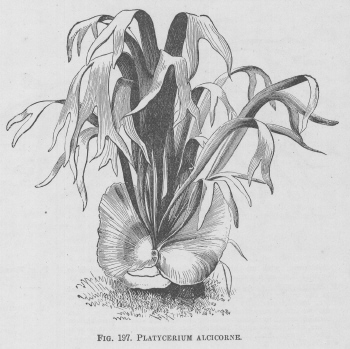
P. alcicorne (elk's-horn).* barren fronds rounded, convex, downy when young, the edge sinuated, the lobes spreading. fertile fronds 2ft. to 3ft. long, clustered, erect, two or three times dichotomous; ultimate divisions ligulate, bluntish, the fruit in the last forks, and at their base, in very irregular patches; under surface covered with thin, cottony down. Temperate Australia, &c., 1808. Green-house. See Fig. 197. The large from, majus, comes from Polynesia.
P. biforme (two-formed). barren fronds very thick, especially towards the base, imbricated, the edge sinuate-lobed. fertile fronds 6ft. to 15ft. long, repeatedly dichotomous from a sub-cuneate disk; barren divisions narrow-ligulate; fertile ones reniform, stalked, 6in. to 8in. broad, the outer edge rounded, entire. East Indies, 1842.
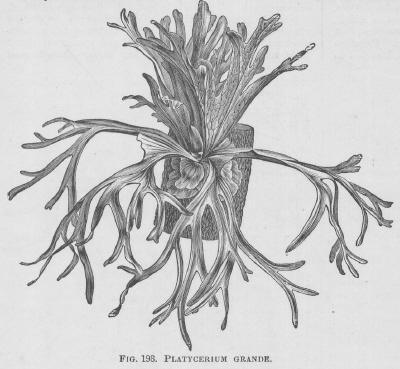
P. grande (grand).* barren fronds very large, sub-orbicular, convex, or the upper ones erect, deeply laciniated with spreading or inflexed divisions. fertile fronds 4ft. to 6ft. long, pendent, in pairs, the disk broad-cuneate, with the sorus against the upper edge, occupying the disk only, with an elongated, dichotomously-forked division beyond it at each corner. North Australia, 1828. See Fig. 198.
P. Hillii (Hill's).* fronds about 1 1/2ft. long, flabellately branched in the upper third, the part just below the branching about 8in. broad, gradually tapering downwards into short stipes; mature fronds very thinly covered with white stellate hairs. sori forming small, roundish or oblong spots at the base of the ultimate lobes, or about an equal distance from the apex if there is no side lobe. Queensland, 1878. Allied to P. alcicorne. (G. C. n. s., x. 74, 75.)
P. Stemmaria (Stemmaria). A synonym of P. aethiopicum.
P. Wallinchii (Wallinck's).* barren fronds deeply lobed, with inflexed, forked divisions. fertile fronds in pairs, pendent, each in two divisions, in each of which the cuneate disk has a rounded upper edge, occupied by a sorus; from either side of the sorus a one-forked division is produced; under surface matted with yellowish woolly pubescence. Malay Peninsula, 1860.
P. Willinckii (Willinck's).* barren fronds erect, sub-orbicular, lobed. fertile fronds in threes, elongated, drooping, narrowly cuneate, dichotomously cut up into narrow-ensiform lobes. sori occupying the terminal lobes. Java, 1875. (G. C. n. s., iii. 56.)