Important: Safety Warning
This page states that certain wild plants are safe to eat. Its identifications and edibility claims are more than a century old and in some cases simply wrong, and deadly look-alikes exist for many edible species. Never eat a wild plant on the strength of this text.
This information has been left in for historical purposes but should not be acted upon.
Podophyllum
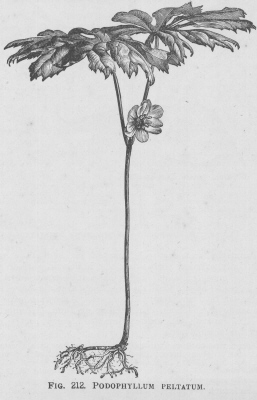
(from pous, podos, a foot, and phyllon, a leaf; alluding to a fancied resemblance, in the five to seven-parted leaf, to the foot of some web-footed animal). Duck's-foot. ORD. Berberideae. A small genus (three species) of hardy perennial herbs, with creeping rootstocks and thick, fibrous roots; one is a native of North America, the second of the Himalayas, and the third (not yet introduced) of Formosa, &c. Flowers white, solitary, terminal, shortly pedunculate, nodding; sepals six; petals six or nine. Berry indehiscent. Leaves peltate, palmately nerved and lobed; cauline ones one or two. The species thrive in moist, marshy, peat borders, in a shady situation. Propagated by division, and by seed.
P. Emodi (Emodi).* fl. 1in. to 1 1/2in. across; sepals very deciduous; petals six, sometimes four, obovate-oblong; peduncle terminal in bud, then apparently supra-axillary. fr. red, 1in. to 2in. long, ellipsoid, edible. l. two, vernal, alternate, long-petiolate, plaited and deflexed in venation, orbicular, 6in. to 10in. across, three to five-lobed to the middle or base; lobes cuneate, acutely serrated. Stem or scape, 6in. to 12in. high, erect. India. (G. C. n. s., xviii. 241.) P. peltatum (peltate). American Mandrake; May Apple. fl. nearly 2in. broad; bud with three green bractlets, which early fall away; stamens twelve to eighteen. fr. ovoid, 1in. to 2in. long, sweet, and slightly acid, edible, ripe in July. l. five to nine-parted; lobes oblong, rather wedge-shaped, somewhat lobed and toothed at the apex. Flowerless stems terminated by a large, round, seven to nine-lobed leaf, peltate in the middle, like an umbrella. Flowering stems bearing two one-sided leaves, with the stalk fixed near the inner edge. h. 6in. to 12in. North America, 1664. The leaves and roots of this plant are poisonous. (B. M. 1819; B. M. Pl. 17.)