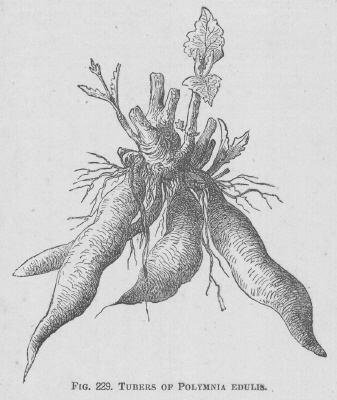
Polygonum
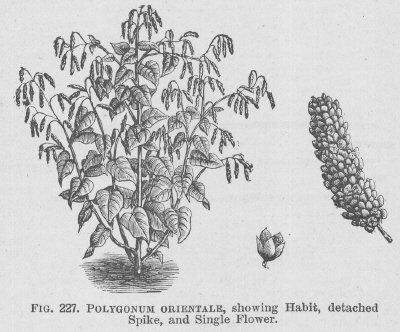
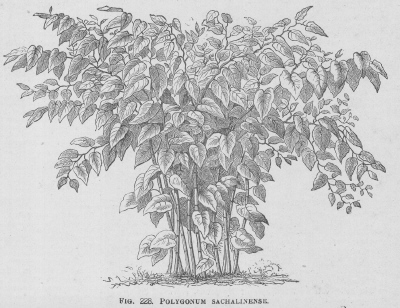
(from polys, many, and gonu, a knee-joint; referring to the numerous joints of the stem). Knot Grass or Weed. ORD. Polygoneae. A very large genus (nearly 150 species) of handsome, annual or perennial, greenhouse or hardy herbs or (rarely) under-shrubs, of variable habit, found throughout the world, but rare within the tropics. Flowers usually fasciculate, some times so lax that they may be regarded as axillary; perianth funnel-shaped or campanulate, usually coloured with five somewhat unequal segments; pedicels articulated above or below the middle. Leaves alternate, with ochreate stipules. A great number of the species, twelve of which are British, are of no ornamental value whatever, but the following are desirable and worth growing. They are of the easiest possible culture in any ordinary garden soil, but they well repay generous treatment and a good position. P. cuspidatum and P. sachalinense are specially noteworthy and fine amongst hardy plants where space is allowed them to develop. The annuals are raised from seeds, sown in the open border, in spring, or raised in heat, and afterwards planted out. This latter plan is the best with such species as P. orientale, which, in a warm, sunny spot, in good, rich soil, forms a very fine plant. The perennials are increased by dividing the rootstocks.
P. affine (kindred).* fl. rosy-red, in dense spikes, freely produced throughout the autumn. l. few and narrow. h. 6in. to 8in. Nepaul, 1822. A very ornamental, hardy perennial. (B. M. 6472.) SYN. P. Brunonis (L. J. F. 117; L. & P. F. G. 37).
P. alpinum (alpine). fl. snow-white, panicled. Summer. l. ovate-lanceolate, deep green, with ciliated margins. h. 3ft. to 4ft. Alps, 1816. This very desirable perennial is particularly useful where cut flowers are much in request.
P. amphibium (amphibious). Willow Grass. fl. bright red, in dense, ovate spikes. July. l. lanceolate. Stem round, leafy. North temperate and Arctic regions (Britain). An aquatic or semi-aquatic perennial herb. When o growing in water, the petioles are very long and the stipules smooth; whilst the terrestrial form has short petioles and hispid stipules. (Sy. En. B. 1242.) P. amplexicaule (stem-clasping).* fl. bright rose-red or white, in solitary or twin racemes 2in. to 6in. long. September and October. l. cordate-ovate or cordate-lanceolate, long-acuminate, the lower long-petioled, the upper sessile and amplexicaul. Stems 2ft. to 3ft. high, from a strong, woody rootstock. Himalayas. Hardy perennial herb. (B.M. 6500.)
P. Bistorta. Bistort or Snakeweed. fl. reddish-pink, in a dense, terminal, erect, solitary spike. June to September. l. chiefly radical, large, oblong or ovate-obtuse, glaucous beneath, on long petioles. h. 1 1/2ft. Europe (Britain), North and West Asia. Perennial herb. (Sy. En. B. 1243.)
P. Brunonis (Brown's). A synonym of P. affine.
P. capitatum (headed). fl. pink, small, growing in dense, round heads, on long stalks, from the upper leaf axils l. ovate or elliptical, 2in. long, green, marked with dark V-shaped bands, extending from the midrib at the centre to the base of the leaf. Stems slender, diffuse, hairy, rooting. North India. A pretty little, cool greenhouse or half-hardy, perennial herb, with a neat, spreading habit. (Ref. B. 11.)
P. chinense foliis-pictis (painted-leaved Chinese). l., some green, others purple, and all with a V-shaped mark, margined on the inside with a dark line of deep purple or blackish-green. China to India, &c. Hardy perennial herb. (B.M. 5238.)
P. compactum (compact).* fl. white, in erect racemes. September. l. somewhat crimped. h. 2ft. Japan, before 1875. This is probably a variety of P. cuspidatum; but it is very distinct in the way implied by its name, being more compact and rigid, and not more than half so tall. The leaves, too, are of a much darker colour. Its habit is, however, less graceful than that of p. cuspidatum. Hardy perennial herb. (B. M. 6476.) P. cuspidatum (pointed-leaved).* fl. creamy-white, forming drooping, feathery panicles, 4in. to 5in. long, succeeded by scarlet fruits. Summer. l. large, somewhat distichous, oval-oblong, cuspidate, petiolate. h. 4ft. to 8ft. Japan, 1825. A hardy perennial herb, of quick growth, and having long, slender stems. It is best grown as an isolated specimen. (B. M. 6503; L. & P. F. G. i., p. 137; R. G. 291.) SYN. P. Sieboldii (of gardens).
P. filiforme variegatum (thread-like, variegated).* l. large, drooping, oval-oblong, finely splashed or marbled with pale green and yellow. Japan, 1865. A hardy perennial, fine for subtropical gardening.
P. orientale (Eastern).* fl. deep rosy-purple or white, in long, drooping racemes, which are both terminal and axillary. August. l. large, ovate-acuminate, pilose or nearly glabrous. h. 3ft. to 4ft., or sometimes nearly 10ft. East Indies, 1707. A large and free-growing, hardy annual, with very robust stems, which give off numerous, lateral shoots.(B. M. 213.)
P. sachalinense (Sachalin).* fl. of a delicate greenish-yellow colour, in axillary racemes; bracts ovate, long-pointed. Late summer. l. broadly ovate or ovate-oblong, acuminate, the lower ones sub-cordate at the base, upper ones truncate, all with glaucous and prominently-veined under-surfaces. Stem erect, strong. h. 10ft. to 12ft. Sachalin Islands, 1869. A strong-growing, hardy perennial, differing chiefly from P. cuspidatum in its angular, striated stems. This plant luxuriates in a moist subsoil near the margin of water, and is a desirable subject for naturalising in semi-wild places. (B. M. 6540.)
P. Sieboldii (Siebold's). A garden synonym of P. cuspidatum.
P. sphaerostachyum (round-spiked).* fl. blood-red, pendulous, in a broad, cylindric, globose spike. Autumn. l. 3in. to 5in. long, linear, linear-oblong, or lanceolate, acute, crispidate crenulate, glabrous and glaucous or pubescent beneath; radical ones stalked, cauline ones sessile. Alpine and sub-alpine Himalaya. Hardy. (B. M. 6847.) P. tomentosum (tomentose). fl. clear rosy-pink, in erect, spikeformed panicles at the tips of the branches. l. large, oblong-lanceolate, very much attenuated at the apex, covered on both surfaces, but especially beneath, with greyish hairs. India, 1876. A half-hardy or greenhouse perennial. (R. G. 810.)
P. vaccinifolium (Whortleberry-leaved).* fl. bright rose, freely produced in long, nearly round spikes. Late summer and autumn. l. smooth, ovate or elliptic, attenuated at both ends, the margin slightly revolute, bright green, sometimes tinged with red above, pale beneath. Stems much-branching, woody, prostrate. Himalaya, 1845. A hardy perennial, one of the most useful plants for rockwork in cultivation. (B. M. 4622.)