Prunus
(the ancient Latin name of the Plum). Plum. ORD. Rosaceae. This genus, as arranged, by Bentham and Hooker, in the "Genera Plantarum," includes Amygdalopsis, Amygdalus, Armeniaca, Ceraseidos, Cerasus, Laurocerasus, and Persica (making a total of about eighty species); but, for horticultural purposes, it is, in most cases, deemed proper to treat these genera separately in this work. The species are evergreen or deciduous, hardy trees or shrubs, mostly natives of the temperate regions of the Northern hemisphere, some being found in tropical America, and rarely in tropical Asia. Flowers white or pink, solitary, corymbosely fasciculate, or disposed in racemes; calyx deciduous; tube obconical, urceolate, or tubulose; limb of five imbricated lobes; petals five, inserted at the mouth of the calyx; stamens fifteen to twenty, inserted with the petals. Fruit a fleshy, often edible drupe, containing a smooth or rugose, indehiscent or two-valved, one-seeded stone. Leaves alternate, simple, frequently serrulated, complicate or convolute in vernation. The species may be propagated by seeds, which should be stratified in autumn, and sown in the following spring. They may also, with the varieties, be readily increased by budding and grafting. P. cerasifera is well adapted for planting to form hedges; the use of the Blackthorn or Sloe, P. spinosa, is also well known for this purpose. P. divaricata, invariably one of the earliest-flowering shrubs or small trees, is exceedingly ornamental, when the flowers escape destruction by spring frosts. P. Pissardii has dark foliage, which is effective when associated with light-coloured or yellow-leaved shrubs. The double-flowered form of P. sinensis may be grown in pots, and used effectively for greenhouse decoration. It may readily be propagated, in spring, from cuttings of tolerably firm shoots; and when plants are established, and their wood well ripened, they force well. P. triloba may also be grown in pots, but the best position for this species is against a wall with a south or west aspect. For culture and varieties of the common Plum, see Plum, where will be found further information applicable to the propagation and cultivation of other species of Prunus. All the species described below are hardy, deciduous trees or shrubs, except where otherwise stated.
P. americana (American). American Wild Yellow or Red Plum. fl. white; pedicels few or several, in simple, umbel-like clusters. April. fr. yellow, orange, or red, 1/2 in. to 2/3 in., or in cultivated states 1in. or more, in diameter, of a pleasant flavour, but with a tough and acerb skin. l. ovate or somewhat obovate, conspicuously pointed, coarsely or doubly serrated, glabrous when mature. h. 8ft. to 20ft. North America. SYN. P. nigra (B. M. 1117).
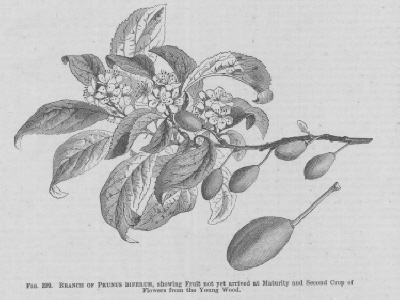
P. biferum (twice-bearing). fl. large, white, appearing in April on the old wood, in small, umbellate clusters, those appearing later at the ends of young shoots in short racemes. fr. stalked, regularly elliptic; skin smooth, glossy, tinted or spotted with violet-rose. l. broadly oval, narrowed to both ends. A vigorous-growing tree, of garden origin. For its peculiarity in bearing flowers and fruit at the same time, this curious Plum is worth growing. (R. H. 1875, 415.)
P. cerasifera (Cherry-bearing).* Cherry or Myrobalan Plum. fl. white, nearly solitary, or fascicled on short branches, pedunculate; calyx lobes reflexed; petals obovate-oblong or orbicular. April. fr. red, globose, with yellow flesh and an ovoid, acute stone. l. elliptic-obovate, acute, serrulated, glabrous beneath. Branches unarmed; branchlets highly glabrous. Native country uncertain. (B. M. 5934.)
P. Cerasus Bigarella (Bigarella). A synonym of Cerasus duracina.
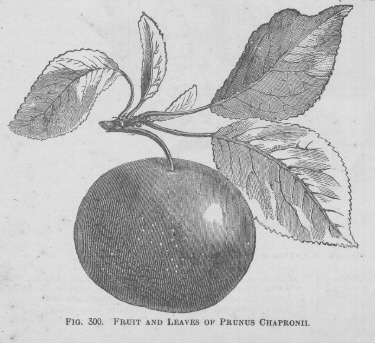
P. Chapronii (Chapron's). fr. shining red, dotted with white, of an agreeable acid flavour, depressed globose, about 1 1/2in. in diameter. l. elliptic, acute, serrulate. 1883. A small, bushy tree, of unknown origin. See Fig. 300. (R. H. 1881, 467.)
P. dasycarpa (thick-fruited.) This is the correct name of the plant described in this work as Armeniaca dasycarpa.
P. divaricata (spreading).* fl. white, 3/4in. in diameter, solitary; calyx lobes recurved; petals rounded, concave. April. fr. yellow, 1in. long, ellipsoid or globose. l. contemporary with the flowers, lanceolate, becoming more ovate and often sub-cordate at base, 2in. long, glabrous beneath; petioles slender. h. 10ft. to 12ft. Caucasus, &c., 1822. A small tree, branching at the base. (B. M. 6519.)
P. domestica (domestic).* Common Plum. fl. white, usually solitary. Spring. fr. variable, both in shape and colour. l. ovate-lanceolate, convolute. Branches unarmed. h. 20ft. England. There are numerous varieties of this species, including double-flowered and variegated-leaved, many of which are desirable for plantations, hedges, &c. The species and its varieties are deciduous. (Sy. En. B. 410.)
P. ilicifolia (Holly-leaved). A synonym of Cerasus ilicifolius.
P. insititia (grafted). Black Bullace; Bullace Plum. fl. white; peduncles twin. Spring. fr. globular, black or white. l. ovate or ovate-lanceolate, convolute, downy beneath. Branches spiny at the apex. h. 10ft. to 15ft. Europe (Britain), Asia. A small, deciduous tree, with spreading, round branches. (Sy. En. B. 409.)
P. laevis (smooth). A synonym of Persica vulgaris laevis. P. Laurocerasus. A synonym of Cerasus Laurocerasus. P. maritima (sea-loving). Beach Plum. fl. white, borne on softly pubescent pedicels. April. fr. purple or crimson, with a bloom, globular, 1/2in. to 1in. in diameter, the stone very turgid. l. ovate or oval, finely serrated, softly pubescent beneath. h. 2ft. to 3ft. North America, 1800. Plant straggling.
P. Mume (Mume). fl. appearing early, usually twin, sub-sessile. fr. globose, very slightly velvety; stone oval, convex, foveolate. l. rounded at base, obovate or broadly elliptic, long-cuspidate, argutely duplicate-serrated, glabrous or mostly pubescent-scabrous beneath. Japan. (S. Z. F. J. ii.)
P. nigra (black). A synonym of P. americana.
P. paniculata (paniculate). A synonym of Cerasus pseudocerasus.
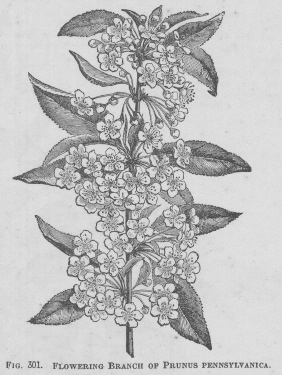
P. pennsylvanica (Pennsylvanian). American Wild Red Cherry. fl. white, many in a cluster, on long pedicels. May. fr. light red, globose, very small, with thin and sour flesh; stone globular. l. oblong-lanceolate, pointed, finely and sharply serrated, shining, green and smooth on both sides. Bark light reddish-brown. h. 20ft. to 30ft. North America, 1773. See Fig. 301.
P. Persica (Persica). A synonym of Persica vulgaris.
P. Pissardii (Pissard's).* fl. white. March and April. fr. small, or hardly medium size, somewhat oval, deep red or purple, even when very young; flesh pulpy, sugary when mature. l. glabrous, broadly oval, red-purple. Twigs glossy black. A handsome, ornamental shrub or small tree, introduced to Europe, a few years ago, from Persia. (R. H. 1881, 190.)
P. pumila (dwarf). This is the correct name of the plant described in this work as Cerasus depressa.
P. salicifolia (Willow-leaved). fl. white, small, growing singly or several together. April. fr. about the colour and size of those of P. cerasifera, l. obovate, acuminate, glossy and rugulose above, quite smooth beneath, finely serrulated, the serratures minutely glandular; petioles short, without glands. China.
P. sinensis (Chinese).* fl. white, small, disposed in clusters along the shoots. Spring. fr. small, globular, deep red, of peculiar but agreeable flavour. l. oblong, acuminated, serrulated. China, 1869. Of this species, there are varieties with rose and double white flowers. See Fig. 302. P. spinosa (spiny). Blackthorn or Sloe. Fl. white, rising before or with the leaves, on solitary peduncles. Spring. fr. black, roundish, sour or acid. l. obovate-elliptic or ovate, smooth except when young, sharply and doubly serrated. h. 10ft. to 15ft. Europe (Britain). A well-known, deciduous shrub, with spinose branches. (Sy. En. B. 408.) There are two or three varieties, including double-flowered, variegated-leaved, large-fruited, and egg-shape-fruited, forms.
P. subhirtella (somewhat hairy). fl. white, with a red calyx, small, borne three or four together on the short growths. l. small, ovate, acuminate. Branches pendent, with slender branchlets. h. 10ft. Japan, 1868. An elegant tree. SYN. Cerasus pendula.
P. triloba (three-lobed).* fl. white or rose, generally double, large. Early spring. l. three-lobed, appearing after the flowers. h. 6ft. China, 1857. A very handsome, early-flowering shrub. SYNS. P. virgata (of gardens), Amygdalopsis Lindleyi (F. d. S. xv. 1532; R. G. 1863, 53 and 54), Prunopsis Lindleyi (R. H. 1883, 367).
P. virgata (twiggy). A synonym of P. triloba.