Psidium
(from Psidion, the Greek name of the Pomegranate). Guava. ORD. Myrtaceae. A genus of stove trees, shrubs, or rarely subshrubs, often villous or tomentose, all (perhaps with the exception of one inhabiting tropical Eastern Asia) natives of tropical and sub-tropical America, one being broadly cultivated over the tropical regions of the globe. Upwards of 100 species have been enumerated, but, according to the authors of the "Genera Plantarum," this number may be considerably reduced. Flowers rather large or rarely small, on axillary or lateral, one to three (rarely many) flowered peduncles, cymose; calyx tube campanulate, urceolate, or pear-shaped, scarcely exceeding the ovary, or more or less produced; lobes of limb four or five; petals four or five, spreading. Berries globose, ovoid, or pyriform, crowned with the calyx limb, or naked; seeds few or many, sub-reniform, hard. Leaves opposite, penniveined. The species thrive best in a compost of sandy, fibry loam, to which a small quantity of leaf mould and dried cowdung should be added; the drainage must be perfect. Propagated by cuttings of the young shoots, getting a little firm at their base, inserted in sand, under a bell glass, in bottom heat. The following species are occasionally seen in cultivation:
P. aromaticum (aromatic). fl. white, solitary. July. fr. yellow, globose, four-celled, hardly the size of a cherry. l. oblong, acuminated, glabrous. Branchlets tetragonal. h. 5ft. to 8ft. Guiana and Cayenne, 1779. Shrub.
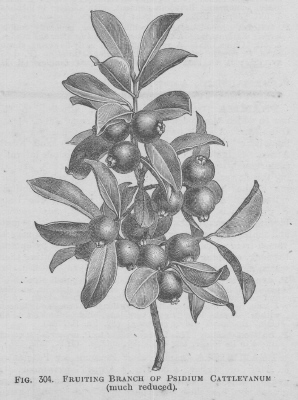
P. Cattleyanum (Cattley's).* fl. white; pedicels opposite, one-flowered, hardly equal in length to the petioles. May. fr. of a fine deep claret-colour, rather large, nearly spherical, growing in the axils of the leaves; the skin has much the consistence of that of a fig, but is thinner; the interior is a soft, fleshy pulp, purplish-red next the skin, but becoming paler towards the middle, and at the centre is quite white; it is juicy, and in consistence is much like a strawberry, to which it bears some resemblance in flavour. l. obovate, coriaceous, quite glabrous. Branchlets terete, glabrous. h. 10ft. to 20ft. Brazil, 1818. Shrub. (B. M. 2501; B. R. 622.) P. cordatum (heart-shaped). fl. white; peduncles one or few-flowered; anthers roundish. May to July. l. ovate or oval, rounded at both ends or cordate at base, sessile or shortly petioled, the veins obsolete or inconspicuous. Branches compressed-cylindrical. h. 5ft. West Indies, 1811. Shrub. (B. M. 1779.)
P. Guava (Guava). fl. white; peduncles three to eight, or many-flowered, downy. June. fr. yellow, globose, somewhat astringent, with an agreeable odour. l. oval or oblong, elliptic, puberulous beneath. Branches tetragonal. h. 6ft. to 15ft. West Indies, &c., 1692. A low tree. SYN. P. pomiferum.
P. polycarpum (many-fruited). fl. white; calyx closed in the bud; anthers oblong; peduncles usually three-flowered. May. l. chartaceous, elliptical or oval-oblong, puberulous beneath; primary veins costate, prominent beneath; secondary ones reticulated and transverse. Branchlets compressed-cylindrical, pubescent. h. 3ft. Trinidad, 1810. Shrub. (B. R. 653.)
P. pomiferum (Apple-bearing). A synonym of P. Guava.
P. pyriferum (Pear-bearing). Common Guava. fl. white, solitary. June. fr. yellowish when ripe, pear-shaped; pulp sweet, aromatic, and pleasant. This low tree is simply a form of P. Guava. (B. R. 1079.)