Important: Safety Warning
This page states that certain wild plants are safe to eat. Its identifications and edibility claims are more than a century old and in some cases simply wrong, and deadly look-alikes exist for many edible species. Never eat a wild plant on the strength of this text.
This information has been left in for historical purposes but should not be acted upon.
Pteris
(the old Greek name for a fern, used by Dioscorides, so called from pteron, a feather; in allusion to the shape of the fronds). Brake or Bracken. Including Amphiblestra, Campteria, Doryopteris, Heterophlebium, Litobrochia, Ornithopteris, Poesia, Pycnodoria, &c. ORD. Filices. A rather large, cosmopolitan genus (upwards of seventy species) of stove, greenhouse, or hardy ferns, including plants of almost every kind of venation and division. Sori marginal, linear, continuous, occupying a slender, filiform receptacle in the axis of the involucre; involucre the same shape as the sorus, usually membranous, at first quite covering it, at length more or less spreading. Except where otherwise indicated, the undermentioned species require stove treatment. For culture, &c., see Ferns.
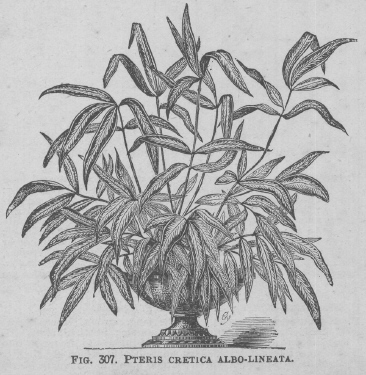
P. albo-lineata (white-lined). A form of P. cretica.
P. aquilina (eagle-like). Adder-spit; Common Bracken or Brake Fern; Eagle Fern. rhiz. wide-creeping, stout, subterraneous. sti. 1ft. or more long, strong, erect, straw or pale chestnut-coloured. fronds 2ft. to 4ft. or more long, 1ft. to 2ft. broad, subdeltoid; uppermost pinnae simple; those next in order lanceolate, cut nearly or quite to the rachis into triangular or linear pinnules; the lowest pinnae long-stalked, 1ft. or more long, with ample, lanceolate pinnules, the latter cut down to the rachis into numerous lanceolate segments, which are again fully pinnate; largest entire ultimate divisions 1in. long, 1/6in. broad; rachis and both surfaces sometimes pubescent. Involucre double, or the inner one obsolete. Ubiquitous (Britain). Many varieties of this species have been found, but they are not constant in cultivation.
P. a. esculenta (edible). Edible Fern of Tasmania. In this variety, the ultimate divisions are narrower than in the type, and not contiguous, and are suddenly decurrent at the base, so that the bases are connected by a narrow lobe. Southern hemisphere, 1850. Greenhouse. The glutinous, underground rhizome of this variety is eaten by the aborigines. SYN. P. esculenta. Other varieties calling for mention are: glabra, a smooth, and lanuginosa, a woolly form.
P. arguta (sharply-notched).* sti. 1ft. or more long, strong, erect, bright straw-coloured or reddish-brown. fronds 1ft. to 3ft. long, 1ft. or more broad; terminal pinna 6in. to 9in. long, 1 1/2in. to 2in. broad, lobed nearly to the rachis, the lobes slightly toothed when barren; pinnae several on each side, similar to the terminal one, the lowest forked, or with one or two similar smaller pinnules from the base on the lower side. sori not usually extending beyond the lower half of the lobes. Madeira, &c., 1778. Green house.
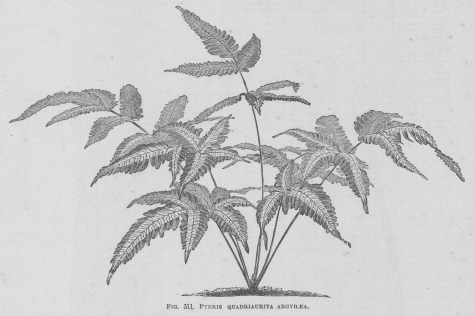
P. argyraea (silvery). A variety of P. quadriaurita.
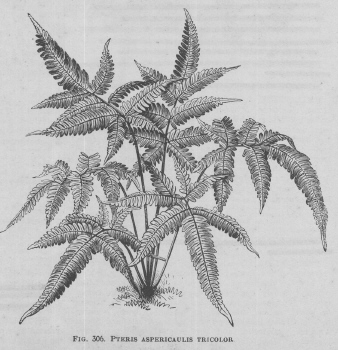
P. aspericaulis (rough-stalked).* rhiz. erect. sti. rough, purplish when young. fronds 1 1/2ft. long, glabrous, pinnate; lowermost pinnae bipartite, nearly sessile, and opposite; pinnae deeply pinnatifid or pinnate, attenuated, adnate towards the apex; segments linear falcate, decurrent at base, rather obtuse, slightly crenulate, minutely white-dotted beneath. sori chiefly on the middle parts of the segments. India. The variety rubro-nervia has a deep purplish-red rachis and midrib.
P. a tricolor (three-coloured). fronds, when young, a beautiful red; when fully developed, a rich, deep green, with attractive silvery markings along the sides of the midribs, which are red. SYNS. P. quadriaurita tricolor (B. M. 5183), P. tricolor.
P. atrovirens (dark green). sti. 1ft. long, prickly. fronds 1ft. to 2ft. long; terminal pinna 6in. to 9in. long, 2in. to 3in. broad, cut nearly to the rachis into numerous linear lobes, which are slightly toothed when barren; lateral pinnae in numerous opposite pairs, the lowest sometimes 1ft. long, the lobes similar to those of the terminal one; the lowest pair forked, with a similar, smaller pinnule on the under side; rachis of the pinnules occasionally prickly beneath. sori not reaching to the points of the segments. Guinea Coast and Angola. SYN. P. spinulifera.
P aurita (eared). A form of P. incisa.
P. biaurita (two-eared). sti. 1ft. to 2ft. long, strong, erect, straw-coloured. fronds with a terminal pinna, 6in. to 12in. long, 1 1/2in. to 2in. broad, cut nearly to the rachis into numerous spreading, linear-oblong lobes, 1in. or more long; lateral pinnae similar to the terminal one, the lower ones 2in. apart, and usually once-forked. sori continued to the apex. Tropics, &c., 1824. SYN. Campteria biaurita. P. nemoralis is, according to Mr. Baker, not distinct from this species.
P. brasiliensis (Brazilian). A form of P. denticulata.
P. collina (hill-loving). A synonym of P. palmata.
P. comans (hairy). sti. 1ft. or more long, erect. fronds bipinnate; terminal pinna 1ft. or more long, cut nearly to the rachis into long-linear lobes, which are sometimes 4in. long, 1/2in. broad, suddenly decurrent at base, bluntly toothed when barren; lateral pinnae in a few opposite pairs, sometimes 1 1/2ft, long, 6in. broad, the lowest sometimes slightly compound at the base. sori falling short of the apex of the segments. East Indies, 1860. SYN. Litobrochia comans. The variety undulata differs from the type in having blunter ultimate segments, with an undulated edge.
P. concinna (neat). A form of P. mutilata.
P. crenata (scolloped). A synonym of P. ensiformis.
P. cretica (Cretan).* sti. 6in. to 12in. long, erect, wiry, straw-coloured or pale brown. fronds 6in. to 12in. long, 4in. to 8in. broad; lateral pinnae usually in two to six opposite, sessile paris, the upper one sometimes a little decurrent, 3in. to 6in. long, 1/8in. to 3/4in. broad, the sterile ones much the broadest and spiny-toothed, the lower pairs often cleft down nearly to the base into two or three linear pinnules. Involucres pale, membranous. Temperate and tropical regions, &c., 1820. Greenhouse. There is a variegated form of this species, albo-lineata.(B. M. 5194.)
P. crispa (curled). A garden synonym of P. straminea. P. Currori (Curror's). sti. stout, erect, staw-coloured. fronds ample, several feet long, 2ft. or more broad; terminal pinna subhastate, deeply lobed; lateral pinnae numerous, the upper ones 4in. to 6in. long, 1in. broad, with deeply and broadly sinuated margins, the lowest in opposite, sessile pairs, 2in. to 3in. distant from the next pair, 16in. long, 5in. broad, cut nearly to the rachis in the lower part into lanceolate, sinuated lobes, 3in. deep; rachis and both surfaces slightly hairy. sori in numerous patches, which are sometimes interrupted and very short. Western tropical Africa. (H. S. F. 140.) SYN. Litobrochia Currori.
P. decussata (decussate). A synonym of P. patens.
P. deflexa (deflexed). sti. 2ft. or more long, strong, erect, straw-coloured or reddish-brown. fronds 2ft. to 4ft. long; terminal pinna 6in. to 9in. long, about 1in. broad, long-pointed, and with numerous oblong-linear lobes on each side, which are nearly cut down to the rachis, about 1/2in. long, 1/4in. broad, the barren ones sharply spinulose-serrated; lateral pinnae numerous, similar, the lower ones stalked; lowest pair much larger than the others, often more than 1ft. long, 6in. to 9in. broad, with numerous pinnate pinnules on each side. sori reaching nearly to the apex of the segments. Brazil, 1844.
P. denticulata (slightly-toothed). sti. about 1ft. long, slender, wiry. fronds 1ft. to 2ft. long, 8in. to 12in. broad; upper pinnae simple, linear, 4in. to 6in. long, united at base, finely spinulose-serrate when barren; those next in order cut to the rachis and forked; lower ones often pinnatifid, with several linear pinnules, especially on the lower side. sori not quite reaching the points of the pinnules. Tropical America, 1824 SYN. Litobrochia denticulata. brasiliensis is a form with broader, more compound pinnae. P. elata (tall). sti. 2ft. to 3ft. long, erect, naked, straw-coloured. fronds ample, tripartite; terminal pinna 1ft. to 1 1/2ft. long, cut nearly or quite to the rachis into numerous linear lobes on both sides, which are 3in. to 5in. long, the barren ones spinulose-serrate; upper lateral pinnae 6in. long, not cut to the rachis; lower ones equalling the terminal one; lateral divisions of the frond deltoid. sori falling short of the points of the segments. Tropical America. SYN. Litobrochia elata.
P. elegans (elegant).* sti. 1ft. or more long. fronds 6in. to 12in. long, deltoid-cordate, pedate-bipinnatifid; divisions close, reaching nearly to the midrib; terminal and upper lateral ones lanceolate, entire, 1in. to 1 1/2in. broad; lower ones with one to four lanceolate pinnules on the lower side, usually none from the upper. sori continuous from base to tip of the divisions. South Brazil. A common species in cultivation. SYN. Doryopteris nobilis.
P. ensiformis (sword-shaped). sti. 3in. to 6in. long, slender, erect, straw-coloured, fronds 6in. to 12in. long, half as broad, with a long terminal pinna and two to four pairs of lateral ones; those of the fertile frond slightly compound, the central portion 2in. to 4in. long, 1/4in. or less broad, entire; upper pinnae of the barren frond decurrent, the lower ones sub-deltoid, cut down to the rachis below into two to six obovate-oblong, sharply-toothed pinnules, which are often nearly 1/2in. broad. India, &c. SYN. P. crenata (H.S.F.127A).
P. esculenta (edible). A synonym of P. aquilina esculenta.
P. fallax (deceptive). A synonym of Pellaea intramarginalis serratifolia.
P. felosma (heavy-smelling). A form of P. quadriaurita. P. flabellata (fan-shaped).* sti. 1ft. or more long, strong, erect, straw-coloured. fronds 1ft. to 3ft. long, 1ft. or more broad; terminal pinna 6in. to 12in. long, 2in. to 3in. broad, numerously lobed nearly to the rachis, the lobes linear, 1in. to 2in. long, barren ones finely serrated; lateral pinnae similar to the terminal one, the lowest with one to three similar, smaller pinnules from the base on the lower side. sori narrow, continuing along nearly the whole length of the segments. South Africa. This species is closely allied to P. arguta.
P. Gheisbreghtii (Gheisbreght's). A variety of P. laciniata.
P.glauca (glaucous). A synonym of Pellaea glauca.
P. gracilis (slender). A synonym of Pellaea gracilis.
P. grandifolia (large-fronded). sti. 6in. to 12in. long, erect, straw-coloured, clothed below with rusty-woolly scales. fronds 1ft. to 2ft. long, simply pinnate; pinnae linear, erecto-patent, entire, sessile or the lower ones stalked, the lower ones 6in. to 12in. long, hardly 1in. broad. sori often continuous along the whole length of the pinnae. Tropical America. (H.S.F. 113B.) SYN. Litobrochia grandifolia. The variety vittata has nearly free veins.
P. hastata (spear-shaped), of Thunberg. A synonym of Pellaea calomelanos.
P. heterophylla (variable-fronded).* sti. wiry, slender, erect, straw-coloured, fronds 6in. to 12in. long, 3in. to 6in. broad, ovatedeltoid, tripinnate; pinnae all, except two or three of the highest, compound, the lowest deltoid, with the pinnules again pinnatifid; ultimate segments of the barren frond ovate, sharply and deeply toothed, cuneate and entire at base, about 1/2in. long, 1/4in. broad, those of the fertile frond about 3/8in. long, 1/8in. broad, the tip sterile and toothed. Involucres broad, pale, membranous. West Indies and Brazil, 1820. (B. M. 4925.) P. Hookeriana (Hooker's). sti. 6in. to 12in. long, erect, pale. fronds 9in. to 12in. long, 6in. to 9in. broad, with a long, linear, entire, terminal pinna; lateral pinnae two to six pairs, sessile, opposite, entire, the largest about 6in. long and 3/4in. broad, the lowest forked at the base. sori slightly intramarginal; involucres narrow, brownish. Ceylon.
P. incisa (cut). Bat's-wing Fern. sti. stout, erect, straw-coloured or bright brown. fronds several feet long, bi-or tri-pinnate; uppermost pinnae simply pinnate, with entire, linear-oblong pinnules; the next with numerous pinnatifid pinnules, 2in to 3in. long, about 3/4in. broad, in opposite pairs, the lowest often quite close to the stem, reduced in size, and their segments dilated; lowest pinnae often very large and compound. sori interrupted or continuous, often reaching the points of the segments. Tropics, &c., 1823. Greenhouse. SYNS.P. Vespertilionis, Litobrochia Vespertilionis. In the form aurita, the lowest pair of pinnules are quite simple, and closely adpressed to the stem at the base of the pinnae.
P. Kingiana (King's). A variety of P. tremula.
P. Kunzeana (Kunze's). sti. 3ft. long, strong, erect, straw-coloured or reddish-brown. fronds ample; terminal pinna 1ft. long, 3in. broad, cut down two-thirds of the way to the rachis into numerous linear, falcate, sharp-pointed lobes, which are slightly spinulose-serrate when barren; lateral pinnae in numerous, nearly opposite pairs, the lower ones stalked, equalling or exceeding the terminal one and similarly pinnatipartite; lowest pair of pinnae large, deltoid, compound below, with smaller, similar pinnules. sori falling short of the tips of the segments. Tropical America. (H. S. F. 139.) SYN. Litobrochia Kunzeana.
P. laciniata (torn). sti. 1ft. or more long, stout, erect, very hairy. fronds 2ft. to 4ft. long, 1ft. to 2ft. broad, deltoid, tripinnatifid, the upper part not cut down to the rachis, with oblong, entire lobes, 1/2in. to 3/4in. long, 3/8in. broad; lower pinnae 1ft. to 1 1/2ft. long, 6in. to 9in. broad, with numerous lanceolate pinnules on each side, which are cut down to a broadly-winged rachis into lobes about 1/2in. long and 1/4in. broad; rachis and both surfaces hairy. sori lateral in the ultimate lobes, but not reaching the apex. West Indies. (H.S.F. 132B.) P. Gheisbreghtii is a less hairy, Mexican variety.
P. leptophylla (slender-fronded).* sti. 6in. to 9in. long, erect, firm, straw-coloured. fronds 9in. to 12in. each way, deltoid; a few of the upper pinnae simple, the largest of these under 1in. long, 1/8in. broad, decurrent at base, strongly spinulose-serrate when barren; central pinnae lanceolate, caudate, pinnatifid, with numerous similar pinnules; lowest pinnae deltoid, with pinnules often 2in. long, and again pinnatifid. sori not reaching the tips of the segments. Brazil, 1824.(H. G. F. 23.) SYN. Litobrochia leptophylla.
P. longifolia (long-fronded).* sti. 6in. to 12in. long, stout, erect, pale, scaly below. fronds 1ft. to 2ft. long, 4in. to 9in. broad, oblong-lanceolate, attenuated below; pinnae sessile, often twenty to thirty on each side, 3in. to 6in. long, 1/8in. to 3/8in. broad, linear, entire, truncate or cordate, or sometimes slightly auricled at base; rachis sometimes scaly. Involucres yellowish-brown, membranous. Tropics, 1770.
P. longipes (long-stalked). sti. 1ft. to 2ft. long, erect, straw-coloured. fronds tripartite; terminal pinna about 6in. long, 1in. broad, with numerous erecto-patent, linear-oblong lobes, which are cut nearly to the rachis; lateral pinnae numerous on each side, not more than 1in. apart, the longest simple one about 6in. long, the lowest compound, sometimes nearly as large as the central portion of the frond, 1ft. long, 6in. broad. sori falling short of the tips of the segments. India. SYN. P. pellucens.
P. macilenta (thin). sti. 6in. to 12in. long, straw-coloured, brownish below. fronds 1ft. to 3ft. long; terminal pinna 4in. to 8in. long, cut down nearly to the rachis into several deeply-sinuated and toothed, oblong lobes on each side; lateral pinnae numerous, the upper ones 2in. apart at the base, cut down to the rachis below into deeply-lobed, deltoid pinnules; lower pinnae 1ft. long, very compound. sori not reaching the points of the segments. New Zealand. A well-marked species. SYN. Litobrochia macilenta.
P. macroptera (large-winged). sti. 1ft. or more long, naked, erect, straw-coloured or brownish. fronds 2ft. or more long, 1ft. to 1 1/2ft. broad, cut nearly to the rachis in the upper part into numerous linear lobes, the lowest of which are 6in. to 9in. long and 1/2in. broad, with about 1in. between them at the base, the point gradually narrowed and very faintly toothed when barren; lateral pinnae few, often only a single pair, like the terminal one, but smaller. sori not reaching the tips of the segments. Brazil. SYN. Litobrochia macroptera.
P. Milneana (Milne's). sti. strong, erect, yellowish-brown fronds 2ft. to 3ft. long, with numerous pinnae on each side, cut down throughout nearly to the rachis into linear-oblong, falcate lobes, 1/2in. to 3/4in. long; lowest pinnae 6in. to 9in. long, 1in. to 1 1/2in. broad, with a single similar, but smaller, pinnule at the base on the lower side. sori falling short of the sub-entire tips. Solomon Isles, 1865. SYN. P. tripartita var. (H.S.F. 138B).
P. moluccana (Moluccan). sti. strong, erect, dark brown. fronds 2ft. to 3ft. long, oblong, simply pinnate; pinnae in numerous, nearly opposite pairs, linear, cuneate at base, spinulose-serrate towards the point, the largest 1ft. to 1 1/2ft. long, 1/2in. to 3/4in. broad. Involucres narrow, membranous. Malayan and Solomon Isles, 1880. (H.S.F. 112B.) P. mutilata (mutilated). sti. slender, erect, bright brown or straw-coloured, those of the fertile frond longest (9in. to 12in.) and strongest. fronds about 6in. each way, deltoid, with a linear, entire point, several entire pinnae, but the lowest pair lanceolate-deltoid, 4in. to 6in. long, 3in. to 4in. broad, with several linear, erecto-patent pinnules on each side, divisions of the barren frond shorter and broader than those of the fertile one, not serrated, but mucronate at the point, and cartilaginously bordered. Involucres narrow, membranous. West Indies. (H.S.F. 131A.) P. concinna is, according to Mr. Baker, a more compound form than usual.
P. nemoralis (grove-loving). A form of P. biaurita.
P. paleacea (scaly). sti. 2ft. to 4ft. long, strong, erect, reddish-brown or straw-coloured, brown-scaly, becoming muricated. fronds 1ft. or more each way; terminal pinna 6in. to 9in. long, 1 1/2in. broad, consisting of numerous contiguous, falcate, linear lobes, 1in. or more long, blunt, not serrated; lateral pinnae similar, closely placed (not 1in. apart at base), imbricated, the lowest with several large similar pinnules from the under side; rachises scaly. sori extending along the whole length of the edge. St. Helena.
P. palmata (hand-shaped).* sti. 1ft. or more long, erect, chestnut-brown. fronds 4in. to 9in. each way; barren ones with a broad, undivided centre, and five or more triangular lobes, of which the terminal one is the largest, the lowest deflexed, and the sinuses rounded; fertile fronds cut down to a broadly-winged centre into linear lobes, of which the upper ones are entire, and the lower ones again cut on the lower side, the longest entire ones 3in. to 4in. long, 1/4in. to 3/8in. broad; costae black. sori continued to the tips of the segments. Tropical America, 1821. (H. G. F. 22.) SYNS. P. collina, Doryopteris palmata.
P. patens (spreading).* sti. 1ft. or more long, erect, chestnut-brown. fronds 3ft. to 4ft. long, 2ft. or more broad; terminal pinna 6in. to 9in. long, 1 1/2in. to 2in. broad, with several narrow-linear lobes on each side, which are widened suddenly on both sides within a short distance of the base, the barren ones slightly serrated; lateral pinnae numerous, similar, but larger, sometimes 1 1/2ft. long, 2in. broad, the lowest forked. sori continued nearly to the ends of the segments. Ceylon, &c. (H. S. F. 137.) SYN. P. decussata.
P. pedata (footed).* sti. blackish, those of the barren fronds 3in. to 4in. long. fronds, barren ones 1in. to 2in. each way, with an almost entire, triangular apex, and a bluntly-divided, lateral lobe on each side; fertile ones 4in. to 6in. each way, cut nearly to the rachis into several pinnae on each side, of which the upper ones are linear and entire, 1in. to 1 1/2in. long, the lowest pair much larger than the others, and with several pinnules on the under side, the lowest of which are again pinnatifid; costae dark-coloured. sori reaching the tips of the segments. Tropical America. (B. M. 3247.) SYN. Doryopteris pedata.
P. pellucens (pellucid). A synonym of P. longipes.
P. podophylla (duck's-foot-fronded). sti. 4ft. or more long, 1/2in. to 3/4in. thick at base, muricated below, straw-coloured. fronds ample, ternately divided; terminal pinna 6in. or more long, 1in. to 1 1/2in. broad, cut two-thirds of the way to the rachis into numerous linear-oblong, falcate lobes, which are finely spinulose-serrate when barren; lateral pinnae in numerous, closely-placed, nearly opposite pairs, 6in. to 9in. long, 1in. to 1 1/2in. broad, with numerous lobes similar to those of the terminal one; lateral divisions of the frond like the terminal one, but smaller. sori continuous, falling short of the tips of the segments. West Indies, &c. (H. G. F. 55.) SYN. Litobrochia podophylla.
P. pungens (prickly). sti. 1ft. or more long, pale or brownish, prickly. fronds 1ft. to 2ft. long, 1ft. to 1 1/2ft. broad; terminal pinna sometimes 1ft. long, upwards of 2in. broad, with a long, entire point, and numerous close, parallel, linear-oblong lobes, 1in. to 1 1/2in. long, which extend nearly to the rachis, and are finely toothed towards the point when barren; lateral pinnae similar to the terminal one, the lowest 2in. to 3in. below the next above it, once-forked, with a smaller, similar pinnule. sori not reaching the apices of the segments. West Indies. If the muricated stipe be not of a permanent character, this cannot, according to Mr. Baker, be regarded as distinct from P. quadriaurita.
P. pyrophylla (Pyrus-fronded). A form of P. quadriaurita.
P. quadriaurita (four-eared).* sti. 1ft. to 2ft. long, strong, erect, straw-coloured or brownish. fronds 6in. to 3ft. long, 4in. to 12in. or more broad; terminal pinna cut nearly to the rachis into numerous close, parallel, linear-oblong lobes, 1/2in. to 1in. long, the barren ones entire or slightly serrated; lateral pinnae 6in. to 12in. or more long, 1in. to 2in. broad, the lowest 1in. to 2in. apart at the base, usually again compound, with one or two similar, but smaller, pinnules branching from them at the base on the lower side. sori often continuous along the whole margin of the segments. Tropics. The following are regarded, by Mr. Baker, as mere forms of this species: P. argyraea, a variety with a more or less distinctly marked band of white down the centre of the frond P. felosma, P. pyrophylla, P. sulcata.
P. q. tricolor (three-coloured). A synonym of P. aspericaulis tricolor.
P. sagittata (arrow-shaped). This name is applied to a form of Pellaea cordata.
P. sagittifolia (arrow-fronded).* sti. 4in. to 6in. long, erect, blackish. fronds 4in. to 6in. long, 2in. to 3in. broad, hastate-lanceolate or sub-triangular, the basal lobes triangular, acuminate, directed downwards, the margins entire, midrib blackish. sori continued all round the margin. Venezuela to Brazil.(H. E. F. 39.) SYN. Doryopteris sagittifolia. P. scaberula (slightly scabrous).* rhiz. wide-creeping. sti. 6in. to 12in. long, strong, flexuous, bright reddish-brown, scabrous. fronds 1ft. to 1 1/2ft. long, 6in. to 9in. broad, lanceolate or ovate-lanceolate, tri-or quadri-pinnatifid; lower pinnae lanceolate-deltoid, 4in. to 9in. long, cut down to the rachis into numerous lanceolate pinnules on each side, which are again cut down into oblong, toothed segments, about 1/4in. long. sori copious, when mature occupying nearly the whole segment, except the midrib. New Zealand. Greenhouse.(H. S. F. 93A.)
P. semipinnata (half-pinnate). sti. 1ft. or more long, strong, erect, bright chestnut-brown. fronds 1ft. to 1 1/2ft. long, 6in. to 9in. broad, ovate-lanceolate; upper part cut nearly to the rachis into numerous close, entire, linear lobes, the lowest of which are 1 1/2in. to 3in. long; lower two-thirds of the frond with six or eight pairs of opposite, distantly-placed pinnae, the largest of which are 3in. to 6in. long, with a long, linear, entire point, and a broad, entire wing on the upper side of the rachis, but the lower side with several linear pinnules, 1in. to 2in. long. Involucres membranous. East Indies, &c.(H. G. F. 59.)
P. serrulata (saw-edged).* Spider Fern. sti. 6in. to 9in. long, erect, wiry, pale or brownish. fronds 9in. to 18in. long, 6in. to 9in. broad, ovate, bipinnatifid; main rachis margined with a wing, which gradually narrows downwards; pinnae in six or more distant, opposite pairs, the upper ones simple, often 4in. to 6in. long, 1/8in. to 1/4in. broad, the lower ones with several long-linear, erecto-patent pinnules on each side, the edges of the barren ones spinulose-serrulate. Involucres narrow-membranous. China, 1770. Greenhouse. The following varieties of this species are enumerated by Mr. B. S. Williams:
P. s. angustata (narrow). An elegant form, with pinnae very much narrower than in the type, and crested at each point.
P. s. Applebyana (Appleby's). A superb garden variety; pinnae long and narrow, pendent, furnished with a much-divided and fringed tassel at all the points. P s. corymbifera (corymb-bearing). This handsome variety is also of garden origin. It has erect fronds, with much-shortened pinnae, forming dense, crisp, corymbiferous heads.
P. s. cristata (crested). An erect garden form, with the apex of each pinna beautifully crested.
P. s. c. semi-fastigiata (slightly fastigiate). The finest variety of all; it has a compact, dense habit, and forms a very large and broad-crested corymb at the apex; the lower portion of the frond is developed as in the normal form.
P. s. polydactyla (many-fingered). In this variety, the points of the pinnae are several times forked or fingered, and frequently much lengthened out.
P. s. tenuifolia (slender-fronded). A form with narrow pinnae.
P. spinulifera (spine-bearing). A synonym of P. atrovirens.
P. Stelleri (Steller's). A synonym of Pellaea gracilis.
P straminea (straw-coloured). sti. 1ft. to 1 1/2ft. long, and, as well as the rachis, stramineous. fronds narrow-deltoid, 1ft. to 1 1/2ft. long; pinnae ascending, the lowest much the largest, deltoid, with compound lower pinnules on both sides, the others lanceolate, 1 1/2in. to 2in. broad, cut down to the rachis or a narrow wing; segments lanceolate, narrowed to a point, the sterile ones sharply and closely dentate, upper ones growing gradually shorter. sori falling short of the tips of the segments. Chili. SYN. P. crispa (of gardens).
P. sulcata (furrowed). A form of P. quadriaurita.
P. tremula (trembling).* sti. 1ft. or more long, strong, erect, bright chestnut-brown. fronds 2ft. to 4ft. long, 6in. to 2ft. broad, the apex with a few, closely-placed, linear, entire lobes, which are obliquely decurrent at the base, the largest hardly more than 1in. long; upper pinnae simply pinnate, with numerous similar lobes on both sides, the largest about 6in. long, above 1in. broad; lower pinnae often very compound, sometimes 1ft. long and bipinnate. sori copious, sometimes filling up the whole segment except the midrib. Australia and New Zealand, 1820. Greenhouse.(H. S. F. 120B.) The variety Kingiana has its ultimate segments large, sometimes 1 1/2in. long, nearly 1/4in. broad, not toothed.
P. tricolor (three-coloured). A synonym of P. aspericaulis tricolor.
P. tripartita var. (thrice-parted). A synonym of P. Milneane
P. umbrosa (shady).* sti. 1ft. to 1 1/2ft. long, erect, bright reddish-brown. fronds 1ft. to 2ft. long, 6in. to 12in. broad, with a terminal pinna and usually six to nine lateral ones, all of which run down the stipe at the base, so as to form a broad wing, which reaches nearly or quite to the next node; upper pinnae 3in. to 6in. long, 1/4in. to 1/2in. broad, finely serrated in the sterile portions; lower ones forked, or with two or four erecto-patent, linear pinnules. Australia, 1823. Greenhouse. (H. S. F. 130B.)
P. undulata (waved). A variety of P. comans.
P. Vespertilionis (bat-winged). A synonym of P. incisa.
P. vittata (striped). A variety of P. grandifolia.