Puccinia
(named after an Italian botanist, Puccini). A large genus of parasitic Fungi belonging to the order Uredineae. In this order, the Fungi grow, with a doubtful exception or two, on living plants, into which they push their jointed mycelium. The reproduction is always effected by conidia, or spores, produced on branches from the mycelium, and never inclosed in larger cells, as in Mould or in Pyrenomycetes (which see). The conidia are usually crowded together in masses, which, for a time, are protected by the epidermis of the host-plant; but this generally becomes torn, and the conidia are exposed. The conidia are known to be of two, or even more, forms in almost all the species in the order, and these forms are usually very different from one another, affording very striking examples of the phenomenon called "pleomorphism." So different are they, that several genera were established on what are now known to be only forms of the same Fungi as had already received names under other forms; hence, much confusion has arisen, and this is only gradually being overcome by careful and exact observations. Even yet much doubt exists as to the true relationships of many of the species. An attempt will be made to render this part of the subject more clear by describing what is now generally accepted as the life-history of two or three of the more important species of the genus Puccinia. The various forms of conidia alternate with one another in the cycle of development of each species, and experiments have led to the belief that some species of Puccinia live on different host-plants in the different stages of the cycle.
The forms of reproductive organs met with in the most complete cycles in the genus, e.g., that believed to exist in P. graminis, are three or four in number. The names employed to denote them were formerly given to them when they were regarded as different species, belonging to genera distinct from that now recognised as the more mature condition (viz., Puccinia). The forms are as follows: 1. The Aecidium (old generic name), or Cluster-cup, in the form of a cup, at first closed, afterwards open above. The sides of the cup (peridium) consist of a single layer of cells. The hollow is filled with closely-packed, erect branches, arising from the mycelium, each of which bears a chain or row of rounded, or angular, thin walled, yellow cells, which separate from one another, and germinate readily, pushing out a mycelium thread. On a leaf of the host-plant, the mycelium pushes through a stoma, and produces the Fungus anew. The Cluster-cups usually stand, as the name denotes, in clusters, on thickened, discoloured tissues of the hosts, though, occasionally, they are scattered over the green parts without causing much discoloration. They generally stand on young stems and on the lower surface of leaves (see Fig. 318), but may be on the upper surface also. On the same mass of tissue as the cups, but, in general, on the other side of the leaf, small, flask-shaped spaces (spermogonia) open by narrow mouths (see Fig. 319). They are lined with branches of mycelium, bearing extremely small, rod-like bodies (spermatia), which do not seem to act as spores, and whose use to the Fungus is doubtful.
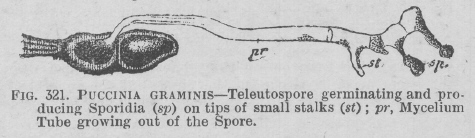
2. The Uredo (old generic name), is often developed on the same mycelium as the former, but later; it may grow only on a different host-plant. The uredospores are not inclosed in a cup, or peridium, but are formed on the surface of convex masses of mycelum. These masses are usually covered and protected by the epidermis of the host-plant till the spores are ripe, when the epidermis bursts. The spores are produced singly on erect branches (see Fig. 320), and, when ripe, fall off, and then are hardly to be distinguished from aecidiospores. Like the latter, they germinate almost at once, and push their mycelium into the tissues of the host-plant through the stomata. 3. The Teleutospore (from teleutaia, final, and spora; so called because it is the final form in the cycle) is sometimes called the Pucciniospore; but this name is less suitable, as other genera besides Puccinia produce such spores. These are, in most cases, produced on the same substratum as the uredospores. but later in the season; and they are most often developed only in late summer. They grow on erect footstalks or branches, to which they usually remain long united, and they are considerably thicker-walled and darker than the others, from which also they differ in form (see Fig. 320). They may be one-celled (Uromyces), two-celled (Puccinia and Gymnosporangium), or three-or more-celled (Triphragmium and Phragmidium). The teleutospores, for the most part, remain for a considerable time without germinating, often continuing unchanged all winter. On germinating (see Fig. 321), a mycelium tube is pushed out from each cell, or only from one. These tubes often become divided near the tip, by cross walls, into a row of cells, from each of which a small branch arises, and bears, at its tip, a small, rounded or oval body, called a sporidium. The sporidia produce a new mycelium, which penetrates into suitable host-plants, and frequently gives rise to aecidia in them. Occasionally, two forms of teleutospores occur in the same Fungus, e.g., one-celled and two-celled in Puccinia mixta. In most of the species, the cycle is not so complete as the above; and, in fact, it has been traced, as yet, in but few species. As has already been said, most cryptogamic botanists believe that some of the species live, during part of the cycle, on one food-plant, and during the other part on another. Such species are said to be heteroecious (from heteros, different, and oikos, a home). Those that live on a single food-plant during the whole cycle are said to be autoecious (from autos, the same, and oikos).
Puccinia is readily distinguished, in the perfect condition, from other genera of Uredineae by the teleutospores being free from one another and two-celled; or, at least, there are two-celled spores, associated, in a few species, with three-or more-celled abnormal exceptions, or with a one-celled from, much like the teleutospores of the allied genus Uromyces. The two-celled spores vary in length of stalks, in forms, and in surface-markings of the cells, &c.; and on these characters we must depend for distinguishing the species. The genus, in the systems in most frequent use on the Continent, is broken up into sections differing from one another in the completeness of the cycle, so far as known, and in other minor peculiarities.
Owing to the parasitic habit of the very numerous species included in the genus, there are few genera of Fungi more directly injurious; and a considerable number grow on and damage garden and field produce. The injurious effects are due, in some cases, to the abstraction of nourishment by the mycelium of the Fungus from the food-cells of the plant, and to the injury done to the epidermis by the spore-masses tearing it off the tissues beneath. These tissues, in consequence, cease to do their part in supplying food to the plant. In a smaller number of cases, the plant is stimulated by the Fungus to a local over-production of diseased cellular tissue. This is peculiarly the case in the aecidium stage, e.g., on Barberry, on Gooseberry, and on Mints. In some cases, plants may suffer extremely, and may even be killed by the Fungi (e.g., P. Malvacearum almost extirpated Hollyhocks in many districts a few years ago), or, if not killed, may be much distorted by them; e.g., Mints attacked by the aecidium of P. Menthae, Anemones bearing P. Anemones, &c. In many cases, the plants are simply weakened, without marked distortion; e.g., cereals affected badly by the red and black rusts (P. graminis and P. straminis), and Onions overgrown by P. mixta. Some do not seem to injure very greatly the plants affected by them, but this is exceptional. Their growth and distribution are favoured by moisture, which promotes the formation and germination of the spores.
Remedies. As usual with internal parasites, no cure is known for plants, or parts of plants, attacked by these Fungi; hence, remedies must be directed to the prevention of the spread of disease. This is best accomplished by the removal and destruction of the infested structures, where this is possible. Where the attack is very serious, e.g., in the case of Hollyhocks and of Onions, it is good policy to sacrifice the entire crop, if necessary, to preserve that of the following year from infection. As already said, moisture favours the distribution of the Fungi, and the soil should, therefore, be well drained. Lastly, where the hurtful Fungi are believed to be heteroecious, it is well to remove the supposed intermediate host-plant; e.g., in the case of Puccinia graminis of cereals and other grasses, which is believed to live on Barberry-bushes as Aecidium Berberidis, the Barberries should be removed from the neighbourhood of the fields. Yet too much reliance must not be placed on this method, as these Fungi are known to thrive when restricted to the one food-plant.
In the following enumeration of the species of Puccinia falling under the observation of gardeners, those of which only teleutospores are known are first mentioned, and afterwards those of a more complex nature.
1. P. Buxi often forms dark, warty spots, in large numbers, on leaves of Box. Teleutospores alone are known. They are brown, smooth, and oblong or clubshaped. The Box does not, as a rule, seriously suffer.
2. P. Malvacearum is only too well known to most gardeners, because of its ravages on Hollyhocks, Mallows, and allied plants. For an account of the appearances produced, of the history of the Fungus, and of the injury done by it, see Hollyhock Fungus. Only teleutospores are known. They are pale brown, smooth, and pointed at both ends. The plants suffering from the growth of this Fungus seldom recover, and often die in a short time. 3. P. Arenariae belongs to the same group, having, so far as is known, only teleutospores; these are pale yellowish-brown, and slender. They form small, brown masses, often in irregularly-concentric groups, on the leaves of Pinks, and of many wild, as well as garden, Caryophyllaceous plants; but, unless the Fungus is very abundant, the host-plant is seldom endangered by its growth.
4. P. Grossulariae is described as having teleutospores of the ordinary type, and also as possessing an aecidium, known as AE. Grossulariae. The latter is very plentiful in some years, on discoloured spots on leaves and fruits of the Gooseberry, throughout Britain; but the Puccinia has not as yet been recorded as British. The relation of the two forms to one another cannot be yet assumed as fully proved. The aecidium does not, in general, do much harm to the leaves and branches; but, when it grows on the fruits, it renders them useless, and thus, in some years, destroys a considerable part of the crop. It causes the formation of thickened, orange-red patches in the parts affected; in these the cups occur. The patches are usually about 1/4 in. across. The teleutospores are elliptic or clavate, chestnut-brown, and covered with broad, low warts.
5. P. mixta has done very serious harm to Chives (Allium Schaenoprasum), and other species of Allium, including all, or nearly all, the cultivated forms of Onions. It has been observed as hurtful at Shrewsbury, and near Aberdeen. This species of Puccinia has spores of three forms present at one time, viz., a uredospore, formerly called U. Alliorum, and two forms of teleutospores--viz., one a Puccinia (two-celled), of oblong form; and the other one-celled, formerly known as Uromyces Alliorum. Both the latter forms are attached to long stalks, and both are smooth and brown. 6. P. Menthae grows abundantly on the wild species of Mentha, and also on the garden Mints, and on various allied Labiatae. This Fungus possesses all the three forms of spores. The aecidium often grows on the young shoots, and causes marked deformities and stoppage of growth in them; generally, it gives rise to long, dark red or purple patches on which the paler cups are scattered. The uredospores and the teleutospores form small masses, either irregularly scattered or in concentric arrangement. The former spores are pale brown, warty, and rounded; the latter are deep brown, and broadly elliptical with rounded ends.
7. P. Gentianae, in 1885, proved very hurtful to Gentiana acaulis, in Kew Gardens, forming spots of teleutospores as in P. Menthae. They resemble the spores of the latter species in form, but are smooth. The aecidium has not been observed in England.
The heteroecious species of Puccinia are of little importance to gardeners, since they do no harm to garden produce in the strict sense. To the systematic student of this group they are of the greatest interest, because of the many problems connected with their mode of life, and the careful and continued experiments required to permit of referring the various forms to their proper cycles. Much still remains to be done in this group. Several of them are found on grasses in their uredospore and teleutospore stages, but are believed to form their aecidia on other plants, usually on Dicotyledons. Others occur in the two former stages on Sedges (Carex), and in the latter on Dicotyledons. P. graminis, to which reference has already been made, is a well-known "rust" of cereals and of other grasses; its uredospores, formerly called Uredo linearis, being one of the "red rusts," and its teleutospores one of the "black rusts." Its aecidiospores are believed to be Aecidium Berberidis, frequently so common, in the form of orange-red patches, on the leaves of Barberries and of Berberis Aquifolium, in shrubberies and by roadsides. None of the other heteroecious species grow on garden plants, but mention is here made of one or two of the cycles that are now admitted, by those who accept heteroecism, as proved to occur among Uredineae.
P. rubigo-vera. The uredospores (Uredo rubigo-vera) and teleutospores (P. straminis) form "rusts" on grasses; the aecidiospores (AE. asperifolii, AE lycopsoids) live on many species of Boragineae.
P. coronata. The uredospores and teleutospores occur on grasses, the aecidiospores (AE. Rhamni) on species of Rhamnus.
P. poarum. The uredospores and teleutospores occur on Poa annua, P. nemoralis, and P. pratensis; the aecidiospores (AE. Tussilaginis) on Coltsfoot (Tussilago Farfara).
P. Caricis. The uredospores (U. Caricis) and teleutospores (P. striola) occur on species of Carex; the aecidiospores (AE. Urticae) on Nettles.
P. silvatica. The uredospores and teleutospores live on certain species of Carex, the aecidiospores on Dandelion (Taraxacum officinale).