Pyrethrum
(Pyrethron, the old Greek name used by Dioscorides, probably from pyr, fire; referring to the acrid roots of this genus). Feverfew. ORD. Compositae. A genus of mostly hardy, herbaceous perennials, now included, by Bentham and Hooker, under Chrysanthemum. "The distinctive features reside in the presence in Pyrethrum of a pappus, in the form of an elevated membranous border, and in the achenes being angular but not winged" (Lindley and Moore). All the species here described are hardy, herbaceous perennials. For culture, &c., see Chrysanthemum.
P. achilleaefolium (Achillea-leaved).* fl.-heads golden-yellow, almost globular, few, on long stalks, and disposed in loose corymbs; inner scales of the involucre round, white, and transparent at the top. Summer. l. pinnatifid, with pinnate segments, covered with silky down when young, and pubescent when full grown. h. 2ft. Caucasus, 1823. A variety known as pubescens has numerous heads arranged in broad corymbs.
P. corymbosum (corymbose).* fl.-heads white; peduncles corymbose; involucral scales ovate-lanceolate, with fuscous, scarious margins. July. l. pinnatisect; segments lanceolate, pinnatifid, the lobes acute and argutely serrated. Stem erect, angular, branched at apex. h. 1ft. Europe, &c., 1596. (J. F. A. 379, under name of Chrysanthemum corymbosum.)
P. frutescens (shrubby). fl.-heads with white ray fiorets. h. 3ft. Canary Islands, 1699. From this species a great number of varieties have sprung. See also Chrysanthemum frutescens.
P. lacustre (lake-loving). fl.-heads pure white, with a yellow centre, about 2in. across, solitary, terminal and axillary. Late summer. l. alternate, numerous, sessile, ovate-lanceolate, coarsely and irregularly toothed. h. 2ft. to 2 1/2ft. Portugal.
P. parthenifolium aureum (golden Parthenium-leaved).* Golden Feather. A free-growing and well-known, hardy plant, extensively used for carpet beds and edgings. Seeds should be sown, in a gentle heat, during March. The seedlings grow very rapidly, and will be ready for planting out in May or early in June. The flower-buds must be picked off whenever they appear.
P. Parthenium (Parthenium). Common Pellitory or Feverfew fl.-heads with a yellow disk and white ray, disposed in a corymbose panicle. June. l. stalked, compound, flat; leaflets ovate, pinnatifid and toothed. Stem erect. h. 2ft. Europe (Britain). The whole plant has a strong and bitter smell. (F. D. 674, under name of Matricaria Parthenium; Sy. En. B. 715, under name of Chrysanthemum Parthenium). The double-flowered form is largely grown, and is very handsome.
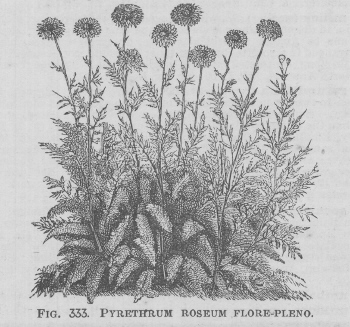
P. roseum (rosy).* fl.-heads larger than those of Chrysanthemum leucanthemum, solitary; ray florets rose-coloured; disk yellow. l. pinnatifid, with decurrent, lanceolate segments of a vivid green colour. h. 1ft. to 2ft. Orient. This species, with one or two others, is important from an economic point of view, as it is largely used in the manufacture of "insect powders." (B. R. 1084; B. M. 1080, under name of Chrysanthemum coccineum.) A large number of varieties, varying much in size and colour of flower-heads, are now grown; there is, too, a large series of double forms, one of which is represented
P. Tchihatchewii (Tchihatcheff's).* fl.-heads with a yellowish disk and a pure white ray, small, solitary, on axillary stalks 3in. to 6in. long. Early summer. l. bipinnatifid, glabrous, dark green, toothed at the base of the petiole. Stems very numerous, rooting. h. 2ft. Asia Minor, 1869. A handsome species, forming a dense tuft. It thrives remarkably well on slopes, dry banks, and under trees where grass will not grow. The seeds, by which it is mostly increased, should be sown in pots or pans, and the seedlings, when large enough, transplanted to their permanent quarters at about 3in. apart. P. uliginosum (moisture-loving).* Great Oxeye. fl.-heads with a yellow disk and a white ray, over 2in. across, on slender and gracefully-bending stalks. August. l. smooth, lanceolate, sharply toothed, about 4in. long, sessile. Stems stout. h. 5ft. Eastern Europe, 1816. A very bold and strong-growing species, having a handsome and distinct appearance when covered with a profusion of its blossoms. It is perfectly hardy, and prefers a rather sheltered situation. (B. M. 2706.)