Pyrus
(the old Latin name used by Pliny for the Pear-tree). Apple, Pear, Service, &c. Including Malus and Sorbus. Cydonia and Mespilus are also included, by Bentham and Hooker, under this genus; but, for horticultural purposes, they are kept distinct in this work. Some of the plants met with in gardens under the generic name of Aronia belong here. ORD. Rosaceoe. A genus comprising from thirty-five to forty species of hardy trees or shrubs, inhabiting the temperate regions of the Northern hemisphere, and the mountains of the East Indies. Flowers in terminal cymes, rarely corymbose, or reduced to one or two flowers; bracts subulate, deciduous; calyx tube urceolate or rarely turbinate; petals five, sub-orbiculate, shortly unguiculate. Fruit fleshy, ovoid, globose, or pyriform. Leaves alternate, deciduous, petiolate, simple or pinnate, often serrate; stipules deciduous. The species are readily raised from seeds, in the way mentioned under Apple and Pear; the garden varieties and weaker-growing, ornamental species are most readily propagated by grafting or budding on the Apple or Pear stocks. Except where otherwise stated, the flowers in the under-mentioned species are white.
P. acerba (sour). A synonym of P. Malus acerba.
P. americana (American). American Mountain Ash. fl. in large, flat cymes. June. fr. bright red, globose, not larger than peas, disposed in clusters. l. odd-pinnate; leaflets thirteen to fifteen, lanceolate, taper-pointed, sharply serrate, with pointed teeth, rather shining above, and scarcely pale beneath. Northern United States, &c., 1782. Tree or tall shrub. (W. D. B. i. 54.) SYN. Sorbus americana.
P. a. microcarpa (small-fruited). This variety is only distinguished from the type by its smaller fruits.
P. angustifolia (narrow-leaved). fl. rose-colour, with distinct styles. April. l. simple, oblong or lanceolate, often acute at the base, mostly toothed, glabrous. h. 20ft. North America, 1750. Tree. "Perhaps a variety of P. coronaria" (Asa Gray). (B. R. 1207; W. D. B. 132.)
P. arbutifolia (Arbutus-leaved).* Choke-berry. fl. white or tinged with purple; cymes woolly. May and June. fr. red or purple, pear-shaped, or, when ripe, globular. l. simple, oblong or obovate, finely serrate woolly beneath. h. 2ft. to 10ft. North America, 1700. Shrub. (B. M. 3668.) SYN. P. floribunda (B. R. 1006).
P. a. melanocarpa (black-fruited). This only differs from the type in its somewhat larger leaves and dark purple fruit. SYN. P. grandifolia (B. R. 1154).
P. Aria.* Aria; White Beam-tree. fl. 1/2in. in diameter, in loose corymbs. May and June. fr. dotted with red, 1/2in. in diameter, sub-globose. l. simple or pinnatifid, rarely pinnate at base, 2in. to 6in. long, very variable, glabrous above, plaited, coarsely and irregularly serrate, deeply lobed, white and flocculent beneath. h. 4ft. to 40ft. Europe (Britain), &c. Bush or small tree. (Sy. En. B. 482.) The following are defined by Mr. Boswell as sub-species: P. A. latifolia (broad-leaved). l. from ovate-oblong to sub-orbicular, more or less lobed, grey-tomentose beneath; lobes deltoid, serrate-acuminate, the nerves five to nine on each side, less prominent beneath. This approaches P. torminalis.
P. A. rupicola (rock-loving). fr. inclining to carmine, 3/4in. in diameter. l. obovate-oblong, lobed above, snow-white beneath; nerves five to eight on each side.
P. A. scandica (Scandinavian). l. less coriaceous than in the type, oblong, deeply lobed or pinnatifid, glabrous above, clothed with a loose grey tomentum beneath; lobes oblong or rounded. Arctic Europe.
P. Aucuparia (fowler's).* Mountain Ash; Rowan-tree. fl. cream-white, 1/3in. in diameter; pedicels and calyces villous; cymes 4in. to 6in. in diameter, compound, corymbose, dense-flowered. May and June. fr. scarlet, with yellow flesh, globose, 1/6in. in diameter. l. 5in. to 8in. long, pinnate; leaflets six to eight pairs, 1in. to 1 1/2in. long, linear-oblong, sub-acute, serrate, pale beneath, and hairy along the midrib and nerves, glabrous beneath when old, or nearly so. h. 10ft. to 30ft. Europe (Britain), Siberia, &c. Tree. (Sy. En. B. 486.) Of this species there are many varieties, the principal of which are: fastigiata, a form of strict, erect, habit; fructu-luteo, with yellow fruit; pendula, with weeping branches; and variegata, with variegated leaves.
P. baccata (berried).* fl., calyx lobes deciduous; peduncles crowded. April and May. fr. yellow, tinged with red, roundish, about the size of a cherry. l. ovate, acute, equally serrated, glabrous, the length of the petioles. h. 15ft. to 20ft. Siberia and Dahuria, 1784. Tree. The pulp of the fruit is used, in Siberia, for making quasar punch. (B. M. 6112.)
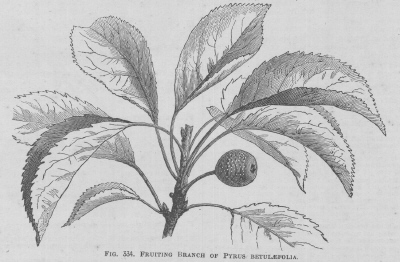
P. betulaefolia (Birch-leaved). fl. disposed in sessile umbels, appearing before the leaves; anthers deep red. fr. brownish, dotted with white, small, sub-globose. l. whitish, on long petioles, elliptic, acute at both ends, serrate, 2in. long, 1in. broad. China, 1879. Shrub. See Fig. 334. (R. H. 1879, 318.) P. Bollwylleriana (Bollwyllerian). fl. disposed in many-flowered corymbs. April. fr. orange-yellow, small, turbinate. l. simple, ovate, coarsely serrated, tomentose beneath and on the buds, when young velvety above, but glabrous in the adult state. h. 20ft. Rhineland, 1786. Tree. (B. R. 1437.) SYN. P. Pollveria (L. B. C. 1009).
P. Botryapium (Botryapium). A synonym of Amelanchier canadensis.
P. Chamaemespilus (Bastard Medlar).* Bastard Quince. fl. reddish. May and June. fr. red, round. l. ovate, serrated, glabrous, clothed, when young, with deciduous down. h. 5ft. to 6ft. Mountainous parts of Europe, &c., 1683. Shrub. SYNS. Cratoegus Chamoemespilus (J. F. A. 231), Sorbus Chamoemespilus.
P. C. Hostii (Host's). fl. rose-pink, in large, terminal corymbs. Spring. l. broad-elliptic, obtuse, often lobed, with serrated margins. h. 10ft. Tree or shrub. SYNS. P. Hostii (Gn., Oct., 1881), Aria Hostii, Cratoegus Hostii.
P. communis (common). Wild Pear. fl. 1in. to 1 1/2in. in diameter; cymes simple. April and May. fr. pyriform, 1in. to 2in. long. l. 1in. to 1 1/2in. long, fascicled on the last year's wood, alternate on the shoots, oblong-ovate, acute, obtusely serrate, more or less pubescent or flocculent below when young; those of the young tree often lobed; petioles slender. h. 20ft. to 40ft. Europe (Britain), &c. Shrub or small tree. (Sy. En. B. 488.) Of this species there are several varieties, the following being the most distinct. See also Pear.
P. c. Achras (Achras). fr. rounded at the base. l. broader than in the type, acute or cuspidate, flocculent on both surfaces when young. Rare.
P. c. Briggsii (Briggs'). A synonym of P. cordata.
P. c. Pyraster (Pyraster). fr. obconical at base. l. shortly acuminate, pubescent below when young.
P. cordata (heart-shaped). fr. very small, globose or pyriform. l. ovate, rounded at base. SYN. P. communis Briggsii (J. B. 180).
P. coronaria (crowned).* Sweet-scented Crab. fl. rose-colour, large, fragrant, few in the corymb; styles woolly, united at base. May. fr. greenish, fragrant. l. simple, ovate, often rather heart-shaped, cut-serrate or lobed, soon glabrous. h. 20ft. North America, 1724. Tree. (B. M. 2009.) P. angustifolia is perhaps a variety of this species.
P. domestica (domestic).* True Service-tree. fl. cream-colour, about the size of those of the Hawthorn, panicled. May. fr. reddish-spotted, obovate, about 1in. long. l. pinnate; leaflets uniform, serrated towards the points, clothed beneath with deciduous, cottony down. h. 20ft. to 60ft. Britain. The fruit of this tree, if tasted in an unripe state, is extremely austere, causing a most painful and durable irritation in the throat; but when mellowed by frost or keeping, it becomes brown, soft, and edible, resembling a medlar, though, to most palates, less agreeable. (G. C. n. s., vi. 649.) SYN. Sorbus domestica (J. F. A. 447).
P. elaeagnifolia (Wild Olive-leaved). fl. white, small; pedicels densely tomentose. May. fr. small, globose, crowned with the prominent calyx. l. lanceolate, oblong-lanceolate, or linear-lanceolate, acute, entire, covered with a whitish, silky pubescence. Asia Minor, &c. An ornamental and distinct bush or small tree.
P. fennica (Finnland). This resembles P. Aria scandica, but has the leaves pinnatifid towards the base; it is regarded, by Boswell, as a hybrid between that plant and P. Aucuparia, of which latter it possesses the sweet-scented flower and other characteristics. Europe (Island of Arran). Tree. SYN. P. pinnatifida (Sy. En. B. 485).
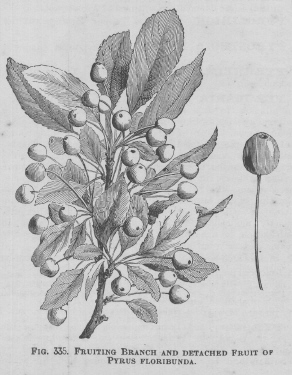
P. floribunda (free-flowering).* fl. beautiful rich rosy-red, very freely produced. May. fr. long-stalked, very small, nearly spherical. l. small. Shoots slender. Japan, &c. One of the most ornamental of hardy shrubs. See Fig. 335. (R. H. 1881, 296, under name of Malus microcarpa floribunda.) P. floribunda (free-flowering), of Lindley. A synonym of P. arbutifolia.
P. grandifolia (large-leaved). A synonym of P. arbutifolia melanocarpa.
P. Hostii (Host's). A synonym of P. Chamoemespilus Hostii.
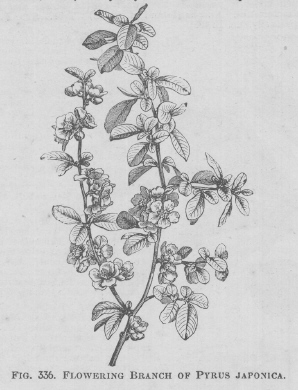
P. japonica (Japanese).* fl. deep scarlet, solitary or two or three together, produced the greater part of the year; calyx glabrous; lobes short, obtuse, entire. fr. green, very fragrant, but not edible, ripening in October. l. oval, somewhat cuneate, crenate-serrate, quite glabrous on both surfaces; stipules reniform, serrated. h. 5ft. to 6ft. Japan, 1815. Deciduous shrub. Under the genus Pyrus, this is the proper name of the plant described in this work as Cydonia japonica. See Fig. 336.
P. leucocarpa (white-fruited). fr. depressed both above and below; eye not sunk; skin dull white or creamy at maturity. 1879. This tree is very remarkable for the peculiar colour of the fruits. See Fig. 337. (R. H. 1879, p. 365.)
P. Malus. Crab; Wild Apple. fl. pink and white, few, 1 1/2in. in diameter; calyx segments woolly; peduncles umbellate. May. fr. yellow, 1in. in diameter, sub-globose, indented at the base. l. 1in. to 2in. long, oblong, rounded, acuminate or cuspidate at the tip, glabrous or downy beneath when young. Branches spreading. h. 20ft. Europe (Britain). Shrub or small tree. See also Apple.
P. M. acerba (sour). fl., tube of calyx glabrous; pedicels slender, glabrous or nearly so. fr. drooping. l., young ones glabrous. SYN. P. acerba.
P. M. Bertini (Bertin's). This form is remarkable for the freedom with which its handsome, brightly-coloured fruits are produced. See Fig. 338. P. M. crataegina (Hawthorn-like). fr. with the calyx segments long and persistent, somewhat resembling some of the large-fruited Thorns. l. long-stalked, like those of the common Crab in outline. See Fig. 339. (R. H. 1881, 291, under name of Malus microcarpa crataegina.)
P. M. mitis (small). fl., pedicels stout, and, as well as the calyx tube and young leaves, pubescent. fr. erect.
P. M. praecox (early). This variety is principally interesting by reason of its long-stalked, persistent fruits. (R. H. 1881, 297, under name of Malus microcarpa proecox.)
P. M. sempervirens (evergreen). Evergreen Crab. fr. short-stalked, round. l. deeply and irregularly toothed, retained on tree sometimes throughout the winter. (R. H. 1881, 296, under name of Malus microcarpa sempervirens.)
P. Maulei (Maule's).* fl. bright red. April. fr. golden-yellow, produced in great abundance, agreeably perfumed, but exceedingly acid to the taste. l. somewhat smaller than those of P. japonica, and plant dwarfer and more compact in habit. Japan, 1874. One of the most beautiful of recently-introduced shrubs. The fruit makes an excellent conserve. Under the generic name Pyrus, this is the correct name of the plant described in this work as Cydonia Maulei. See Fig. 340.
P. nivalis (snowy). Snow-tree. fl. white, large, shortly-stalked. May. fr. rounded or depressed; skin yellowish-green, spotted with brown or red on the sunny side, smooth. l. oboval-obtuse, mucronate, crenated at the summit, or lanceolate, entire, covered with a greyish pubescence. Europe, &c. Tree. (B. R. 1482; J. F. A. ii. 107.)
P. pinnatifida (pinnatifid-leaved). A synonym of P. fennica.
P. Pollveria (Bollwyllerian). A synonym of P. Bollwylleriana. P. prunifolia (Prunus-leaved). Siberian Crab. fl. much resembling those of the common Pear; peduncles pubescent; styles woolly at the base. April and May. fr., when ripe, yellowish, but red on the side exposed to the sun, globose, of an austere taste, decaying like the fruit of the Medlar, and then more palatable. l. ovate, acuminate, serrate, glabrous, resembling those of the Cherry-tree, on long petioles. h. 20ft. to 30ft. Siberia, 1758. Tree. (B. M. 6158.)
P. salvifolia (Sage-leaved). fl. on simple, umbellate pedicels. April and May. fr. large, elongated, very useful for making perry. l. lanceolate, quite entire, tomentose beneath, when young velvety above, but in the adult state glabrous. Branches thick. h. 20ft. to 30ft. Europe. Tree. (B. R. 1482.) This is simply a form of P. nivalis, with somewhat broader leaves.
P. sambucifolia (Elder-leaved). fl. larger than in P. americana; cymes smaller. June. fr. larger, when young ovoid, at length globose. l. oblong-oval or lanceolate-ovate, mostly obtuse or abruptly short-pointed, serrate (mostly doubly), with more spreading teeth, often pale beneath. Excepting in the above characters, this species resembles P. americana, of which it is perhaps a variety. Tree.
P. Sieboldii (Siebold's), of Carriere. fr. regularly top-shaped; stalk long, inserted in a shallow basin; eye slightly depressed; skin russet-brown, with pale spots; flesh white, juicy, with a very peculiar flavour. Japan, 1880. Tree. (R. H. 1880, p. 110.)
P. Sieboldii (Siebold's), of Regel. A synonym of P. Toringo.
P. Simonii (Simon's). fl. numerous, in compact corymbs. Spring. fr. yellow, somewhat spherical, 2in. in diameter. l. cordate-ovate, furnished with bristly teeth. China, 1872. A vigorous tree, with upright branches. (R. H. 1872, 28, Fig. 3.) P. sinensis (Chinese). Sandy Pear; Snow Pear. fl. white. April. A tree differing from the European Pear in its "longer, greener branches; larger, more lucid, and almost evergreen leaves; insipid, apple-shaped, warted, very gritty fruit; and a calyx the inside of which is destitute of the down that is found in all the varieties of the European Pear" (Lindley). Very conspicuous in spring, by reason of the glossy, bronzy-red tints of the young leaves. China, 1820. (B. R. 1248; G. C. n. s., iv. 457.)
P. spectabilis (showy).* fl. pale red, large, when open semi-double; buds of a deeper hue; umbels sessile, many-flowered; petals ovate, unguiculate; styles woolly at base. April and May. l. oval-oblong, serrated, glabrous, as well as the calyx tube. h. 20ft. to 30ft. China, 1780. Tree. (B. M. 267.)
P. s. Kaido (Kaido). fl. before expansion dull vinous-red; the interior when expanded blush-white, and the exterior blush at the edges, the centre wine-red; very abundant, large. fr. numerous, said to be edible after becoming bletted. Japan, 1874.
P. Toringo.* Toringo Crab. fl. white or faintly rosy. May. fr. very small, long-stalked. l. simple or lobed, often almost compound, and much resembling those of some of the Crataegus on the young barren shoots. Japan. Tree or shrub. See Fig. 341. (R. H. 1881, 296, under name of Malus microcarpa Toringo.) SYN. P. Sieboldii (of Regel).
P. T. Ringo (Ringo). A free-flowering, ornamental bush or small tree, with, generally, three or four-celled fruits. Leaves generally more incised than in the type. (R. H. 1881, 297, under name of Malus microcarpa Ringo.)
P. torminalis (griping). Wild Service. fl. numerous, 1/2in. in diameter. April and May. fr. pyriform or sub-globose, greenish-brown dotted. l. 2in. to 4in. long, oblong-ovate or cordate, six to ten-lobed, when mature glabrous on both surfaces; lobes triangular, acuminate. h. 10ft. to 50ft. Europe (Britain), North Africa. Tree.
P. ussuriensis (Ussuri). fl. white; filaments as long as calyx; styles three, free, glabrous. May. l. broadly oval, pointed, sharply toothed, fading to a fine brownish-red in autumn. Stalk of roundish fruit about the same length as its diameter. h. 20ft. to 30ft. Amurland, &c., 1861. Tree.