Quercus
(the Latin name). Oak. ORD. Cupuliferae. A well-known genus, comprising nearly 300 species, of mostly hardy trees, rarely shrubs. Flowers monoecious, in unisexual, amentaceous or erect, very rarely andro-gynous, sessile or sub-sessile spikes; males in catkins, with usually six, sometimes ten to twelve stamens; females solitary, inclosed in imbricating bracts or scales, with a more or less perfect three-celled ovary, very rarely four or five-celled. Nut (glans or acorn) fixed to, or included within, a cup; seed, by abortion, usually solitary. Leaves alternate, annual or perennial, entire, toothed, or lobed, membranous or coriaceous, penniveined. As acorns do not long retain their germinative powers, it is best to sow them soon after they are ripe. It is of little use trying to import from, or export to, distant countries seeds of any of the species unless these are packed tightly in damp clay or earth. The curious variegated and other forms of the common Oak, &c., must be propagated by grafting. See also Oak. A selection from the introduced species and their varieties is given below. They are hardy trees, except where otherwise stated. The flowers are usually produced in spring, and the nuts shed in the autumn.
Q. acuta (acute-leaved). fl., catkins flexile, shorter than the leaves, pendulous, solitary or fasciculate; female spikes short. fr., cup hemispherical, with concentric rings; nut ovoid or ellipsoid, apiculate, thrice exceeding the cup. l. acute or obtuse at base, elliptic or oblong, abruptly acuminate, entire or undulatecrenate towards the apex, 2in. to 4 1/2in. long, 3/4in. to 2in. broad; young ones fulvous-tomentose, older ones glabrous; petioles about 1in. long; stipules 2/3in. long, narrow-linear, pilose at back. Japan. Tree or shrub. Of this evergreen species there are two varieties in gardens: albo-nervis, with white-veined, and roseonervis, with red-veined, leaves. (W. & F. 85.) SYN. Q. Buergeri.
Q. Aegilops. Aegilops, Vallonea, or Velani Oak. fl. greenish-white. fr., cup very large, hemispherical, with lanceolate, elongated, spreading scales; nut brown, very ornamental. l. ovate-oblong, with bristle-pointed, tooth-like lobes, hoary beneath. h. 20ft. to 50ft. Grecian Archipelago, 1731. Evergreen or nearly so. The cups and acorns are exported from the Levant in large quantities, being in great demand for tanning purposes. (K. E. E. 7.) SYN. Q. Ungeri (K. E. E. 13). Of this species, there are two varieties: latifolia, with rather broader leaves, and pendula, with drooping branches.
Q. agrifolia (scabby-leaved). Enceno Oak. fl., catkins longer than the leaves. fr., cup turbinate, 1/2in. broad, with adpressed scales, more or less ciliated on their margins; nut 2/3in. to 1 1/4in. long, ovoid-oblong, exserted, acute. l. broadly ovate or oval, subcordate, remotely spine-toothed, 1 1/4in. to 2in. long, seven to eighteen lines broad, chartaceous; adult ones glabrous; petioles 1/4in. long. Young branches pubescent. h. 20ft. California, 1849. Evergreen. (J. H. S. vi. 157.) Q. alba (white). American White Oak; Quebec Oak. fl., catkins slender. fr., cup hemispherical-saucer-shaped, rough or tubercled at maturity, naked, much shorter than the nut, which is about 1in. long, ovoid or oblong, with an edible kernel. l., mature ones 3in. to 6in. long, 1in. to 3in. broad, obovate-oblong, obliquely cut into from three to nine oblong or linear, obtuse, mostly entire lobes, smooth, pale or glaucous beneath, bright green above. h. 60ft. North America, 1724. A large and valuable, deciduous tree. (B. M. Pl. 250; E. T. S. M. i. 145.) In the variety repanda, the leaves are irregularly sinuated or sinuately lobed.
Q. aquatica (aquatic). Water Oak. fr. small; cup saucer-shaped or hemispherical; nut dark brown, globular-ovoid. l. obovate-spathulate or narrowly wedge-shaped, with a long tapering base, and an often obscurely three-lobed summit, varying to oblanceolate, thick, 1in. to 4in. long, 1/2in. to 2in. broad; those on seedlings and strong shoots often incised or sinuate-pinnatifld, then mostly bristle-pointed; petioles rarely 1/4in. long. h. 60ft. to 80ft. North America (near ponds, &c.), 1723. Deciduous. The wood of this species is similar to that of all other North American Oaks.
Q. austriaca sempervirens (evergreen Austrian). A synonym of Q. glandulifera.
Q. Ballota (Ballota). Barbary Oak; Sweet Acorn Oak. fr., scales of the cup usually convex at back; kernel of a mild and agreeable flavour. l. often rounded at base, dentate or entire, very hoary beneath. South-west Europe, &c.
Q. bambusaefolia (Bambusa-leaved). A synonym of Q. salicina.
Q. Banisteri (Banister's). A synonym of Q. ilicifolia. Q. bicolor (two-coloured). Swamp White Oak. fl., catkins pilose. fr. borne on peduncles much longer than the petioles; cup hemispherical, about 1/2in. long, hoary, the upper scales awn-shaped, sometimes forming a mossy-fringed margin; nut scarcely 1in. long, ellipsoid. l. obovate or oblong-obovate, wedge-shaped at base, coarsely sinuate-crenate and often rather pinnatifid than toothed, soft-downy and white-hoary beneath, the main primary veins six to eight pairs, lax and a little prominent. h. 60ft. North America, 1800. Deciduous. (E. T. S. M. 153.) SYN. Q. Prinus tomentosa.
Q. Buergeri (Buerger's). A synonym of Q. acuta.
Q. Catesbaei (Catesby's). Scrub Oak. fr. hemispherical-turbinate half as long as the blackish, ellipsoid nut, with adpressed, slightly silky scales. l. 4in. to 7in. long, 3in. to 6in. broad, shortly petiolate, cuneate at base, oblong, deeply cut into three to five unequal, often falcate or spreading, ovate, acuminate lobes, which are subulate-mucronate at the apex, and also sometimes on the margins, the central one trilobed; young ones pubescent, adult ones glabrous. h. 15ft. to 30ft. North America, 1823. Deciduous.
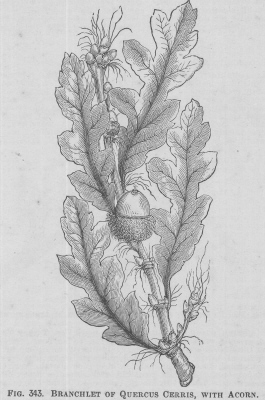
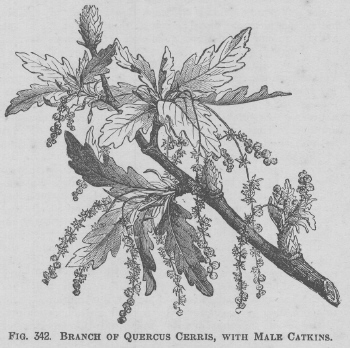
Q. Cerris (Cerris).* Bitter, Mossy-cupped, or Turkey Oak. fl. greenish-white; catkins pubescent, 1in. to 3in. long; females at the sides of a short peduncle. fr. solitary or twin; cup hemispherical, bristly, with elongated, pubescent scales; nut brown, cylindrical, 3/4in. to 1 1/4in. long. l. oblong or obovate, variable, sinuate-toothed or often pinnatifid, with obtuse or acute, often mucronulate lobes, very shortly pilose on both sides, rarely stellate above, on very short petioles; stipules narrow-linear, pilose. Young branches pubescent. h. 40ft. to 60ft. South Europe, &c., 1735.(W. D. B. ii. 92.)
Q. C. austriaca (Austrian). l. on rather long stalks, ovate-oblong, slightly but copiously sinuated, downy and hoary beneath; lobes short, ovate, acute, entire; stipules shorter than the footstalks. h. 40ft. South-east Europe, 1824. (K. E. E. 20, under name of Q. austriaca.) Q. C. crispa (curled). l. somewhat curled at the edges. Bark corky. h. over 60ft.
Q. C. dentata (toothed). A garden synonym of Q. C. subperennis.
Q. C. fulhamensis (Fulham). A garden synonym of Q. C subperennis.
Q. C. Lucumbeana (Lucombe). A garden synonym of Q. C. subperennis.
Q. C. pendula (pendulous). l. narrow, deeply lobed; lobes obtuse or sub-acute. Branches long, pendent or prostrate.
Q. C. subperennis (almost evergreen). fr., scales of the cup ovate, loosely erect. l. variable, sometimes incised, sometimes curled, almost evergreen. This variety is also known in gardens as Q. C. dentatA (W. D. B. 93), Q. C. fulhamensis (G. C. n. s., viii. 139), and Q. C. Lucumbeana.
Q. C. variegata (variegated). In this variety, the leaves are variegated.
Q. cinerea (ashy-grey). Blue Jack; Upland Willow Oak. fl., catkins 1in. to 1 1/2in. long. fr. solitary, sessile or very shortly pedunculate; cup hemispherical-turbinate, with adpressed, silky scales; nut globular, often half as long again as the cup. l. acute or obtuse at base, oblong or obovate-oblong, often obtuse, mucronate, entire, sparsely stellate-hairy above, and thickly so below, 1 1/2in. to 3in. long, six to ten lines broad, on very short petioles. North America, 1789. A small, twisted, sub-evergreen tree, rarely exceeding 30ft. in height, the bark yielding a yellow dye. SYN. Q. Phellos cinerea.
Q. coccifera (berry-bearing). Kermes Oak. fl., males on long, slender peduncles; females sessile, three to seven, on a rachis eight to fifteen lines long. fr. on a short, thick peduncle, sometimes sub-sessile, solitary or twin; cup hemispherical, with velvety, sub-equal scales; nut more or less exserted, rarely included. l. elliptic or oblong, cordate at base, or obtuse or rarely acute, sparsely spiny-toothed or mucronate-serrate, or rarely entire, rigid, on short petioles. Branchlets stellately pubescent. h. 15ft. South Europe, &c., 1683. Evergreen. The bark of this species is used by tanners, and it sustains an insect like the cochineal, which is used as a crimson dye. (K. E. E. 29; S. F. G. 944.)
Q. coccinea (scarlet).* fl., catkins pilose. fr. top-shaped or hemispherical, with a conical, scaly base, seven to nine lines broad, coarsely scaly; nut 1/2in. to 3/4in. long, half or more covered by the cup. l., in the ordinary forms (at least, on full-grown trees), bright green, shining above, turning red in autumn, deeply pinnatifid, 3in. to 8in. long, 2in. to 5in. broad; lobes divergent and sparingly cut-toothed; petioles 1in. to 2in. long. h. 50ft. North America, 1691. Deciduous. (E. T. S. M. 163.)
Q. conferta (clustered).* Hungarian Oak. l. very shortly stalked or almost sessile, 5in. to 7in. or more long, 3in. to 4in. broad, pubescent beneath with stellate hairs, oblong-obovate, tapering gradually to the base, pinnately lobed; lobes oblong, acute, not spine-pointed, entire or slightly lobulate; petioles pilose; stipules longer than the petioles. South-eastern Europe. (G. C. n. s., v. 85.) SYN. Q. pannonica.
Q. cupressoides (Cypress-like). A synonym of Q. pedunculata fastigiata. Q. cuspidata (cuspidate). fl., catkins slender, simple or branched, almost equaling the leaves, slightly erect. fr. in an alternate, ovoid, acute, fulvous-velvety spike, the scales sub-verticillate, connate except at the apex, including the nut. l. acute or obtuse at base, ovate-lanceolate or oblong, acuminate, entire or undulate-serrate, coriaceous, 1 1/2in. to 3 1/2in. long, seven to fifteen lines broad, on short petioles; young ones pilose, adults glabrous. h. 30ft. Japan. Evergreen. (G. C. n. s., xii. 233; S. Z. F. J. 2.) angustitolia and latifolia are respectively narrow-leaved and broad-leaved forms. variegata is a form with prettily variegated foliage.
Q. densiflora (dense-flowered). fl., catkins dense-flowered, equalling or slightly longer than the leaves. fr. one to three on a peduncle shorter than the petioles; cup 1/3in. long, nearly 3/4in. broad, the outer scales silky, the inner ones adpressed, 1/4in. long; nut half-exserted, ovoid, pubescent. l. obtuse or rarely acute at base, oblong, ovate, or obovate-oblong, obtuse or sub-acute at apex; margins cartilaginous, revolute, undulated, entire or nearly so; young ones stellately tomentose on both sides. California, 1865. Semi-evergreen tree or shrub.
Q. Esculus (Esculus). Italian Oak. fr. nearly sessile, solitary or in pairs; cup scaly, hemispherical; nut the size of a small pea. l. scattered, aggregated at the top, ovate-oblong, sinuated, smooth, paler beneath, 2in. to 3in. long, not more than 1 1/2in. broad; segments bluntish, somewhat angular at the base. h. 20ft. to 30ft. South Europe, 1739.
Q. falcata (sickle-shaped). American "Spanish" Oak. fl., catkins slender, pilose, 2in. to 3in. long. fr. solitary or twin, on a very short peduncle; cup saucer-shaped, with a somewhat turbinate base, about half the length of the globose, brown nut, which is four to five lines long. l. obtuse or rounded at the base, very variable, three to five-lobed above, greyish-downy or fulvous underneath, 3in. to 5in. long, 2in. to 3in. broad; lobes prolonged, mostly narrow and more or less scythe-shaped, especially the terminal one, entire or sparingly cut-toothed. North America, 1763. A large, deciduous tree, often 80ft. high; bark rich in tannin.
Q. ferruginea (rusty). A synonym of Q. nigra.
Q. fruticosa (shrubby). A synonym of Q. humilis.
Q. glabra (glabrous). Japanese Oak. fl., male spikes 1 1/2in. to 2in. long, erect, usually solitary, the rachis slightly adpressed-pilose. fr. solitary or fascicled and connate at the sides of a peduncle; cup hemispherical, seven to eight lines broad, with cinereousvelvety, adpressed scales, thrice exceeded by the oblong nut. l. obovate-oblong, long-narrowed to the base, obtuse at apex, acuminate, entire, glabrous, 2in. to 4in. long, 1in. to 1 1/2in. broad, on petioles nearly 1/2in. long. Branches glabrous. Japan, 1879. Evergreen. (G. C. n. s. xiv. 785; S. Z. F. J. i. 89.)
Q. glandulifera (gland-bearing).* fl., catkins filiform, loose, pendulous; female spikes hoary-pubescent, longer or shorter than the petioles, few-flowered. fr. solitary or few to a peduncle; cup hemispherical, five to eight lines broad, with adpressed, puberulous, lanceolate scales; nut ovoid or ellipsoid, twice or thrice exceeding the cup. l. obtuse or rarely acute at base, elliptic, obovate, or lanceolate, acute or acuminate, rarely obtuse, glandular-serrate, 2in. to 5in. long, 3/4in. to 2in. broad; young ones adpressedly silky; adults glabrous above; petioles varying from one to six lines long. Japan, 1870. Evergreen. The plant grown in gardens under this name and figured G. C. n. s., xiv. 714, is probably a hybrid from Q. Cerris subperennis. SYNS. Q. austriaca sempervirens, Q. sclerophylla (of gardens).
Q. glauca (glaucous). fl., catkins loose-flowered, diffuse, solitary or fasciculate, nearly 2in. long, the rachis tomentose. fr. solitary or twin, on a very short peduncle; cup hemispherical, four to five lines long, with five to seven concentric, silky lamellae; nut ovoidacute, about eight lines long. l. acute or slightly obtuse at base, ovate-lanceolate or oblong, acuminate, serrate or undulate-serrate, 2 1/2in. to 5in. long, 3/4in. to 2in. broad; young ones much narrowed at base, sparsely pilose above, adpressedly silky beneath. Young branches sparsely pilose. h. 30ft. Japan, 1822. Deciduous. Of this species, several varieties are to be found in gardens. Q. gramuntia (Gramont). A synonym of Q. Ilex.
Q. humilis (dwarf). fr. sessile or shortly pedunculate; cup shortened, broadly cyathiform, with adpressed, greyish-pubescent scales; nut more or less exceeding the cup. l. sometimes persistent, shortly petiolate, ovate, elliptic, or obovate, with irregular, acute or obtuse teeth, 1in. to 1 1/2in. long, 1/2in. to 1in. broad, on very short petioles, sparsely puberulous above, hoary beneath. h. 1ft. to 12ft. South-west Europe, 1874. Shrub or under-shrub. (G. C. n. s., i. 113.) SYN. Q. fruticosa.
Q. Ilex (Holly).* Evergreen, Holly, or Holm Oak. fl. solitary or few on a peduncle, or sub-sessile; cup hemispherical or rarely turbinate, with velvety, erect, more or less adpressed scales, rarely slightly spreading at apex; nut fully twice as large as the calyx. l. elliptic, oblong, ovate or lanceolate, acute, toothed or entire, coriaceous, glabrous above, beneath, as well as on the branches, velvety stellate-hoary. South Europe, 1581. A large, evergreen shrub, or low or middle-sized tree, of which there are many varieties. (K. E. E. 38; W. D. B. 90.) SYN. Q. gramuntia. The principal forms are: crispa, leaves wrinkled at the edges; fagifolia, leaves broader and less rigid, more or less undulated, and sometimes slightly serrated; integrifolia, leaves lanceolate, entire; latifolia, leaves broad and almost entire; longifolia, leaves very long and narrow; serratifolia, leaves lanceolate, serrated; Fordii (SYN. fastigiata), habit pyramidal, not spreading as in the type (R. H. 1861, 114).
Q. I. fastigiata (pyramidal). A synonym of Q. I. Fordii.
Q. ilicifolia (Holly-leaved). Bear or Black Scrub Oak. fr., cup saucer-shaped, about half as long as the fully-developed nut, turbinate at base; nut brown, ovoid, globular, five to six lines long. l. obovate, wedge-shaped at base, angularly five (rarely three to seven) lobed, 2in. to 4in. long, white-downy beneath, rather thick, on slender petioles; lobes short and triangular, spreading. Young branches slightly velvety-hoary. h. 3ft. to 8ft. North America, 1800. A straggling, deciduous shrub. (E. T. S. M. 171.) SYN. Q. Banisteri.
Q. imbricaria (imbricating). Laurel Oak; Shingle Oak. fl., catkins slender, pilose, 1in. to 1 1/2in. long. fr. solitary, sessile or very shortly pedunculate; cup three to four lines long, narrowed at the base, inclosing one-half to one-third of the nearly hemispherical nut, the broad and whitish scales closely adpressed. l. entire, 3in. to 5in. long, lanceolate-oblong, acute or obtuse at each end, mucronate, pale and downy beneath, borne on short petioles. h. 40ft. to 50ft. North America. Deciduous.
Q. incana (hoary). fl., catkins slender, often 1in. long. fr. solitary, twin, or in threes; cup, when young, covered with ovate, adpressed, publescent scales; nut ovoid-oblong, half as long again as the cup, l. ovate-lanceolate or oblong, obtuse at base, acuminate at apex, remotely serrated except at base, stellate-puberulous above, minutely stellate-tomentose beneath. Young branches velvety-hoary. h. 40ft. Nepaul, 1818. Evergreen. SYN. Q. lanata.
Q. inversa (inverted-fruited). A synonym of Q. thalassica.
Q. lanata (woolly). A synonym of Q. incana.
Q. libani (Lebanon). fr. solitary, sub-sessile; cup campanulate, 3/4in. to 1in. long, with thick, grayish-velvety, adpressed scales; nut broadly ellipsoid, depressed at apex, slightly or twice exceeding the cup. l. ovate-lanceolate, acute, obtuse or acute at base, 1 1/2in. to 3in. long, eight to fifteen lines broad, deeply crenate serrate, glabrous above, the young ones minutely stellate-puberulous beneath. h. 30ft. Syria, 1870. (R. H. 1872, 155, and 1877, 172.) The form pendula has pendulous branches.
Q. lyrata (lyrate). Over-cup Oak; Water White Oak. fr. sessile, 1in. long; cup round-ovate, with rugged scales, almost covering the roundish nut. l. 5in. to 8in. long, shortly stalked, crowded at the ends of the branchlets, obovate-oblong, acute at the base, seven to nine-lobed, white-tomentose beneath, or at length smoothish, shining above; lobes triangular, acute, and entire. h. 50ft. North America, 1786. Deciduous.
Q. macrocarpa (large-fruited). Burr Oak; Mossy-cup White Oak. fr., cup very variable, especially in size, deep, thick, and woody, conspicuously imbricated with hard and thick, pointed scales, the upper ones awned, so as to make a mossy-fringed border; nut broadly ovoid, 1in. to 1 1/2in. long, half immersed in, or entirely inclosed by, the cup. l. obovate or oblong, lyrately pinnatifid or deeply sinuate-lobed, or nearly parted, irregular, downy or pale beneath, 4in. to 15in. long, 2in. to 4in. broad; lobes sparingly and obtusely toothed, or the smaller ones entire. h. 30ft. North America. A handsome, deciduous tree. (E. T. S. M. 149.) Q. olivaeformis is regarded, by Professor Asa Gray, as a mere form of this species, with oblong cups and nuts, and narrower and more deeply lobed leaves.
Q. montana (mountain). A synonym of Q. Prinus.
Q. nigra (black).* Barren or Black Jack Oak. fr. sub-sessile, solitary or twin; cup top-shaped, coarse-scaly; nut short, ovoid. l. broadly cuneate, but sometimes rounded or obscurely cordate at the base, widely dilated and somewhat trilobed (rarely five lobed) at the summit, occasionally with one or two lateral, conspicuously bristle-tipped lobes or teeth, rusty-pubescent beneath, shining above, 4in. to 9in. long. h. 8ft. to 25ft. North America, 1739. Deciduous. SYN. Q. ferruginea.
Q. obtusiloba (obtuse-lobed). A synonym of Q. stellata.
Q. olivaeformis (Olive-shape-fruited). A variety of Q. macrocarpa.
Q. palustris (marsh-loving). Pin Oak. fl., catkins pilose; cup flat saucer-shaped, five to seven lines broad, sometimes contracted into a short scaly base or stalk, five-scaled, very much shorter than the ovoid or globose acorn, which is five to seven lines long. l. deeply pinnatifid, with divergent lobes and broad rounded sinuses. h. 60ft. North America, 1800. Deciduous. (E. T. S. M. 167.)
Q. pannonica (Hungarian). A synonym of Q. conferta.
Q. pectinata (comb-like). A synonym of Q. pedunculata filicifolia.
Q. pedunculata (peduncled).* fr., cup imbricated; nut oblong; stalk elongated. l. oblong, smooth, dilated upwards; sinuses rather acute; lobes obtuse. Branches spreading, tortuous. h. 50ft. to over 100ft. Europe (Britain), &c. Deciduous. A sub-species of Q. Robur. (Sy. En. B. 1288.) The following are varieties:
Q. p. Concordia (Concordia).* l. bright yellow, maintaining their colour throughout the season. In places where this variety succeeds well, it is one of the most effective of golden-foliaged trees. (I. H. xiv. 537.)
Q. p. fastigiata (pyramidal). A handsome tree, with erect, pyramidal branches; in general form it resembles the Lombardy Poplar. (G. C. n. s., xix. 179.) SYNS. Q. cupressoides, Q. pyramidalis (of gardens).
Q. p. filicifolia (Fern-leaved). l. with narrow lobes almost cut down to the midrib. SYN. Q. pectinata (G. C. n. s., xiv. 632)
Q. p. heterophylla (variable-leaved).* l. variable in outline, irregularly sinuate or lobed.
Q. p. Hodginsii (Hodgins'). l. much smaller than in the type. Habit pyramidal.
Q. p. pendula (pendulous). Weeping Oak. A variety with pendulous branches.
Q. p. purpurascens (purplish). l., young ones almost entirely purple, very striking. Young shoots and footstalks tinged with purple.
Q. p. variegata (variegated). l. variegated with purple and white. Q. Phellos (Phellos).* Willow Oak. fl., catkins slender, half as long as the leaves. fr. solitary, sessile or very shortly pedunculate; cup saucer-shaped, with ovate, adpressed, obtuse, silky scales; nut usually one-half longer than the cup. l. acute or obtuse at base, linear-oblong, bristly-acuminate or cuspidate, entire or undulated, light green, 3in. to 4in. long. h. 50ft. North America, 1723. Deciduous.
Q. P. cinerea (ashy-grey). A synonym of Q. cinerea.
Q. Prinus (Prinus). Chestnut Oak. fr. on peduncles shorter than the petioles; cup thick, 1/2in. to 1in. wide, mostly tuberculate, with hard and stout scales, hoary, about half the length of the edible nut, which is 1in. or less long. l. variable, obovate or oblong, with an obtuse or acute base, undulately crenate-toothed, minutely downy beneath; the main primary ribs ten to sixteen pairs, straight, prominent beneath. h. 20ft. to 90ft. North America, 1730. Deciduous. SYN. Q. montana.
Q. P. tomentosa (tomentose). A synonym of P. bicolor.
Q. pseudosuber. Bastard Cork-tree; False Cork Oak. fl., male catkins numerous, 2in. long; female flowers scattered. fr. few, shortly pedunculate or sub-sessile; cup 1/2in. to 1in. long, hemispherical or obovoid-turbinate; scales greyish pubescent, at length spreading or reflexed; nut often twice as long as the cup. l. obtuse or acute at base, ovate or oblong, 2 1/2in. to 3in. long, shortly petiolate, toothed or crenate, mucronate, above sparsely, and below thickly, white-pubescent; stipules narrow-linear, pubescent. h. 50ft. South Europe, 1824. Evergreen. (K. E. E. 35.) SYN. Q. Turneri.
Q. pyramidalis (pyramidal). A garden synonym of Q. pedunculata fastigiata.
Q. pyrenaica (Pyrenean). A synonym of Q. Toza.
Q. reticulata (netted). fr. on long peduncles; cup hemispherical, pubescent, two to four lines long, with adpressed scales; nut semi-exserted. l. shortly petiolate or sub-sessile, sub-cordate or cordate at base, obovate, rounded at the apex, 2in. to 4in. long, 1 1/2in. to 3in. broad mucronate, crenate-denticulate, or almost entire, glabrescent above, fulvous-tomentose and reticulated beneath. Young branches yellow-tomentose. h. 10ft. Mexico, 1840. Half-hardy evergreen.
Q. Robur (Robur). Black Oak; Common Oak. Under this name Hooker, De Candolle, and other eminent authorities, include Q. pedunculata and Q. sessiliflora, the British representatives of the genus, as sub-species; but for garden purposes, it is desirable here to accord them specific rank. See also Oak.
Q. rubra (red).* Champion or Red Oak. fr., cup saucer-shaped or flat, with a narrow, raised border (3/4in. to 1in. in diameter) of rather fine, closely adpressed scales, sessile or on a very short and abrupt, narrow stalk or neck, very much shorter than the oblong-ovoid or ellipsoid nut, which is 1in. or less in length. l. acute or often obtuse at the base, elliptic or oblong, rather thin, moderately (rarely very deeply) pinnatifid, turning dark red after frost. Bark of trunk dark grey, rather smooth. North America, 1769. A large tree. The wood is reddish and coarse-grained. (E. T. S. M. 169.)
Q. salicina (Willow-like). Willow Oak. fl., catkins shorter than the leaves. fr. solitary, on a short peduncle; cup shortly hemispherical, 3/4in. broad, with five or six concentric zones; nut ellipsoid, much exserted. l. shortly petiolate, slightly acute or obtuse at base, acuminate, entire or remotely serrate-denticulate, coriaceous, glabrous above, and beneath when old; young ones adpressedly pilose beneath. Young branchlets pubescent. Japan, 1860. Evergreen shrub. SYN. Q. bambusaefolia.
Q. sclerophylla (hard-leaved), of Lindley. fr. sessile, approximating; cup sub-globose, 1/2in. broad, tomentose, with adpressed scales; nut slightly protruding, pubescent. l. petiolate, ovate or elliptic, sub-acute at base, obtuse and narrowed at apex, deeply serrate, 3in. to 6in. long, 1 1/4in. to 3in. broad, glabrous above, glaucous-pubescent beneath. Branches glabrous. North China, 1850. Evergreen shrub. (L. & P. F. G. i. 59.)
Q. sclerophylla (hard-leaved), of gardens. A synonym of P. glandulifera.
Q. serrata (serrated).* Japanese Silkworm Oak. fl., catkins loose, pendulous, 1in. to 2in. long; females in the axils, solitary or twin. fr., cup hemispherical, seven to twelve lines broad, with grayish-velvety scales, larger at the base; nut ellipsoid, scarcely exceeding the cup. l. obtuse or rarely acute at base, oblong or lanceolate, acute or rarely obtuse, crenate-serrate, with long, bristly teeth, 2in. to 8in. long, 1/2in. to 2in. broad, on petioles 1/3in. to 1in. long; young ones slightly silky; adults glabrous. Young branches silky-pubescent. h. 6ft. Japan. Half-hardy evergreen. (W. & F., Dec. 12, 1883.)
Q. sessiliflora (sessile-flowered).* fr. sessile, or on a usually shortened peduncle; nut oblong. l. on more or less elongated petioles, oblong, smooth; sinuses opposite, rather obtuse; lobes acute. h. 60ft. Britain. Deciduous. A sub-species of Q. Robur. It may be distinguished from the closely-allied Q. pedunculata by its less tufted appearance, the paler green of its foliage, its less tortuous spray and branches, the lighter-coloured bark, the larger buds, and by the stalked leaves being frequently retained, after withering, until the following spring. The wood of Q. sessiliflora is, moreover, darker, heavier, and more elastic than that of Q. pedunculata; the acorns, too, are sessile, or very shortly stalked. (Sy. En. B. 1289.)
Q. s. cochleata (shell-shaped). The edges of the leaves in this form are curved upwards, and the upper surface is thus rendered more or less shell-shaped.
Q. s. Louetti (Louett's).* l. long, narrow, almost sessile, narrowed to both ends, about 5in. long and less than 1in. broad.
Q. s. rubicunda (rubicund). l. rather deep red, especially in the earlier part of the summer.
Q. Skinneri (Skinner's). fl., catkins pubescent. fr. very distinct, large, on a peduncle two to six lines long; cup flat-patelliform, 1 1/4in. to 1 1/2in. broad, with adpressed, ovate-deltoid, sub-velvety scales; nut 1 1/2in. long, and as much broad at base, globose-ovoid. l. long-stalked, ovate or sub-lanceolate-oblong, acute or obtuse at base, acuminate at apex, bristly-toothed on the margins and at apex; young one slightly puberulous; adults glabrous. Young branches glabrous. Mexico. Shrub. (G. C. 1841, p. 116.)
Q. stellata (starry). Post Oak. fr., cup deep saucer-shaped, naked, one-third or one-half the length of the nut, which is ovoid in shape, 1/2in. to 3/4in. long. l. greyish or yellowish-downy beneath, pale and rough above, thickish, sinuately cut into five to seven rounded, divergent lobes, the upper ones much larger and often one to three-notched. North America, 1819. A deciduous tree, rarely exceeding 50ft. in height. (E. T. S. M. 151.) SYN. Q. obtusiloba.
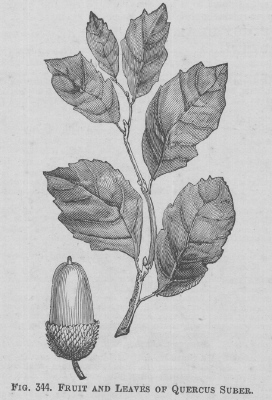
Q. Suber (probably derived from suphar, bark).* Cork Oak; Cork-tree. fr. often solitary, pedunculate or sessile; cup obovate-hemispherical, obconical or rarely obtuse at base, 1/2in. to 3/4in. long, and more broad, with velvety, erect and adpressed scales; nut often exceeding the cup by one-half. l. usually 1in. to 2in. long, 1/2in. to 1 1/4in. broad, on petioles two to six lines long, ovate, oval, or oblong, acute, toothed or rarely entire, glabrous above, beneath, as well as on the branchlets, stellate-velvety-hoary. Bark suberose. h. 25ft. South Europe, 1581. This evergreen tree furnishes the cork of commerce. See Fig. 344. (K. E. E. 33; W. D. B. 80.) Q. thalassica (sea-green). fl., catkins elongated, dense, pilose. fr. many, approximating, sessile in spikes, on peduncles 2in. to 3in. long; cup five lines broad, shortly hemispherical, tomentose, with adpressed, mucronate scales; nut obovoid, eight lines in length, long-exserted. l. acute or acuminate at base, elliptic or obovate-oblong, slightly obtuse, acuminated, 3in. to 5in. long, 1/2in. to 1 1/3in. broad, entire or slightly serrated near the apex, very glabrous above, glaucous-tomentose beneath. Branches tomentose, China, 1850. Evergreen shrub. SYN. Q. inversa (L. & P. F. G. i. 36).
Q. tinctoria (dyers'). Quercitron; Black, Dyers', or Yellow-barked Oak. fr., cup flat beneath; nut globose. l. downy beneath, obovate-oblong, dilated, widely sinuated, large, turning brownish, orange, or dull red, in the autumn, resembling those of Q. coccinea, but having fewer lobes; lobes short, obtuse, slightly toothed, bristle-pointed. Bark dark-coloured and rough. h. 80ft. to 100ft. United States, 1800. (B. M. Pl. 251.)
Q. Toza (Toza).* fr. sessile or shortly pedunculate; cup hemispherical, four to six lines long, with loose, adpressed scales, pubescent outside; nut two to four times longer than the cup, ovate-ellipsoid. l. ovate or oblong, 2in. to 4in. long, 1/2in. to 1 2/3in. broad, variously pinnatifid, stellato-pilose above, very densely stellato-rufous-tomentose beneath; lobes ovate or oblong, obtuse. South Europe, &c. Deciduous. (K. E. E. 22.) SYN. Q. pyrenaica.
Q. Turneri (Turner's). A synonym of Q. pseudosuber.
Q. Ungeri (Unger's). A synonym of Q. AEgilops.
Q. virens (green). Live Oak. fr. one to three on usually conspicuous peduncles; cup turbinate, five to eight lines long, greyish, with adpressed, slightly velvety scales; nut oblong, exceeding the cup by one-half or more. l. 1in. to 3in. long, 1/2in. to 1 1/4in. broad, oblong-elliptical, hoary beneath as well as on the branches, entire or irregularly lobed-dentate. h. 40ft. or more. North America, 1737. Evergreen.