Ricinus
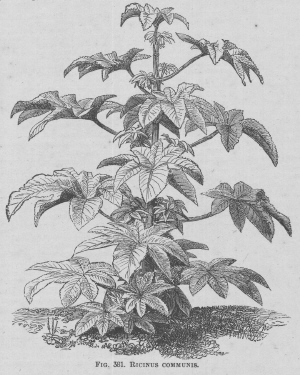
(from ricinus, a tick; which insects the seeds are supposed to resemble). ORD. Euphorbiaceae. A monotypic genus. The species is with us a well-known, tall, half-hardy, annual herb, but, in warmer regions, it grows as an arborescent shrub. Castor oil is yielded by the seeds of this plant, which, together with the capsules, are very variable. Any rich soil is suitable for the culture of Ricinus, and propagation may be readily effected by seeds, which should be sown and placed in heat early in March. It is best to sow single seeds in small pots, as the roots quickly become matted when there are many plants together, and cannot be separated without causing a severe check.
Young plants must be kept growing on under glass until early in June, when they may be hardened and put into their permanent positions outside. Varieties of Ricinus are most useful subjects for sub-tropical gardening, on account of their handsome foliage.
R. communis (common).* Castor-oil Plant; Palma-Christi. fl. green, apetalous, rather large, disposed in sub-paniculate racemes at the apices of the branches; upper flowers male, clustered; lower ones female, shortly pedicellate. July. fr., capsule smooth or prickly. l. alternate, ample, peltate, palmately seven or many-lobed; lobes serrated. h. 3ft. to 5ft. Probably of tropical African origin, but broadly dispersed, and naturalised throughout tropical regions, 1548. See Fig. 381. (B. M. 2209; S. F. G. 952; A. B. R. 430, under name of R. armatus.) There are several varieties of this species; the one grown under the name of R. Gibsonii having bronzy-purplish leaves.