Robinia
(named in honour of John Robin, herbalist to Henri IV. of France, and his son, Vespasian Robin, who first cultivated the Locust-tree in Europe). Locust-tree. ORD. Leguminosae. A genus comprising five or six species of mostly hardy, sub-glabrous, clammy, or bristly trees or shrubs, natives of North America and Mexico. Flowers white or rose-purple, in axillary racemes; calyx teeth short and broad, the two upper ones sub-connate; standard ample, reflexed, naked within; wings falcate-oblong, free; keel incurved, obtuse; bracts membranous, very caducous. Leaves impari-pinnate; leaflets entire, reticulate-penniveined; stipules bristly or spiny. The species described below are all hardy and deciduous, and are very handsome subjects for the ornamentation of the shrubbery. Any common soil will suit them, provided it be not too wet. Propagation may be best effected by layering; the rarer kinds, however, are usually increased by grafting on the commoner sorts, especially R. Pseudacacia.
R. dubia (doubtful). fl. pale rose-coloured, sweet-scented; racemes loose and pendulous. June to August. Pods brown. thickly beset with short prickles. l., leaflets ovate. h. 25ft. Hybrid tree.
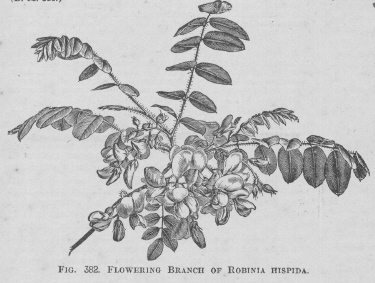
R. hispida (hispid).* fl. deep rose-colour, large, inodorous, in loose and usually pendulous racemes. May and June. Pods glandular-hispid. l., leaflets eleven to eighteen, smooth, ovate or oblong-ovate, rounded or slightly cordate at base, tipped with a long bristle. Branches and stalks more or less bristly. h. 3ft. to 8ft. North America, 1743. Shrub or small tree. See Fig. 382. (B. M. 311.)
R. h. macrophylla (large-leaved). l., leaflets large, ovate-roundish. Branches and peduncles glabrous, without prickles. h. 10ft. An ornamental variety.
R. jubata (bearded). A synonym of Caragana jubata.
R. Pseudacacia.* Bastard Acacia; False Acacia; Common Locust. fl. white, fragrant, in slender, loose, pendulous racemes, 3in. to 5in. long; calyx spotted. April and May. Pods smooth. l., leaflets nine to seventeen, oblong-ovate or elliptical. Branches naked. h. 30ft. to 60ft. North America, 1640. A tree, with hard and durable wood. There are many varieties of this species in English gardens.
R. P. Bessoniana (Besson's).* Branches thornless. This variety forms a compact, round-headed tree.
R. P. crispa (curled). l., leaflets all, or for the most part, undulately curled. h. 40ft.
R. P. Decaisneana (Decaisne's). fl. bright rosy-pink. (R. H. 1863, p. 151.)
R. P. fastigiata (pyramidal). A form with a habit similar to that of the Lombardy Poplar.
R. P. inermis (unarmed). A small-growing, round-headed bush. It is usually grafted on tall stems of the common type.
R. P. monophylla (one-leaved). l. reduced to a single leaflet. R. P. semperflorens (ever-flowering). This variety continues flowering throughout the summer. (R. H. 1875, 191.)
R. P. sophoraefolia (Sophora-leaved). l. large, somewhat resembling those of Sophora japonica. h. 25ft.
R. P. stricta (upright). This has the general tendency to grow upright, but the plant is not as fastigiate as the Lombardy Poplar. h. 30ft.
R. P. tortuosa (twisted). fl., racemes similar to those of the type, but smaller and fewer-flowered. Branches curiously twisted. h. 40ft.
R. P. umbraculifera (umbrella-bearing). l., leaflets ovate. Branches much crowded, smooth. Head orbicular. h. 40ft.
Other forms of R. Pseudacacia are: macrophylla, leaves long, and leaflets broad; microphylla, leaves small, and leaflets narrow; monstrosa, leaves large and twisted; pendula, shoots slightly drooping; procera, tall, and vigorous-growing; spectabilis, leaves large, shoots straight and vigorous.
R. viscosa (clammy).* fl. rose-colour, crowded into roundish, erect racemes, nearly inodorous. May and June. Pods glandular-viscid. l., leaflets eleven to fifteen, ovate and oblong, obtuse or slightly cordate at the base, paler and pubescent beneath, tipped with a short bristle. Branches, petioles, &c., glandular-viscid. h. 20ft. to 40ft. North America, 1797. Tree. (B. M. 560, under name of R. glutinosa.) R. bella-rosea is either a form of this species without the characteristic viscidity, or a hybrid between it and R. Pseudacacia.