Rosa
(the old Latin name, from the Greek rhodon, which again is taken from the Arabic ward, a rose). Rose. Including Lowea. ORD. Rosaceae. An important genus of highly ornamental, mostly hardy, erect, sarmentose, or tall climbing, glabrous, silky or glandular-pilose, usually prickly shrubs, dispersed over the whole temperate and sub-alpine regions of the Northern hemisphere, rare in America, extending South as far as Abyssinia, the East Indian Peninsula, and Mexico. About 250 species have been enumerated, and more than 180 described as such, but the number specifically distinct is probably not more than thirty or forty. Flowers white, yellow, pink, or red, ample, showy, solitary or corymbose; calyx ebracteolate, the tube globose, urceolate or ventricose, the throat constricted, the lobes five, very rarely four, spreading, leafy, often pinnatisect, deciduous or persistent, imbricated; petals five, very rarely four, spreading; stamens numerous, in many series, inserted on the disk, the filaments filiform; carpels indefinite, rarely few, free; styles exserted; achenes numerous, included within the baccate tube of the calyx, which, in the fruiting state, is often edible. Leaves alternate, impari-pinnate, very rarely one-foliolate or consisting solely of connato, leafy stipules; leaflets often serrated; stipules sheathing at base, and adnate with the petioles (see Fig. 383). horticulturists as that now under consideration. The Rose has been immortalised, from the most ancient times, by authors and poets of all countries. As the emblem of Youth, it was dedicated to Aurora; of Love and Beauty, to Venus; of Danger and Fugacity, to Cupid. It was given by the latter, according to classical writers, as a bribe to Harpocrates the God of Silence: hence, undoubtedly, the origin of the common expression, "under the rose." The Rose is the national emblem of England. Apart from the value of the genus as an unrivalled collection of the most beautiful floral objects, it forms an important factor in commerce. The raising of new varieties, &c., and the manufacture of rosewater and attar, give employment to thousands of persons. Rosa is also a prominent contributor to our Materia Medica: according to Dr. Lindley, "one of the most earnest defenders of its powers has not hesitated to assure the world that the Pharmacopoeia should be formed of Roses alone"! (Introduction to "Rosarum Monographia," 1820.) The Rose is justly designated the Queen of Flowers. Its easy mode of propagation, its adaptability to meet the requirements of most cases where flowers are needed, and its general floriferous habit, under varied circumstances, are all well-known characteristics. In horticultural exhibitions, throughout the summer, Roses are always largely represented, and many beautiful shows are limited almost exclusively to this one flower alone. For out flowers, too, Roses are unequalled, and they may be procured, under cultivation, at almost all seasons, especially the invaluable Tea section. For covering arbours, arches, walls, &c., the climbing varieties, which include a good selection, are admirably adapted; while there are hosts of others, suitable for beds by themselves, mixed borders, culture in pots, and for any other purposes where their flowers can be admired. In some places, a Rose Garden is established, and planted with the various sections of the genus; the original species, and those of more recent introduction, are available for affording much interest and beauty in wild gardens, and often for climbing up tall shrubs and trees; several of the dwarf-growing ones are useful for rockeries. It is needless to attempt referring to all the purposes for which the Rose is so well adapted; they are generally familiar, and numerous other books and periodicals refer to the subject in more lengthened terms than is necessary or even possible here. Many of the species are very beautiful, because of the numerous bright-coloured fruits, called " hips," which succeed the flowers. Even the common Dog Rose (R. canina) is very ornamental in this respect; and the beautiful R. rugosa, where it succeeds, is covered with large fruits towards autumn, while it also continues more or less plentifully to keep flowering. The common Sweetbriar Rose, and many others, are familiar examples, because of their highly-coloured hips.
PROPAGATION. Rose propagation may be accomplished in many ways, namely, by seeds, cuttings, layers, suckers, and sports; sometimes by division; and very extensively by budding and grafting.
Seeds. Raising Roses from seeds is a practice seldom resorted to except for obtaining new and improved varieties. As a rule, only an exceedingly small percentage of seedlings fulfil these conditions, now that good sorts are so numerous; by far the largest majority will be found worthless. When seeds are to be saved, the hips must remain on the plant until quite ripe, when they should be gathered, dried in the sun, and afterwards rubbed out. The seeds may either be sown at once, or the hips may be kept whole, and stored in sand or soil, until spring. Rats and mice are very partial to the seeds, which they devour greedily; it is, therefore, necessary to make provision, as far as possible, against their attacks. Birds are also destructive in the seed-bed, if this is in the open ground. Rose seeds may be sown in a warm, sheltered position in the open air, or in pans or shallow boxes of sandy soil, which may afterwards be placed in a cold frame. The seeds vary a great deal in the time they take to germinate; some seedlings appear the first season, many not until the second. The first autumn, all that are large enough to handle should be transplanted from 6in. to 12in. apart, according to their different sizes, and protection must be provided for these, and for others in seed-beds, throughout the winter. Seedling Roses do not produce their first flowers at any fixed time; some blossom in less than a year, but many more do so the second season, while others take a longer period. The first flowers indicate little beyond the colour; those which follow are often of far better substance and superior merit.
Cuttings. Roses of all kinds on their own roots are now much favoured, and propagation by means of cuttings may be successfully practised from spring until late in autumn. Formerly, the method chiefly adopted was by cuttings made of dormant shoots, and inserted in autumn; and this is still extensively practised. The mode of procedure with ripened cuttings in autumn is very easily explained, and, if the cuttings are good and properly inserted, success is almost as certain as with cuttings of Gooseberries or Currants. Rose cuttings should be made from wood of the current year, which should be of medium strength, and well ripened. They may be cut from 9in. to 12in. in length, and if a heel can be obtained, so much the better, but this is not absolutely essential for striking them. The Hybrid Perpetuals, and any others which are equally as hardy as, or more than, these, may be inserted in the open ground. They should be placed about 6in. deep, and from 1ft. to 1 1/2ft. apart. The best plan is to dig the soil and insert cuttings as the work proceeds; care must be taken to tread round them thoroughly, in order that frost may not lift them out. In preparing cuttings for insertion, none of the eyes should be removed, as frequently, when the upper portion of the cutting dies, shoots proceed from the joints beneath ground, and so the plant is safe. This is one of the advantages Roses raised from cuttings always have over those worked on another stock, namely, that all the shoots thrown up at any time are those of the Rose itself, and if the upper branches are cut down by frost in all probability the lower portion of the stem will escape injury. Occasionally, after a sharp spell of frost, it will be necessary to tread round cuttings inserted in the previous autumn, to keep them firm and in position. Good plants will be ready for lifting in the course of a year, when they should be transferred to permanent positions for flowering. Cuttings of Tea-scented and other somewhat tender Roses, when inserted in autumn, will not succeed under the system above described; they must be more carefully treated, by being placed in pots of sandy soil, and provided with protection under glass. They may be dibbled in rather close, and merely kept in a cold frame through winter, during which time they will form a callus, and be ready for emitting roots when subjected to a little heat in spring. This valuable section is more generally propagated in summer; but in autumn ripened cuttings may be procured from outside plants, when there are none grown in pots. Cuttings of Roses may be readily rooted at almost any time during summer, when suitable firm, partially-ripened growths can be obtained. The leaves at this season should be carefully preserved, and cuttings with two or three eyes may be successfully rooted. The first batch may generally be procured early in the season, from plants that have been forced, and none are better suited for propagating. If inserted, and placed in a close frame with a little heat, or on a slight hotbed, and kept moist and shaded, roots will, as a rule, soon be emitted, and the young plants may then be potted off singly, and still grown on for a time under similar conditions until they are sufficiently established to be inured to cooler quarters, gradually hardened, and eventually placed in the open air. At the middle, and towards the latter part, of summer, Rose cuttings, with leaves attached, may be readily rooted under what is termed cool treatment in the open air. A shady position is essential, such as is frequently obtainable against the back wall of a forcing or other plant house which faces south. Bell or hand-glasses are often used; but a better plan is to prepare some sandy soil, and to use the framework of an ordinary rough box, about 10in. deep, and without either bottom or top. Place this on the border, should there be one, put in about 3in. of prepared soil, press it firm, and lay some sand over the surface. All this should be made ready before the cuttings are detached, as they are much injured if allowed to lie about, if only for a short time, before being inserted. Dibble them in rather close, and give a good watering afterwards; make the top as nearly as possible air-tight, by fitting large panes of glass closely to cover it. On the north side of a lean-to house, if this situation is available, but little shading will be necessary, and it is best to leave the glass on without ever removing it until the cuttings show signs of making roots; air may then be gradually admitted. The young plants may be lifted so soon as they are sufficiently established, potted up, and placed in a close frame for a few days; afterwards harden, and get them well ripened before winter.
Layers. Propagation by layering is a sure method of increasing dwarf or weeping Roses that may be brought to the ground, but it is not extensively practised. By layering in June, and early in July, if suitable, firm wood of the current year can be obtained, the rooted plants may be detached the following autumn. When the work is deferred till later in the season, they are not usually ready for removal until the following year. Layering with a tongue is the most successful method. See Layering.
Suckers. Suckers are sometimes produced by Roses, and may be utilised for increasing stock, if desired. They should be taken off in autumn, and planted out separately; if there are no roots, some will generally form if the suckers are inserted rather deeply in sandy soil, and nursed a little through winter.
Sports. Several varieties have originated from sports that have been observed on Roses, as well as on many other plants, and which arise from some cause which seems to affect the colour more than any other quality. Sports cannot be artificially produced; all that can be done is to perpetuate any which appear, and are worthy of it, by one of the ordinary methods of propagation.
Division. Propagating Roses by division is not much practised, but it may be adopted with such as the Fairy Rose (R. indica minima), the Scotch Rose (R. spinosissima), and a few others, which spread and grow, as it were, into bushes.
Budding. This is the principal mode of propagating Roses, and the operation is one which may be successfully carried out at the proper season, after a little practice, by almost anyone. Nurserymen who make Roses a speciality have thousands budded annually. Various' stocks are used, that most extensively employed being, perhaps, the common Dog Rose of the hedgerows. Stocks obtained from the seed of this plant are also much favoured, in some establishments, for dwarf Roses, particularly Teas. The Manetti is also largely employed. For effecting a union, it is necessary that the stock be in a growing state, sufficiently so to allow of its bark separating freely from the wood beneath. The buds should be dormant, well matured, and preferably obtained from firm shoots that have borne flowers; sappy wood shoots are unsuitable. The latter part of June, and all through July, is the principal season for Rose-budding outside, as the stocks are then in a growing state, and plenty of buds are generally obtainable. Under glass, and with the stocks established in pots, it may be carried out extensively earlier in the season; according as buds can be obtained, the stocks may be introduced into a slight warmth, and soon brought into proper condition. On the process of preparing and inserting buds, full information may be found under Budding, where also further remarks are made on the various stocks that are used for Roses.
Grafting. This is an effectual mode of Rose propagation; the whip or splice method and crown-grafting are best suited, but the parts rarely unite so well as they do when budded. Cleft and saddle-grafting are also practicable. Stocks may be of the same sorts as those used for budding. The work is performed principally in January and February under glass, and in the open air during March. When the stocks are in pots, they may be started in a little heat, and so got in advance of the scions, which may be procured in about a fortnight afterwards from well-ripened, dormant trees outside. After the grafts are inserted, the stocks should be returned to the same heat as that in which they have been growing, until a union between the parts has taken place, when they may be gradually hardened off and grown in cooler and more suitable quarters. For description of the methods of grafting above named, see Grafting. CULTIVATION. To grow Roses successfully, a rich soil must be provided, such as a deep loam of a stiff rather than light nature, although the plants on their own roots will thrive better in rather light soils than will others worked on the common tall Briar or on seedling Briar stocks. The wild Rose grows naturally in heavy, clay land; under cultivation, it is, consequently, best suited with strong soil of a rich nature. Shallow, sandy or gravelly soils are unsuited for Roses, and so, on the other hand, are any which are improperly drained. In gardens where Rose-beds have to be formed in unfavourable situations, it is best to dig out the natural soil in the first place, and replace it with a properly-prepared compost; or it may be that changing a portion will suffice. A depth of about 1 1/2ft. should be provided for such strong-growing kinds as most of the Hybrid Perpetuals, and a similar depth is advised for all Roses if it can be provided. The soil can scarcely be made too rich; plenty of manure may be added when the ground is being prepared for planting, and an annual top-dressing in addition is generally found beneficial, and indeed necessary, in the production of good flowers. It may be applied with advantage soon after growth commences, in spring; the flowering shoots are then pushing up, and need plenty of feeding from the root. Respecting situations, there are few in which some representative of this beautiful genus may not be grown successfully. It is not convenient, nor, perhaps, desirable, to attempt the formation of a Rose-garden in all gardens, even when they are extensive; but beds of Roses may generally be introduced into flower-gardens and pleasure-grounds, and any quantity of plants, so far as circumstances and space admit, may be put into other positions without any fear being entertained of having too many. For cutting purposes, in private establishments, it is found a good plan to devote a portion of the kitchen garden to Rose-growing, where the ground can be well trenched previous to planting, and enriched with manure at any time when it is considered necessary. For a Rose-garden, an open situation is desirable, with a south or south-eastern aspect, and sheltered from other points, particularly north and east. Climbing Roses are very beautiful, and generally very floriferous; they may be employed with good effect for covering arches, arbours, pillars, &c., and also for training up trees and tall-growing shrubs. Transplanting of all the more hardy Roses may best be done in October and November. Tea varieties, and any others of a tender nature, are generally not safe to withstand the winter unprotected, and are consequently planted in spring. Dwarf plants should be allowed a space of from 2ft. to 3ft. clear between them, standards not less than 3ft. Sometimes, both are planted alternately in beds. Roses are better arranged by themselves in this way than intermixed with other plants; and this remark also applies to the flowers when cut. It is so customary to find Roses mixed with well-night everything in the way of cut flowers that few persons keep them exclusively by themselves; but it is only by doing so that their full beauty as cut flowers may be seen. The foliage, too, that belongs to plants from which the flowers have been cut seems to suit each so well individually that some of it should always be used; the foliage, for instance, from Tea Roses does not look well with Hybrid Perpetuals, that of neither sort of leaves will do for mixing with flowers from any of the species, and so forth.
The pruning of different Roses depends a good deal on the class to which they belong, the way in which they are trained, &c. Autumn and spring pruning are practised, the latter most extensively, especially since the springs of late years have been so precarious. If a shoot is shortened back in autumn, the eyes that are left, with the intention of their remaining dormant until the following spring, will often be excited into growth during winter, because of the prevalence of mild weather; they then succumb to the first frost. Spring pruning may generally be performed from the middle to the end of March; but the season varies according to the weather and the state of the trees. The young shoots will frequently grow out several inches at the top; and although this growth will have to be sacrificed, it would be unsafe to prune, unless the season were sufficiently advanced to insure the development of the eyes that are left, without injury from frost. Standard Hybrid Perpetuals have to be cut rather severely to keep their heads within limits. All small shoots should be kept removed, and the strongest ones allowed plenty of space. Dwarf plants of this class may be allowed to grow more freely; but the shoots must be kept thinned, in order that they may become thoroughly ripened. Badly-ripened wood never bears good flowers; it should, therefore, in pruning, be removed first, and afterwards other shoots which are misplaced or tend to cross each other and destroy the form and symmetry of the trees. Hybrid Perpetuals may be cut back to from four to eight eyes, according to their vigour and habit. Teas, in the open air, with a few exceptions, seldom grow very vigorously, and a thinning and slight shortening of the shoots are often all they need. Hardy Pillar and Climbing Roses, such as varieties of R. sempervirens, may have their lateral growths shortened back after flowering; this admits light and air to the others left, and but little further pruning will be necessary in spring. If more vigorous shoots are required than those which develop, hard pruning to two or three eyes will cause their production. The amount of pruning which Roses need, and the time and manner of performing the operation, are subjects very widely discussed, and upon which much difference of opinion exists. The principal conditions are: judgment on the part of the operator, a knowledge of the varied habits of Roses, and treatment of each individually as its requirements suggest.
Roses in Pots and under Glass. Greenhouses and conservatories without Roses are rarely found, as, fortunately, no one with a cool glass house need be afraid of inserting a plant to cover the back wall or a portion of the roof, if pot culture cannot be attempted. The Teas are especially well suited for pots, and also the Hybrid Perpetuals; with a sufficient quantity of plants, and by forcing and management, flowers may be obtained nearly or quite the whole year through. Plants for pot culture are best on their own roots--that is, raised from cuttings or layers--but others worked on Manetti stocks or seedling Briars are available. They may be grown from the first in pots, or lifted from the open ground, in September or October, and potted. A rich compost of turfy loam should be provided, with some decayed manure, charcoal, and, if convenient, a few 1/2in. crushed bones intermixed. If the plants are intended for forcing, they should be established in pots at least for a season; the flowers seldom develop properly on those lifted only a short time from the open ground. The Hybrid Perpetuals may be plunged outside during winter, or until required for forcing, and protected with dry litter or bracken; the Teas should be placed for safety in a cool house or pit. As the growth allowed in pots must be somewhat limited, close pruning will be necessary, particularly in the early stages of training, and the shoots must always be kept well thinned by summer disbudding. Established plants do not need repotting every year; if their roots are healthy and not pot-bound, a top-dressing of rich soil sometimes answers better than potting, and liquid manure may be given when the flowers are developing. For forcing Roses to flower in early spring, artificial heat is necessary, and the plants should have been grown some time previously in pots, as already noted. After being pruned and otherwise prepared, a portion may be introduced into a little heat during December, or early in January. About 50 deg. at first will suffice, but when growth commences, and the days lengthen, this may gradually be raised to about 65 deg., with plenty of air on all favourable occasions. Syringing may be practised daily until the flowers begin to expand, when the plants may be transferred to a cool greenhouse, unless they are only required for providing cut flowers, when they should be subjected to a cool temperature and plenty of air. After flowering, the plants may be placed in a sunny position outside until the autumn, but they must not be neglected in watering; the proper maturation of the wood for the succeeding year must be one of the main objects in view.
Other methods of growing Roses have to be adopted when the plants are trained to a greenhouse roof or rafter. For this purpose, they are best planted in a prepared border, which may usually be made inside the house; good soil and drainage must be provided here, as in other situations. Nurserymen supply pot plants specially grown with long shoots for training; or the growths may be easily trained up, if a light, suitable position can be provided, which, however, is not always convenient when stages and hot-water pipes come in the way. Roses permanently planted under glass must be allowed their full season of rest all the winter; their roots should then be kept moderately dry, but almost any quantity of water may be given during the summer. Thinning of the numerous flowerless shoots which appear must be constantly attended to in the growing season. This will admit light and air, and prevent the necessity of removing the large quantity of wood at pruning time that would otherwise be necessary. Many climbing varieties of Tea Roses are unsurpassed amongst greenhouse climbers during spring and summer.
FUNGI. Several species of Fungi, belonging to widely different groups, are parasitic upon the living leaves and young branches of cultivated Roses, and many others are found growing upon dead and withered parts of the plants. The latter do not need further mention, though possibly some of them may be injurious, in their younger stages, to living parts of the Rose-plants. The most generally hurtful of all the true parasitic Fungi is Rose Blight, which is one of the so-called Mildews, and belongs to the group of Erysipheae (see Mildew and Oidium). Its scientific name is Sphaerotheca pannosa, but it differs generically from Erysiphe in little save that in each of the minute, black perithecia scattered over the mycelium there is only one ascus. In this lie eight oval spores. S. pannosa grows on all young parts of plants in the form of a dense, pale grey, velvety coat, covering large patches of the surface. The parts attacked by it are much altered in appearance, the leaves becoming blistered and twisted, and the flower-stalks and calyces swollen and distorted. An account of the structure of the Fungi in this family will be found under the headings quoted above. S. pannosa is found to grow also on the Peach. The application of powdered sulphur, or of weak solution of sulphide of potassium, will destroy the Fungus without injury to the host-plant.
Another kind of Mildew has been observed on the lower surface of the leaves of Roses in conservatories. This also forms grey patches, but they are less extensive and far less dense than in the former species. Irregular, brownish spots appear on the upper surface of the leaves; they extend over the leaves, which soon wither. These are the work of Peronospora sparsa, and bear scattered conidiophores, or slender, branched stalks, on which oval conidia are produced, on the tips of the branches. No remedy is known for this Fungus; and all parts that bear it should be cut off and destroyed. See Peronospora. The Rose Rust (Uredo or Lecythea Rosae) and the Rose Brand (Phragmidium mucronatum) are believed to be forms of a single species of Fungus, the Uredo being the summer form of spore, and the Phragmidium the autumn form, or teleutospore. Both forms occur scattered in small masses on the lower surface of the leaves; indeed, they grow on the same patches of mycelium; but the Brand appears later in the season. The Rust consists of pale yellow, one-celled, round or oval bodies, covered with very fine, prickly warts. The Brand is made up of very different spores, since each is formed of a row of from four to nine cells, which have a brown, warty outer coast. Each spore is borne on a long stalk, thickened below; and each ends, at the tip, in a long, conical, colourless papilla or outgrowth. This Fungus is seldom dangerous to Roses; but it renders the leaves unsightly. Unfortunately, no cure is known; hence, it is advisable to remove and to burn such leaves as show traces of the Fungus, to prevent it from spreading to healthy plants. See Phragmidium.
Another Fungus that, at times, renders the leaves of Roses unsightly, is that known as Asteroma Rosae, Lib. (Actinonema Rosae, Fr.), which forms dark purplish-brown spots, with the appearance of fibres radiating from the centre of each. In the spots lie scattered, dark pycnidia, containing two-celled spores. This Fungus is probably only an immature condition of some unknown pyrenomycetous Fungus. To prevent any extension of the slight harm done by it, remove and burn affected leaves.
The leaves are liable to become covered, on the upper surface, with a sooty deposit, imperfect conditions of species of Capnodium. C. Persoonii has been recorded from Roses on the Continent; but probably the species varies. The Fungus grows chiefly in the secretions of the Aphides so common on Roses; the dark crust obstructs access of light and air to the leaves. The best remedy is to get rid of the Aphides, and to clean the leaves, and keep them clean by syringing or sponging.
INSECTS. In Kaltenbach's "Pflanzenfeinde," nearly 100 species of insects are recorded as more or less hurtful to Roses, i.e., by feeding upon them as larvae or as perfect insects; and to that number many more could now be added. Hence, only such as are markedly hurtful to these favourite flowers are selected for notice here.
The roots may, at times, be damaged by larvae of Cockchafers, and other subterranean foes; but these need not detain us. The larvae of Agrilus viridis feed below the bark on stems of Roses, usually close to the origin of a branch. The beetles are from 1/5in. to 2/7in. long, rather narrow, and brassy-green or blue; they are not uncommon in the South of England.
The twigs and young leaves are much injured by Aphides or Green Flies, of which five species are recorded, with descriptions and coloured figures, in Buckton's "British Aphides," as feeding on Roses. Of these, Siphonophora Rosae, S. rosarum, and S. dirhoda, are often very plentiful on Sweet Briar and on the Cabbage Rose, and also attack the wild Dog Rose. Evergreen Roses seem less liable to be injured by them. The other kinds of Aphides are less evidently hurtful. All of them may be treated in the same way. The remedies recommended under Aphides will be found useful. It is desirable to keep the plants as free as possible from these insects, alike because of the sap they abstract, and because of their excretions covering the leaves and obstructing the functions of the latter, as well as affording a medium for the growth of dark-coloured Fungi, which still further interfere with the welfare of the plants. The larvae of a small Moth (Spilonota roborata), and those of a Sawfly (Paecilosoma candidatum), bore into the pith of Rose-branches from May to July, of course killing them, and causing the leaves on them to wither. The latter insect has been observed near Oxford by Prof. Westwood, but is, fortunately, rare. The infested branches should be cut off and destroyed while still tenanted by the larvae. The leaves of Rose-bushes are devoured by numerous insects, mostly Moths and Sawflies. Of the larger Moths, there may be named the Lackey Moth, the Gold-tail Moth and its allies (see Liparis), the Vapourer Moth (see Orgyia antiqua), the Bufftip Moth (Pygaera bucephala), the Winter Moth (Cheimatobia brumata), and the Barred Yellow Moth (Cidaria fulvata). Each of these, save the last, will be found described under the headings quoted. Cidaria fulvata is a Geometer, about 1in. in spread of wings, with a slender body. It is yellow, with a broad, brown, angled band crossing the front wings, and a pale, triangular spot at the tip, bordered below by a short, dark streak. The larvae of these moths should be shaken or picked off the bushes, collected, and destroyed. Those of the Winter Moth live between leaflets united by threads of silk. The females of this very destructive species are unable to fly, since their wings are too small to be of use. Hence, they can be prevented from reaching the buds to lay their eggs in them, if the stems and supports of the plants have a belt of any sticky substance (e.g., tar, alone or mixed with grease) smeared on them, and occasionally renewed between November and January, since it is at this season that the moths emerge from the pupae in the soil.
Among the smaller Moths, a good many species of Tortricina (which see) feed in leaves of Roses, either joining the leaflets by means of silk threads, or rolling them up in tubes, in which the larvae live. They may either become pupae in these shelters, or may lower themselves, when full-fed, to the soil, in which they become pupae. The larvae have the habit of lowering themselves by silk threads when the branches are jarred, and advantage may be taken of this habit by placing something below to catch them. Among the commoner and more harmful are Lozotaenia rosana, Pardia tripunctana, Croesia Bergmanniana, and Peronea variegana; but a good many others might be named which feed on Roses, as well as on other plants. The larvae of all have much the same habits, and it would occupy too much space to proceed here to distinguish them from one another. In the large group of moths known as Tineina (see Moths), there are a good many that live on Roses. Some of these live in the same manner as the Tortricina; but the larvae of others, belonging to the genera Nepticula, Tischeria, &c., mine between the surfaces of the leaflets, and disfigure them with pale, wavy lines or blotches. These mines do comparatively little injury to the plants. When desirable, the larvae may be killed in them by pressure between the finger and thumb, and the numbers may thus be kept down.
The Sawflies (Tenthredinidae) are frequently far more hurtful than the Moths to Rose-bushes, and the number of kinds which, as larvae, feed on the leaves of Roses, either entirely or partially, is pretty large. For an account of these insects, and of the remedies to be employed, see Rose Sawflies.
Several gall-flies make galls upon the young twigs and on the leaves: for an account of these, see Rose Galls. Typhlocyba Rosae, a small insect nearly related to the Frog-hopper (Aphrophora spumaria), is often plentiful in all stages on, and is hurtful to, Roses, as well as to Apple-trees. Frequently, large numbers of these insects are to be found on the lower surfaces of the leaves. They are about 1/6in. long, pale yellow or whitish, with brown feet; the front wings transparent, rarely yellow along the edges; hind wings milky white. The best remedy is said to be the removal and burning of all superfluous branches in early spring.
The flowers are often gnawed and damaged by Beetles; of these, the worst are the Rosechafer (which see), and the Bracken Clock (Phyllopertha horticola, see Fig. 385), both of which are addicted to eating out the stamens and pistils of Roses, Strawberries, fruit-trees, &c. P. horticola is peculiarly abundant in the North. It is about 1/4in. to 1/2in. long, green or blue, and pubescent, with rusty-red or bluish-black wing-cases, and a pitted thorax. Where troublesome, the insects may be shaken off the bushes on dull days, and readily captured; on fine days, they are too active to permit of this remedy.
R. abyssinica (Abyssinian). fl. white; calyx and peduncles thickly downy. June. l., leaflets shortly stalked, broader towards the point than at the base; petioles very rough with unequal glands and bristles. Prickles very numerous and strong. Otherwise resembling R. sempervirens. Abyssinia. (L. R. 13.)
R. acicularis (needle-prickled).* fl. pale blush, solitary, fragrant; calyx tube naked; sepals somewhat divided, hairy, longer than the tube; petals obovate, emarginate, spreading, shorter than the sepals; bracts ovate, convex. June. fr. yellowish-orange, obovate. l. dense, opaque, very glaucous; leaflets about seven, oval, convex, slightly rugose, simply serrated; stipules narrow; petioles naked or a little hairy. Branches erect, clothed with slender, straight prickles and a few bristles. h. 8ft. North temperate zone, 1805. (L. R. 8.)
R. alba (white).* fl. white or delicate blush, gratefully fragrant; sepals pinnate, reflexed. June and July. fr. scarlet or blood-coloured, oblong, unarmed. l., leaflets oblong, glaucous, nearly naked above, simply serrated. Prickles nearly straight or falcate, slender or strong; bristles none. h. 4ft. to 7ft. Of garden origin, 1597. Of this plant, which Mr. Baker regards as probably a cross between R. canina and R. gallica, there are many varieties. R. alpina (alpine).* fl. pink or rose-red, solitary; sepals undivided, spreading; petals obcordate, concave; peduncles after flowering deflexed, and, as well as the calyx, hispid or smooth. June. fr. orange-red, ovate or rarely sub-globose, pendulous, more or less elongated. l., leaflets five to eleven, ovate or obovate, argutely or doubly serrated. Young stems prickly; old ones usually naked. h. 3ft. Europe, 1683. Of this species there are several varieties. R. pendulina is a form with a smooth calyx and elongated, hispid peduncles. R. pyrenaica is a form with calyx and peduncles hispid. (B. M. 6724.)
R. anserinaefolia (Anserina-leaved). fl. white, in few or many-flowered corymbs, shortly pedicellate; sepals caudate-acuminate, deciduous. Summer. fr. smooth, 1/4in. in diameter. l. 1in. to 3in. long; leaflets broadly elliptic, obtuse, simply serrated, 1/3in. to 2/3in. long; petioles slender. Branches with few or many unequal, stout, compressed, hooked prickles. h. 10ft. Orient. Plant sub-scandent.
R. arvensis (field-loving). A synonym of R. repens.
R. Banksiae (Lady Banks').* fl. white and very double, nodding, numerous, small, weakly but pleasantly scented; calyx tube hemispherical; sepals entire, pointed; peduncles naked, very slender. June. l., leaflets one to five, flat, oblong-lanceolate, obtuse, often waved, simply serrated, very hairy at base of middle nerve; petioles naked, rarely hairy. Branches unarmed, weak, climbing. h. 20ft. China, 1809. (B. M. 1924; B. R. 397.)
R. B. lutea (yellow). A yellow-flowered variety. (B. R. 1105.)
R. berberifolia (Berberis-leaved). A synonym of R. simplicifolia. R. blanda (charming).* fl. rose-coloured, one to three; calyx tube and peduncles smooth and glaucous. May and June. fr. globose. l., leaflets five to seven, oval or oblong, obtuse, pale on both sides and minutely downy or hoary beneath, serrated; stipules large. h. 1ft. to 3ft. North America. Plant nearly unarmed, or with scattered, straight, deciduous prickles. SYNS. R. fraxinifolia (B. R. 458), R. Woodsii (B. R. 976).
R. bracteata (large-bracted).* Macartney Rose. fl. white, large, solitary, terminal; calyx, as well as the short peduncles, densely tomentose; bracts large, surrounding the base of the calyx. July. l., leaflets five to nine, obovate, slightly serrated, shining, glabrous; stipules nearly free, bristly. Branches erect, tomentose, armed with strong, recurved, often twin, prickles. h. 2ft. China, 1795.
R. b. scabriuscula (slightly scabrous). Branches bristly; prickles smaller than in the type, nearly straight. (B. M. 1377, under name of R. bracteata.)
R. Brunonii (Brown's). A synonym of R. moschata.
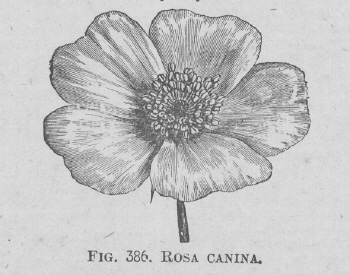
R. canina (canine).* Dog Rose. fl. usually pink, sometimes solitary, or with many in a cluster; sepals usually naked, reflexed, pinnate; styles free or nearly so, hirsute. June to August. fr. ovoid, urceolate, or sub-globose, the mouth of the disk conspicuous. l., leaflets eglandular (rarely, except on the midrib and veins beneath), glabrous or thinly hairy, acute, very sharply toothed. Branches long, arching. h. 6ft. to 8ft. Europe (Britain), Orient. "Varieties innumerable: 150 are treated as species in Deseglise's 'Catalogue of the Roses of Europe and Asia.' One series of forms has erect, sub-persistent sepals, and another leaves slightly glandular beneath" (Baker). See Fig. 386.
R. carolina (Carolina). Swamp Rose. fl. pink, numerous, corymbose; calyx with leaf-like appendages, and, as well as the peduncles, glandular-bristly. June to September. fr. depressed-globular, somewhat bristly. l., leaflets five to nine, elliptical, often acute, dull above, pale beneath; stipules narrow. Stems 4ft. to 7ft. high, armed with stout, hooked prickles, not bristly. North America, 1726. (L. R. 4.)
R. centifolia (hundred-leaved).* Cabbage Rose. fl. rose-purple, odorous, large; sepals spreading; petals inflexed; peduncles and calyx glandular-viscous. June and July. fr. ovate, some what pulpy, fragrant. l., leaflets five to seven, ovate, flat, simply serrated, glandular on the margins, rather flaccid, slightly pilose beneath. Prickles scattered, nearly straight, scarcely dilated at base h. 3ft. to 6ft. Orient, 1596. This species and its varieties have given rise to innumerable handsome garden Roses.
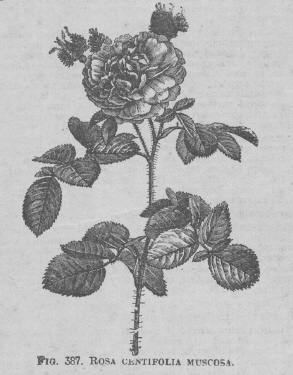
R. c. muscosa (mossy).* Moss Rose. fl. rose or white; petals inflexed; peduncles and calyx glandular-mossy. l., leaflets ovate, flat, simply serrated. Prickles unequal, small, numerous. See Fig. 387.
R. c. parviflora (small-flowered). fl. purple, smaller than in the type, solitary, very double, overtopped by the young shoots; sepals ovate, pointed. l., leaflets small, stiff, ovate, acute, flat, very finely and simply toothed.
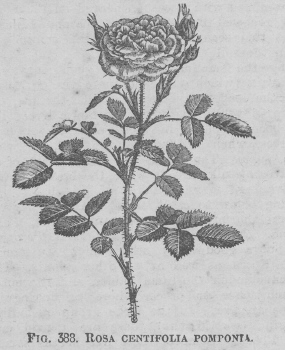
R. c. pomponia (Pompone). Pompone Rose. A dwarf form, having small flowers and leaves. See Fig. 388.
R. cinnamomea (Cinnamon-like). fl. pale or bright red, solitary or two or three together; sepals very narrow, longer than the concave, obcordate petals. May. fr. red, globose or spherical-ovate. l., leaflets five to seven, oval-oblong, simply serrated, cinereous-pubescent beneath; stipules of the sterile branches linear-oblong, those of the flowering branches dilated above, with spreading auricles. Prickles twin, falcate, the larger ones subulate, the smaller ones bristly and not glandular. h. 6ft. Europe and North Asia. R. c. dahurica (Dahurian). This resembles the type, but the stipules are narrow, and the prickles long and spreading.
R. c. majalis (May). Prickles of the flowering branches solitary, recurved. A small form.
R. damascena. (Damascus).* Damask Rose. fl. white or red, large, more or less corymbose, sweet-smelling; calyx, as well as the peduncles, glandular-hispid, viscous; sepals reflexed. June and July. fr. ovate, pulpy. l., leaflets five to seven, ovate, rather rigid, oblong in bud. Prickles numerous, unequal, dilated towards the base. h. 2ft. to 4ft. Orient, 1573. A parent of many beautiful garden forms.
R. d. variegata (variegated). fl. densely paniculate-corymbose. l., leaflets somewhat round-ovate, variegated with yellow, pubescent on the margins.
R. Ecae (Mrs. Eca Aitchison's). fl. golden, solitary, less than 1in. in diameter. Summer. fr. globose, glabrous, shining, crowned by the reflexed calyx segments. l. small; leaflets five to nine. slightly glandular. Afghanistan. A much-branched, dwarf, very prickly shrub. (J. L. S. xix. 8.)
R. Eglanteria (Eglantine), of Linnaeus. A synonym of R. lutea.
R. Eglanteria (Eglantine), of Miller. A synonym of R. rubiginosa.
R. ferox (fierce). fl. terminal, aggregate in twos or threes, rarely solitary; sepals pinnatifid, at length deflexed, deciduous; petals white, yellowish at base; peduncles short, glandular-hispid. June. fr. blood-coloured, naked, sub-globose. l., leaflets five to seven, ovate or roundish-ovate, glandularly biserrate, nearly glabrous above, copiously glandular beneath. Branches erect; prickles thick, very unequal, dilated at base, hooked. North Asia. Plant dwarf and much-branched.
R. ferox (fierce), of Lawrence. A synonym of R. rugosa. R. Fortuneana (Fortune's). fl. white, double, about 3in. in diameter, solitary, on short, bristly peduncles; sepals ovate, undivided; petals loosely and irregularly arranged. June. l., leaflets three to five, ovate-lanceolate, finely serrated, thin, bright green, shining on both sides; stipules small, subulate, deciduous. Branches slender, sparingly armed with small, falcate prickles. China, 1846. A scrambling, hybrid shrub, of which R. indica is one of the parents.
R. fraxinifolia (Ash-leaved). A synonym of R. blanda.
R. gallica (French).* fl. varying from red to crimson, double or semi-double, erect; sepals spreading; peduncles and calyx glandular-hispid, somewhat viscous. June and July. fr. subglobose, very coriaceous. l., leaflets five to seven, coriaceous, rigid, ovate or lanceolate, deflexed; stipules narrow, divaricate at apex. Prickles unequal. h. 2ft. to 3ft. Europe and Western Asia. A very variable plant. See Fig. 389. (B. M. Pl. 104.) R. arvina and R. hybrida are probably hybrids between this species and R. repens.
R. g. Agatha. Agatha Rose. fl. purple, small, very double; sepals more or less pinnate; outer petals spreading, inner ones concave.
R. g. inermis (unarmed). fl. purple, double; calyx tube campanulate; sepals shortly and simply pinnate; peduncles scarcely glandular. Branches smooth, glabrous.
R. g. pumila (dwarf). fl. red, single; peduncles and calyx hispidulous-glandular, dark. l. roundish-ovate, rarely lanceolate, more or less keeled; stipules very narrow. Branches more or less prickly. (J. F. A. 198, under name of R. pumila.) R. glutinosa (glutinous). fl. pale blush, small, solitary, on short, bristly-viscid stalks. June. fr. scarlet, without bracts, prickly, crowned by the hoary sepals. l. hoary; leaflets three to seven, flat, roundish, small, coarsely serrated, glandular and viscid; stipules much dilated upwards; petioles sparsely prickly. Prickles on old stems unequal, falcate. h. 2ft. Orient, 1821. (S. F. G. 482.)
R. gracilis (slender). A synonym of R. involuta Sabini.
R. gymnocarpa (naked-fruited). fl. red, remarkably small, solitary or sometimes in pairs; calyx segments ovate, simply acuminate, deciduous. June. fr. red, the size of a small pea, smooth, and naked. l., leaflets five to nine, glabrous, rather distant, oval, sharply and doubly glandularly serrated. Branches glabrous, furnished with scattered, weak prickles. h. 1ft. to 4ft. California.
R. Hackeliana (Hackel's). fl. pink, minute, solitary, very shortly pedunculate; sepals undivided or pinnatifid. June. fr. ovate-spherical, glandular-bristly. l., leaflets five to seven, small, somewhat elliptic-orbicular, obtuse, simply serrulated, tomentose on both sides, densely so beneath; stipules ovate-oblong, dilated. Prickles nearly straight or often hooked and dilated at base. South Europe. A dwarf species.
R. hemisphaerica (hemispherical).* fl. yellow, solitary, shortly pedunculate; calyx tube hemispherical; sepals lanceolate, almost undivided; petals obovate. July. fr. erect, globose. l. leaflets five to seven obovate, paler beneath and pubescent on the nerves, somewhat biserrate; petioles, as well as the peduncles, slightly spiny. h. 3ft. Orient, 1629. SYN. R. sulphurea (B. R. 46). R. hibernica (Irish). fl. pale pink, few or many; sepals leafy, persistent; peduncles naked. June and July. fr. erect, globose, naked. l., leaflets simply serrated, glaucous-green above, thinly hairy on the nerves beneath; petioles pubescent; stipules nearly naked on the back, the auricles gland-ciliated. Branches short; prickles rather crowded, gradually passing into bristles. h. 2ft. Britain. (Sy. En. B. 463.) Perhaps a hybrid between R. canina and R. spinosissima. In the variety cordifolia the peduncles are bristly and glandular, while in glabra they are naked.
R. hispida (hispid). fl. white, with a faint tinge of yellow, solitary; sepals lanceolate, cuspidate; petals oval, very obtuse; peduncles thickened at apex. June. fr. black, large, globose, glabrous. l., leaflets seven, oval, serrated with acuminate teeth, glabrous; petioles unarmed. Branchlets hispid-prickly. h. 3ft. 1780. A garden plant. (B. M. 1570.) SYN. R. lutescens (L. R. 9).
R. humilis (dwarf). fl. pale blush, usually in pairs; sepals ovate, with a narrow point, their edges cottony; bracts pointed, somewhat hairy. June to August. l., leaflets usually five, some what shining, lanceolate, acuminate, finely toothed; stipules naked, very narrow. Branches slender, reddish-brown, armed with a pair of needle-shaped prickles under the stipules. North America. A low, weak, spreading species.
R. hystrix (bristly). A variety of R. sinica.
R. indica (Indian).* Blush, Common China, or Monthly Rose. fl. red, very numerous, usually semi-double; calyx tube naked; sepals nearly simple, acuminate, deciduous, glandular outside, petals obcordate, concave. All season. fr. scarlet, obovate. l. shining, without pubescence; leaflets three to five, even, elliptic, acuminate, nearly simply crenate-serrate, dark green above, glaucous beneath; petioles rough with bristles and little, hooked prickles; stipules very narrow, subulate. Branches stout, armed with brown, hooked prickles. h. 4ft. to 20ft. Native country not clearly known. 1789. R. borbonica is probably a hybrid between R. indica and R. gallica; R. Noisettiana (see Fig. 390) and R. Ternauxiana, between R. indica and R. moschata; R. reclinata, between R. indica and R. alpina; R. ruga, between R. i. fragrans and R. repens; and R. Fortuneana, of Lemaire (L. J. F. 361), is doubtless also a hybrid of which R. indica is one of the parents.
R. i. anemonaeflora (Anemone-flowered). fl., calyx highly glabrous. l., leaflets ovate-lanceolate, argutely serrated.
R. i. caryophylla (Clove-leaved). fl. rose, sub-paniculate; petals cucullately inflexed. l., leaflets ample, slender.
R. i. flore-pleno (double-flowered). This only differs from the type in having double flowers. See Fig. 391. There are a large number of garden varieties in cultivation.
R. i. fragrans (fragrant). Sweet-scented Chinese Rose. fl. rose-coloured, semi-double, fragrant; peduncles thickened. fr. ovate. l., leaflets three to five, ample; stipules fringed or entire. Stem firm; prickles strong.
R. i. longifolia (long-leaved). fl. rose, almost single; peduncles rather rough. l., leaflets three to five, long-lanceolate. Stemfirm, nearly unarmed. R. i. minima (smallest).* fl., petals obovate, acuminate. l., leaflets ovate, obtuse, purplish. Stem and branches prickly and bristly, or nearly glabrous. (B. M. 1762, under name of R. semperflorens minima.) SYN. R. Lawrenceana (B. R. 538). There are double-flowered forms of this which now generally pass under the name of "Fairy Rose."
R. i. semperflorens (ever-flowering). fl. purple, on filiform peduncles; sepals elongated, sub-appendiculate. l., leaflets slender, lanceolate or ovate. Stem and branches slender and weak, prickly or unarmed. (B. M. 284, under name of R. semperflorens; S. E. B. 91, under name of R. indica.)
R. involucrate (large-involucred). fl. white, fragrant, 2in. to 3in. in diameter, solitary or shortly corymbose, rarely axillary and longer pedicelled; calyx tube unarmed; petals retuse; bracts large, lanceolate. July. fr. globose, densely tomentose. l. 3in. to 4in. long; leaflets three or four pairs, 1 1/2in. long or less, elliptic or oblong, acute or acuminate, finely serrated; stipules small, laciniate. Branchlets and inflorescence densely tomentose; prickles straight, often in stipular pairs. h. 3ft. India, 1818. (B. R. 739; L. R. 1, under name of R. Lyelli.)
R. involuta (involute). fl. white or pink; sepals leafy, persistent, densely glandular on the back; peduncles densely bristly. June and July. fr. red, globose, sparingly produced. l., leaflets doubly serrated, glabrous or pubescent and glandular beneath; petioles and stipules densely glandular and ciliated. Branches sometimes arching; prickles scarcely curved, crowded, gradually passing into bristles. h. 2ft. Europe (principally Britain). A very variable species, of which there are many distinct forms. The following may be mentioned:
R. i. Sabini (Sabin's). fl., calyx tube sub-globose, more or less bristly; sepals pinnate. fr. sub-globose. l., leaflets with copious, compound serratures, thinly pubescent above; petioles (and peduncles) densely hairy, glandular, and bristly. Prickles straight, 1/3 in. long. This is the commonest form of the species. SYN. R. gracilis.
R. i. Wilsoni (Wilson's). fl., calyx tube almost glabrous; sepals nearly simple. fr. sub-obovoid. l., leaflets often cordate, terminal, large, glabrous above, the ribs thinly hairy and nearly glandless beneath, the serratures simple. Prickles as in R. i. Sabini. (Sy. En. B. 464.)
R. laevigata (smooth). A synonym of R. sinica.
R. Lawrenceana (Lawrence's). A synonym of R. indica minima.
R. laxa (loose). fl. solitary; calyx tube roundish, hairy, sometimes underset with floral leaves; sepals entire, silky; petals white, yellowish at base, somewhat cordate; peduncles very short, hairy. July. fr. roundish. l. pendent; leaflets oblong-elliptic, doubly serrated, shining above, hairy beneath; petioles glandular-hairy, somewhat prickly; stipules fringed. Branches slender, silky-hairy; prickles stipular, in pairs. h. 3ft. Siberia.
R. lucida (clear).* fl. red; calyx lobes glandular-bristly; peduncles one to three-flowered. May to July. fr. depressed-globular, smooth when ripe. l., leaflets five to nine, elliptic or oblong-lanceolate, shining above, sharply serrated. Stems 1ft. to 2ft. high, armed with unequal, bristly prickles, which are mostly deciduous, the stouter, persistent ones nearly straight, slender. North America, 1724.
R. 1. flore-pleno (double-flowered).* A charming variety, with double flowers, met with in nursery catalogues under the name of "Rose Button."
R. lutea (yellow).* Austrian Briar. fl. yellow, few, 2in. to 2 1/2in. in diameter; calyx tube hemispherical or globose, glabrous, unarmed or prickly; sepals long-acuminate, entire or with marginal laciniae; petals obcordate. June. l. 1 1/2in. to 3in. long; leaflets two to four pairs, petiolulate, elliptic-ovate or orbicular, obtuse or apiculate, deeply or doubly glandular-serrate; petioles glandular-pubescent; stipules broad. Branches with straight prickles, erect. h. 3ft. Orient. (B. M. 363, under name of R. l. unicolor.) SYN. R. Eglanteria.
R. l. punicea (scarlet). fl., petals scarlet above, and yellow beneath; stigmas purple. (B. M. 1077, under name of R. l. bicolor.)
R. lutescens (yellowish). A synonym of R. hispida.
R. macrophylla (large-leaved). fl. bright red, solitary or corymbose, 1in. to 3 1/2in. in diameter; calyx tube 1/2in. to 1 1/2in. long; sepals 1in. to 2in. long, persistent; petals broadly obcordate; peduncles, pedicels, and calyx usually very bristly and glandular. June. fr. sometimes 2in. long. l. 2in. to 8in. long; leaflets elliptic-ovate, acuminate or acute, finely serrated, usually pubescent beneath; petioles pubescent; stipules large, sheathing. Prickles straight or slightly curved, or absent. h. 6ft. Temperate Himalaya and China.
R. micrantha (small-flowered). fl. pale red, 1in. in diameter; sepals deciduous, densely glandular, with a leafy point and one or two leaflets. June. fr. scarlet, urceolate. l., leaflets small, more pointed than those of R. rubiginosa, glabrous above, densely glandular beneath. Branches long, arched; prickles equal. h. 4ft. Europe (Britain).
R. microcarpa (small-fruited). fl. white, small, very numerous, corymbose; bracts deciduous; stalks smooth. July. fr. scarlet, the size and form of those of Crataegus Oxyacantha. l. distant; leaflets three or five, oblong or ovate-lanceolate, naked, simply crenate-serrate, dark shining green above, paler beneath; petioles downy or naked; stipules subulate. Branches slender, flagelliform, with a few hooked prickles. h. 10ft. China, 1822. Climber. (B. M. 6548; L. R. 18.)
R. microphylla (small-leaved). fl. of a delicate blush-colour, small. August to October. fr. Prickly, green or yellowish when ripe. l., leaflets ovate, small; bracts appressed, pectinate. h. 2ft. to 4ft. China. (B. M. 6549.) This species connects the Bracteateae and the Cinnamomeae. There is a double-flowered form in cultivation.
R. mollis (soft). fl. red; sepals persistent, densely glandular. June and July. fr. globose or turbinate, densely prickly, rarely naked, ripening early. l., leaflets very hairy, doubly serrate. Branches erect; prickles uniform, scattered, slender, nearly straight. North Europe (Britain). Allied to R. spinosissima. SYN. R. mollissima (Sy. En. B. 466).
R. m. pomifera (Apple-bearing).* fl., sepals copiously pinnate, quite persistent; petals often ciliated and glandular. fr. more or less pear-shaped, scarlet, large, very handsome, ripening early in autumn. Branches arching. (G. C. n. s., xxv. 237, under name of R. pomifera.)
R. mollissima (very soft). A synonym of R. mollis.
R. montana (mountain-loving). fl. varying from whitish to rose, generally solitary on short, erect peduncles. Summer. fr. deep red, globular or oblong, glandular-prickly. l. doubly dentate, with five to seven rounded leaflets, glabrous above, hairy beneath. Prickles scattered, nearly straight, thin. h. 6ft. South Europe, &c.
R. moschata (musky).* fl. yellowish-white, 1 1/2in. to 2in. in diameter, very numerous, in compound corymbs; calyx tube small, obovoid; sepals 1/2in. long, often pinnatifid; petals or-bicular-obovate; inflorescence pubsecent. August. fr. dark brown, 1/3in. in diameter. l. 2in. to 6in. long; leaflets two to four pairs, ovate or ovate-lanceolate, acute or acuminate, with very numerous and acute serratures, puberulous beneath. Prickles scattered, stout, recurved. h. 12ft. South Europe to India, 1590. Climber. (B. R. 829, 861) SYN. R. Brunonii (B. M. 4030; F. d. S. 366-7).
R. multifiora (many-flowered).* fl. white, pink, or purple, corymbose, often very numerous; sepals short, ovate, entire, not persistent. June. fr. bright red. l., leaflets five to seven, ovate-lanceolate, soft, slightly wrinkled; stipules pectinate. Branches, as well as the peduncles and calyx, tomentose; prickles slender, scattered. h. 12ft. China and Japan, 1822.
R. m. carnea (flesh-coloured). fl. pink, double. (B. M. 1059; B. R. 425.) R. m. flore-pleno (double-flowered). This only differs from the type in having the flowers double.
R. m. platyphylla (broad-leaved). fl. purple, large, double. l., leaflets broader than in the type. (B. R. 1372.)
R. nitida (shining).* fl. of a brilliant red, on bristly stalks; sepals very narrow; petals obcordate, concave, nearly erect; cymes one or few-flowered. July. fr. bright scarlet, depressed-spherical, somewhat hispid. l. very shining dark green, changing to purple in autumn; leaflets three to seven, narrow-lanceolate, naked, simply serrated; petioles slender, naked; stipules gland-fringed. Branches erect, much divided, covered all over with prickles and bristles. h. 2ft. North America, 1807. (L. R. 2.)
R. nutkana (Nootka Sound). fl. varying from pale to bright red; calyx segments entire, long-acuminate, glandular without, spathulate at apex; peduncles solitary, glabrous. June. fr. ovate, glabrous. l., leaflets ovate-elliptic, obtuse, obsoletely glandular-serrated, pubescent at the midrib below; petioles prickly. Branches glabrous; prickles stipular. h. 6ft. Nootka Sound.
R. orientalis (Eastern). fl. solitary, shortly pedunculate; sepals straight, undivided or pinnatifid. June. fr. spherical or ovate, densely bristly, rarely glabrous. l., leaflets five to seven, nearly round or elliptic-ovate, almost simply serrated, greyish-tomentose on both sides. Prickles all subulate, nearly straight, unequal, Orient. A dwarf species.
R. phoenicia (Phoenician). fl. white, disposed in a compound, corymbose panicle; calyx tube highly glabrous; sepals undivided or minutely lobulate; petals longer than the calyx. June. l., leaflets three or five, ovate-elliptic, obtuse, deeply and simply serrated, opaque above, hairy or pilose and paler beneath. Branches elongated, climbing; prickles scattered, hooked. Orient.
R. pimpinellifolia (Pimpernel-leaved). A synonym of R. spinosissima. R. pisocarpa (Pea-fruited). fl. 1in. in diameter, solitary or in few-flowered corymbs; corymbs; calyx glandular, with very long lobes; petals rose-coloured, orbicular, bifid; stamens very numerous. July. fr. bright red, globose, erect, 1/3in. to 1/2in. in diameter. l. 2in. to 3in. long; leaflets four to seven, 3/4in. long, broadly elliptic, obtuse, finely serrated; petiole and rachis minutely pubescent. California, 1877. A straggling, much-branched, unarmed or spiny bush. (B. M. 6857; G. M., Oct. 9, 1886.)
R. repens (creeping). fl. white, with a yellow eye, one to six, rarely solitary, scentless; calyx purple; sepals deciduous, naked at back, short, broad. June and July. fr. small, naked, sub-globose. l., leaflets quite glabrous, glaucous beneath. Branches trailing, purple, glaucous; prickles uniform, stout, strongly hooked, often very large. h. 2ft. to 8ft. Europe (Britain). SYN. R. arvensis. R. bibracteata is a variety with larger leaflets and stronger shoots.
R. r. capreolata (tendrilled). Ayrshire Rose. fl. on glandular-hispid or rugose peduncles. l., leaflets ovate, argutely serrated, slender. Prickles slender, very acute.
R. rubella (reddish). fl. pale or deep red, solitary, without bracts; sepals erect, entire, rough; petals concave, emarginate; peduncles hispid. June. fr. scarlet, pendulous, long-ovate. l., leaflets seven to eleven, almost flat, oval, pointed, simply serrated or nearly so, dark green above, paler beneath; petioles sparingly glandular, without hairs; stipules dilated towards their ends. Branches erect, reddish, 3ft. to 4ft. high, bristly and prickly. Europe. This and its varieties, gentilis, reversa, and stricta, are probably hybrids between R. alpina and R. spinosissima.
R. rubiginosa (rusty-leaved).* Eglantine; Sweetbriar. fl. pink, one to three; sepals densely glandular, pinnate, sub-persistent. June. fr. globose. l., leaflets glabrous above, pubescent beneath. Branches compact; prickles with a few bristles and glandular hairs intermixed. h. 5ft. Europe (Britain). Plant very sweet-scented. SYN. R. Eglanteria. R. permixta and R. sylvicola are mere varieties of this species.
R. rubrifolia (red-leaved). fl. deep red, small; sepals very narrow, longer than the petals. August. fr. oblong, with very tender flesh. l., leaflets ovate, toothed, tinged with red, very glaucous, wrinkled, opaque. Stems deep red or purple, covered with pale bloom and armed with small, short, pale, hooked prickles. h. 6ft. Europe. Otherwise like R. canina.
R. r. fenestralis (fenestrate). A synonym of R. setigera.
R. r. laevis (smooth). fl., sepals entire. fr. corymbose, and, as well as the peduncles, smooth. (B. R. 430, under name of R. rubrifolia.)
R. rugosa (wrinkled).* fl. red, large, solitary, bractless; sepals reflexed, hairy, entire, very narrow; petals emarginate; peduncles beset with straight, short, scattered prickles. June. fr. varying from orange-red to deep red, very large and showy, depressed-globose, pendulous, crowned by persistent, erect sepals; ripening in autumn. l., leaflets five to nine, ovate, much wrinkled, simply serrated, obtuse. Branches slender, armed with very dense, straight, nearly equal prickles. h. 4ft. Japan, 1845. (L. R. 19.) SYN. R. ferox (B. R. 420). R. Iwara is supposed to be a hybrid between this and R. multiflora.
R. r. kamtschatica (Kamtschatkan). fl., petals obcordate, sometimes apiculate; bracts elliptical, nearly naked. l. grey; leaflets obovate, blunt, with callous teeth. Branches downy, pale brown, procumbent. Prickles under the stipules large and spreading, two or three together; intermediate ones much smaller.
R. r. nitens (shining). l. pale shining green, highly glabrous on both sides. (B. R. 824, under name of R. kamtschatica nitens.)
R. Sempervirens (evergreen).* fl. white, fragrant, very numerous; sepals nearly simple; peduncles usually glandular-hispid. June to August. fr. orange, small, usually glandular-hispid. l. persistent; leaflets ovate-lanceolate, simply serrated, smooth on both surfaces, paler beneath. South Europe and India, 1529. Climber. (B. R. 459.) The following are varieties: R. s. Leschenaultiana (Leschenault's). fl., peduncles beset with glandular bristles. l., leaflets ovate-lanceolate; petioles and stems prickly, pruinose and violaceous. Stems climbing 60ft. to 70ft.
R. s. prostrata (prostrate). fl. white or pale red, solitary or numerous; peduncles sometimes furnished with two or many bracts. Stems prostrate.
R. s. scandens (climbing). Peduncles and fruit slightly hispid.
R. sepium (hedge). fl. pink; sepals sub-persistent; styles pubescent; peduncles naked. June. fr. ovoid, naked, l., leaflets small, narrowed to both ends, glabrous, but densely glandular beneath. Prickles with a few bristles and glandular hairs intermixed. h. 3ft. Europe (Britain). Plant looser in habit than R. rubiginosa, which it somewhat resembles.
R. sericea (silky). fl. white, rarely pink or pale straw-coloured, solitary, ebracteate, 2in. to 2 1/2in. in diameter, almost axillary; calyx tube and peduncles bristly and glandular; sepals pubescent, persistent; petals obcordate, usually four. May. l. 1in. to 3in. long, crowded; leaflets seven to nine, usually oblong, obtuse, acutely toothed, silky beneath. Branches perfectly glabrous and unarmed or prickly only, or also loosely or densely bristly and glandular. India, 1822. Plant erect or sub-scandent. (B. M. 5200; L. R. 12.)
R. setigera (bristle-bearing). Climbing or Prairie Rose. fl. deep rose-coloured, changing to white, corymbose; calyx and peduncles glandular. July. fr. globular. l., leaflets three to five, ovate, acute, sharply serrated, smooth or downy beneath. Stems climbing, armed with stout, nearly straight prickles, not bristly; strong shoots growing 10ft. to 20ft. in a season. North America. Climber. SYN. R. rubrifolia fenestralis (L. R. 15). R. simplicifolia (simple-leaved). fl. sweet-scented, solitary, without bracts; calyx tube downy, covered with needle-shaped prickles; sepals entire; petals deep yellow, with a dark crimson spot at their base. June. fr. pale green, depressed-globose. l. sessile, erect, simple, narrow-obovate, densely pubescent; stipules absent. Branches slender, pubescent, bristly; prickles slender, falcate. h. 2ft. to 3ft. Siberia and Persia, 1790. (G. C. n. s., xxiv. 468.) SYNS. R. berberifolia, Hultheimia berberifolia, Lowea berberifolia (B. R. 1261). R. Hardii (G. C. n. s., xxiv. 469) is a hybrid between this species and R. involucrata.
R. sinica (Chinese).* Cherokee Rose. fl. white, large, solitary; calyx very bristly; sepals rigid, spreading. June. fr. orange-red, muricate. l. evergreen, mostly trifoliolate; leaflets smooth and shining, hispid on the midrib. Stem long, trailing, smooth, the branches armed with very stout, curved prickles. China (naturalised in Southern United States, West Indian Islands, &c.), 1759. (B. M. 2847; B. R. 1922; L. R. 16.) SYN. R. laevigata.
R. s. hystrix (bristly). fr. purple, very brittle. l. distant. Branches covered with little, short, stiff bristles, a few large, falcate prickles being mixed among them. (L. R. 17, under name of R. hystrix.)
R. spinosissima (very spiny).* Burnet or Scotch Rose. fl. white or pink, 1in. to 1 1/2in. in diameter, one to three or more together; calyx tube usually glabrous; sepals simple, more or less persistent. May and June. fr. short. l. small, slightly or not glandular; leaflets seven to nine, singly or doubly serrated, usually broad. Prickles crowded, very unequal, nearly straight, passing into stiff bristles and glandular hairs. h. 1ft. to 4ft. Europe (Britain), Siberia. (Sy. En. B. 461.) SYN. R. pimpinellifolia.
R. s. altaica (Altaic). fl., calyx and peduncles smooth. l. broader than in the type. Plant taller. (B. R. 888, under name of R. grandiflora.) R. s. argentea (silvery). fl. white, semi-double; calyx and peduncles purple, hispidulous. l., leaflets ovate, white-tomentose beneath. Stems and branches hispid, prickly, intermixed with minute bristles. (B. M. 1570, under name of R. hispida argentea.)
R. s. myriacantha (many-spined). fl., calyx and peduncles hispid. l., leaflets minute, doubly-serrated. Prickles very numerous, the lower ones often reversed. (L. R. 10, under name of R. myriacantha.)
R. s. reversa (reversed). fl. yellowish-white. Stems clothed below with very slender, deflexed prickles. (B. M. 431.)
R. stylosa (large-styled). fl., sepals reflexed, much pinnate; styles as long as, or shorter than, the stamens; peduncles elongated, more or less bristly and glandular. l., leaflets pubescent beneath. A tall, rarely low bush. To this species, which is intermediate between R. canina and R. repens, the following varieties are referred: fastigiata, gallicoides, Monsoniae, opaca, systyla.
R. sulphurea (sulphur-coloured). A synonym of R. hemisphoerica.
R. tomentosa (tomentose). fl. bright rose-pink, sometimes pure white, generally one to three; calyx tube prickly or naked; sepals copiously pinnate, not quite persistent. June and July. fr. ovate-urceolate or sometimes turbinate. l. 4in. to 5in. long; leaflets copiously duplicate-serrate (rarely simply-serrate), thinly grey-downy above, more so below. Branches elongated, arching; prickles scattered, equal, straight or nearly so, slender. h. 6ft. Europe (Britain). (Sy. En. B. 467.) Of this species there are numerous varieties.
R. turbinata (top-shaped). fl. reddish-violet, ample, sub-corymbose; calyx turbinate, nearly smooth; sepals undivided, sub-spathulate; peduncles rugulose-hispid. June. l., leaflets five to seven, ovate-cordate, bullate-wrinkled, ample, simply serrated, approximate, slightly villous beneath; stipules large, amplexicaul. Stems almost unarmed; branches smooth. h. 5ft. 1629. Of garden origin: perhaps a hybrid between R. canina and R. gallica.
R. Webbiana (Webb's). fl. pink, 1in. to 3in. in diameter, usually solitary; calyx often densely bristly, sometimes quite smooth; sepals persistent, caudate-acuminate, exceeding the obcordate petals. June. fr. ovoid or globose, 1/2in. to 1in. in diameter. l. 1/2in. to 2in. long; leaflets two to five pairs, oblong or orbicular, rarely obovate, entire towards the usually rounded base; stipules small. Prickles copious, erect, straight or curved. h. 2ft. to 5ft. Inner Himalaya.
R. Woodsii (Woods'). A synonym of R. blanda.
VARIETIES. These are almost innumerable, particularly in the Hybrid Perpetual class, which is so well known and so justly popular with all cultivators, either for exhibition purposes, culture in pots, or for garden decoration, &c. The beautiful varieties of Tea, Hybrid Tea, and Noisette Roses are best adapted for culture under glass, where their extremely delicate flowers are unsurpassed; if placed in the open air, the plants require a warm position, and protection in winter. The other classes referred to below are mostly what are known as Garden Roses, because they are not generally used for exhibition, but for climbing and for other decorative garden purposes.
Hybrid Perpetual Roses.
The subjoined selection of varieties from this class, although somewhat long, contains only a portion of such as are alike worthy of being included, but which have necessarily to be omitted. They are nearly all of vigorous-growing habit under liberal treatment, therefore no reference is made on this point to each individually.
ABEL CARRIERE, maroon, shaded scarlet; large, full, good form. ABEL GRAND, silvery-rose, glossy and clear; very sweet-scented. ALFRED COLOMB, bright flery-red; large, full, and of fine globular form; fragrant and superb. ALFRED K. WILLIAMS, carmine-red; large, full, and perfect form; grand exhibition flower. ANNIE LAXTON, beautiful rose-colour; large, full, and good form. AUGUSTE RIGOTARD, cherry-red; large, full, fine foliage; free-flowering. BARONESS ROTHSCHILD, delicate pink, suffused with white; very large and fine, but scentless. BEAUTY OF WALTHAM, bright rosy-crimson; medium size, full, fragrant. CAMILLE BERNARDIN, beautiful pale crimson, with lilac shade; large, full, and fine form, very sweet; superb. CAPTAIN CHRISTY, very soft flesh-colour, deeper centre; very large; fine in autumn. CENTIFOLIA ROSEA, bright rose; large but rather thin, having the scent of the Cabbage Rose. CHARLES DARWIN, deep crimson, with brownish tint, and slightly shaded with violet; a good autumnal blossomer, and thoroughly distinct. COMTESSE DE SERENYE, delicate rose, large; best in dry seasons. COUNTESS OF OXFORD, bright carmine, shaded purple; very large and full; a reliable variety. COUNTESS OF ROSEBERY, carmine-rose; smooth, beautifully cupped; free-flowering. DEVIENNE LAMY, carmine-red; large, full, and fine, globular form. DR. ANDRY, brilliant red; large and full, good form. DUCHESSE DE CAYLUS, brilliant carmine-red; a large, fine flower of great substance, perfect form; thorough perpetual. DUCHESSE DE VALLOMBROSA, soft rose, with bright pink centre, passing to rosy-white; large, full. DUCHESS OF BEDFORD, rich velvety-crimson, suffused with scarlet; petals reflexed. DUCHESS OF CONNAUGHT (Noble), bright crimson, shaded with brownish-crimson; medium size, globular. DUKE OF EDINBURGH, fine vermilion; large, full, and good form; superb. DUKE OF TECK, crimson-scarlet; large, full, and good form; very free-flowering. DUKE OF WELLINGTON, bright crimson; medium size, full, and perfect form. DUPUY JAMAIN, bright cerise, large; fine in autumn. EDOUARD MORREN, deep rose; large, and very double. ETIENNE LEVET, carmine; large, full, and exquisitely formed; a good show flower. FISHER HOLMES, deep rich crimson; full and good form. FRANCOIS MICHELON, beautiful rich rose; reverse of petals silvery; large, full, and of fine form. GENERAL JACQUEMINOT, brilliant crimson-scarlet; an abundant blossomer and very fragrant. HARRISON WEIR, rich velvety-crimson, enlivened with scarlet; large, full, and stout in texture; fragrant. HEINRICH SCHULTHEIS, delicate pinkish-rose; large, full, and fine form, very sweet-scented; a thorough perpetual. HENRY BENNETT, flery-red, shaded carmine; large and good form, very showy. HER MAJESTY (Bennett), rich delicate rose, similar in shade to BARONESS ROTHSCHILD; the flowers are fully 6in. across, and of great substance; an extremely large and fine new variety. HORACE VERNET, velvety-crimson, shaded with purple; extra fine. JEAN LIABAUD, velvety-crimson, shaded black, very large; a fine dark Rose. JOHN HOPPER, deep rose; back of petals lilac tint; very large and double, good form. JOHN STUART MILL, bright clear red; large, full, and beautiful form; a good variety for general cultivation. JULES MARGOTTIN, bright rose; large and full. LA FRANCE, silvery-white, back of petals rose; an abundant blossomer and highly fragrant; superb. LORD MACAULAY, bright velvety-crimson; medium size, full, and good form. LOUIS VAN HOUTTE, reddish-scarlet and amaranth, shaded with bluish-purple; large, full; a grand dark Rose. MADAME GABRIEL LUIZET, pale pink; large, full, finely cupped, fragrant. MADAME LACHARME, white, the centre sometimes shaded with light rose in opening, large; good habit, free-flowering. MADAME NAUCHURY, fine satin-like rose, with a soft lavender shade. MADAME VICTOR VERDIER, brilliant cherry-red; large and finely cupped; extra fine. MAGNA CHARTA, bright pink, suffused with carmine; large and full. MARGUERITE DE ST. AMAND, pale pink; large, full, and fine form; superb. MARIE BAUMANN, vivid red; large, full, and fragrant; superb. MARIE RADY, deep red; very large, full, and imbricated. MARQUISE DE CASTELLANE, beautiful bright rose, very large; a fine, bold flower. MAURICE BERNARDIN, beautiful rich crimson, shaded with violet; large, double, fragrant. MDLLE. THERESE LEVET, delicate pink. MERVEILLE DE LYON, white, with a slight tinge of satiny-rose; large, and of excellent form; a superb variety; extra fine. MONSIEUR BONCENNE, blackish-velvety-purple; large, full, and good form. MONSIEUR E. Y. TEAS, deep cherry-red; large and full, very fragrant; superb. MRS. HARRY TURNER, dazzling crimson-scarlet, with rich maroon shading. MRS. JOWITT, brilliant crimson, shaded with lake; flowers very large and double. OXONIAN, beautiful shaded rose, of good substance; very sweet. PAUL NERON, deep rose, exceedingly large and full; good habit. PIERRE NOTTING, blackish-red, slightly purpled; very large, of exquisite form, very fragrant. PRINCE ARTHUR, rich scarlet, shaded crimson; large, nearly full, good form; an abundant blossomer. PRINCE CAMILLE DE ROHAN, velvety-crimson-maroon, shaded with blood-red; large, and full; very fine. PRINCESS BEATRICE, rosy-pink; large, full, and fine globular form. QUEEN OF QUEENS, pink, with blush edges in summer, altogether pink in autumn; large, full, and double; free-flowering. REYNOLDS HOLE, deep maroon, flushed over with scarlet, distinct, large; a fine dark Rose. SENATEUR VAISSE, scarlet-crimson; beautiful shape, large, free-flowering, and highly fragrant. STAR OF WALTHAM, rosy-crimson, very rich and effective; large, full, and good form. SULTAN OF ZANZIBAR, blackish-maroon, edged with scarlet, medium size; a bright dark variety. ULRICH BRUNNER, lively carmine-rose; large, nearly full; very showy and good. VICTOR VERDIER, rose, shaded with carmine; full. XAVIER OLIBO, dark velvety-crimson; large and full; one of the finest dark Roses. Tea-Scented Roses.
ADAM, pale blush-rose, large and double; fine. ALINE SISLEY, purple-rose, good form; free. ANNA OLLIVER, rosy-flesh; base of petals darker; full, and good form. BELLE LYONNAISE, pale lemon; large, full, and fine form; a seedling from GLOIRE DE DIJON, quite distinct in colour. CATHERINE MERMET, fine fleshy-rose; large, full and perfect, imbricated; superb. COMTESSE DE NADAILLAC, bright rosy-flesh; base of petals coppery-yellow; distinct. DEVONIENSIS, creamy-white, large and full; a fine old Rose. DEVONIENSIS, CLIMBING, flowers same as old variety; of very vigorous habit. DUCHESS OF EDINBURGH, deep glowing crimson; large and full. ETOILE DE LYON, deep yellow; large and very double, full. GLOIRE DE DIJON, fawn, shaded with salmon; very large, good form; a splendid and well-known Rose for all purposes, blossoms well late in the season. GOUBAULT, bright rose, deeper centre. HOMER, blush, edged with deep rose. INNOCENTE PIROLA, creamy-white, exquisite form; very free. ISABELLA SPRUNT, sulphur-yellow, medium size; an abundant blossomer, beautiful in bud. JEAN DUCHER, salmon-yellow, centre peach; large, full, and good form. JEAN PERNET, bright yellow, medium size. LA BOULE D'OR, pale yellow, deeper centre; large and very double; does not open freely. MADAME BERARD, salmon-yellow; back of petals clear rose; large and full, fine form; free-flowering. MADAME BRAVY, white, centre flushed with pink; large, double, finely formed. MADAME CAMILLE, delicate salmon-pink; large, full, and fine form. MADAME DE WATTEVILLE, white, slightly shaded salmon; large, well-shaped, remarkable in colour. MADAME FALCOT, bright buff-yellow; fine. MADAME HIPPOLYTE JAMAIN, white, with yellow centre, tinted with soft rose; fine form, large and full. MADAME LAMBARD, beautiful bright red early in the season, paler in autumn; base of petals coppery-yellow; large, full, and good form; very beautiful. MADAME MARGOTTIN, beautiful citron-yellow, deeper centre, perfect form; fine. MADAME TRIFLE, salmon-yellow; outer petals sometimes deep coppery-yellow; large and full; a seedling from GLOIRE DE DIJON. MADAME WILLERMOZ, white, cream centre; very fine. MARIE DUCHER, transparent rose; very large, full, fine form; good habit. MARIE VAN HOUTTE, lemon-yellow, edged with lively rose; medium size, good form; superb. NARCISSE, sulphur-yellow, deeper centre. NIPHETOS, purest white; large and double. PERFECTION DE MONTPLAISIR, canary-yellow, medium size; free-flowering. PERLE DES JARDINS, bright orange-yellow; large, full, and good form. RUBENS, white, shaded with rose, centre peach; large and full, good form. SAFRANO, fawn-colour; beautiful in bud. SOMBREUIL, pale lemon; large and very double. SOUVENIR D'ELISE VARDON, flesh-white, shaded with salmon; beautiful form, large and full; tender. SOUVENIR DE MADAME PERNET, fine light rose, shaded clear yellow; very large. SOUVENIR DE M. PAUL NERON, white, delicately edged and tinted with pale rose; medium size, full. SOUVENIR D'UN AMI, deep rose; large and full, good form. SUNSET, deep orange-yellow; medium size, full; between MADAME FALCOT and PERLE DES JARDINS; superb. VICOMTESSE DE CAZES, yellow, centre coppery-yellow; a distinct and beautiful, but rather tender variety.
Hybrid Tea Roses.
BEAUTY OF STAPLEFORD, pink-rose, shaded centre; large. BEDFORD BELLE, blush-white, tinted rose. CHESHUNT HYBRID, cherry-carmine, large and full; a good pillar Rose. COUNTESS OF PEMBROKE, satin-rose, highly perfumed; fine form. HON. GEORGE BANCROFT, bright rosy-crimson, shaded purple, very large. LADY MARY FITZWILLIAM, delicate flesh-colour, very large, globular; a grand variety. NANCY LIFE, soft rose, sweetly scented, buds long; very free-flowering. PEARL, flesh-white, flowers small, but of perfect form. VISCOUNTESS FALMOUTH, delicate pinkish-rose; back of petals bright pink; highly scented. VISCOUNTESS FOLKESTONE (Bennett), creamy-pink, centre deep salmon-pink; large and very fragrant; new. W. F. BENNETT, bright crimson, described as being like a crimson NIPHETOS; a valuable new variety. YE PRIMROSE DAME (Bennett), primrose-yellow, centre apricot; full, and of good form; new.
Noisette Roses.
AIMEE VIBERT, pure white; small, full, in large clusters. CAROLINE KUSTER, pale yellow; large and globular form. CELINE FORESTIER, yellow, with a deep yellow centre, of medium size; free-flowering; opens well out-of-doors. CLOTH OF GOLD, deep yellow, sulphur edges, large and fine; a shy blossomer, requiring a warm south wall. JAUNE DESPREZ, buff yellow; of robust habit. LAMARQUE, white, lemon centre; a first-class Rose for any purpose. MARECHAL NIEL, beautiful deep yellow; very large, full and globular form, very sweet-scented; undoubtedly one of the finest yellow Roses ever introduced. OPHIRIE, coppery-yellow, medium size, full; a fine climbing Rose. REVE D'OR, deep yellow, medium size; makes a good pillar or climbing Rose. SOLFATERRE, bright sulphur, large and full. TRIOMPHE DE RENNES, canary-colour; large, double, fine form. WILLIAM ALLEN RICHARDSON, deep orange-yellow, small, showy, and distinct; a good climbing Rose.
Provence Roses (R. centifolia).
CABBAGE OR COMMON, rosy-pink, large and fragrant. CRESTED or CRISTATA, rose, pale edges; large and beautiful. WHITE or UNIQUE, paper-white; large and fine.
Miniature Provence or Pompon Roses (R. centifolia pomponia).
BURGUNDY, pale purplish-pink; very dwarf and small. DE MEAUX or POMPON, rosy-lilac, very small. SPONG, rosy-lilac, dwarf; a somewhat larger flower than DE MEAUX. WHITE BURGUNDY, white, slightly tinted; dwarf.
Moss Roses (R. centifolia muscosa).
BARON DE WASSENAER, light crimson; vigorous, flowers in clusters. COMMON or OLD, pale rose, moderate, fragrant. COMTESSE DE MURINAIS, white, large and double; very free. GLOIRE DES MOUSSEUSES, rosy-blush; one of the largest. LANEII, rosy-crimson, large and double. LITTLE GEM, crimson; a miniature variety, very small and double, beautifully mossed. MADAME EDWARD ORY, rosy-carmine, vigorous. WHITE BATH, white, beautiful in bud.
French Roses (R. gallica).
BOULA DE NANTEUIL, crimson-purple, very large. D'AGUESSEAU, bright crimson, large. GLOIRE DE COLMAR, rich velvety-crimson, fine. KEAN, rich purple, crimson centre; vigorous. NAPOLEON, deep rose, shaded purple; vigorous. OEILLET PARFAIT, blush-white, striped crimson; very double.
Damask Roses (R. damascena).
LA VILLE DE BRUXELLES, rose, large and fine. MADAME HARDY, pure white; vigorous. MADAME ZOUTMAN, creamy-white, shaded pink, large. YORK AND LANCASTER, white and red, striped; a beautiful, old-fashioned, vigorous border Rose.
Hybrid Bourbon, Hybrid China, and Hybrid Noisette Roses (R. indica hybrida). BLAIRII, No. 2, blush, with rose centre, large. CHARLES LAWSON, vivid rose, very large and double; fine. CHENEDOLE, bright red; good for pillars. COUPE D'HEBE, rich deep pink, large and double; vigorous. FULGENS, fine crimson; vigorous. MADAME PLANTIER, pure white; very vigorous and free-flowering. PAUL RICAUT, rosy-crimson; very free. PAUL VERDIER, carmine-red, vigorous. VIVID, rich crimson; fine.
Bourbon Rose.
SOUVENIR DE LA MALMAISON, blush-white, shaded flesh-colour, large and full; flowers best in autumn.
Austrian Briar Roses (R. lutea).
AUSTRIAN COPPER, coppery-red, single. AUSTRIAN YELLOW, yellow, single. HARRISONII, golden-yellow; very free and good. PERSIAN YELLOW, deep golden-yellow, vigorous.
Ayrshire Roses (R. repens hybrida).
BENNETT'S SEEDLING or THORESBYANA, pure white; vigorous; flowers in clusters. DUNDEE RAMBLER, white, tinged with pink. RUGA, pale flesh, semi-double, very fragrant. SPLENDENS or MYRRH-SCENTED, flesh-colour.
Boursault Roses (R. alpina.)
AMADIS or CRIMSON, purplish-crimson. GRACILIS, bright pink. SPLENDENS, rosy-blush. Vigorous-growing climbing Roses.
Evergreen Roses (R. sempervirens).
FELICITE PERPETUELLE, creamy-white; flowers borne in cluster in the greatest profusion. FLORA, bright rose; full and exceedingly fine. PRINCESS MARIE, deep reddish-pink. Good pillar Roses that retain their foliage through a great part of the winter.
Banksian Roses (R. Banksiae).
ALBA or WHITE, pure white, small, and very double, Violet-scented. LUTEA or YELLOW, yellow, very double. These are half-hardy, sub-evergreen Roses, that require a warm wall, and need but little pruning.