Roscoea
(named after William Roscoe, 1753-1831, the famous historian, and the founder of the Liverpool Botanic Garden). ORD. Scitamineae. A genus comprising half-a-dozen species of stove, perennial, Himalayan herbs, with thick, fleshy, fibrous rhizomes. Flowers purple, blue, or yellow, in a terminal, fascicled or spiked, sessile or pedunculate inflorescence; calyx long, tubular, two or three-toothed; corolla tube often elongated, shortly enlarged above; lobes three, the dorsal one erect, incurved and concave, the lateral ones spreading or recurved. Leaves narrow or sub-cordate-lanceolate; sheaths long and loose, sometimes very large. R. purpurea, the species known to gardeners, thrives in light turfy loam, and may be readily increased by divisions. R. purpurea (purple-flowered). fl. full purple, arising from two or three elongated, sheathing bracts; upper lobe erect, fornicate, two lower ones linear-oblong, spreading; lateral ones short, connate within the upper one; lip large, deflexed, obovate, deeply bilobed at apex. l. sessile, lanceolate, striated, very finely acuminated. Stem slender, leafy, about 10in. long, clothed with the striated sheaths of the leaves. Roots tuberous, fasciculately clustered. 1820. (B. M. 4630; B. R. 1840, 61; H. E. F. 144; L. B. C. 1404; S. E. B. 108.)
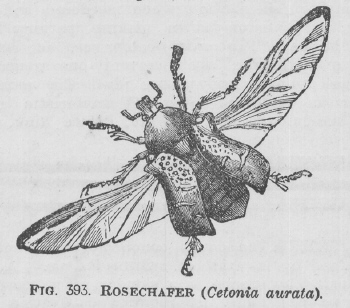
Rosechafer. This is one of the handsomest of English Beetles, and is easily known by its size (from 2/3in. to nearly 1in. long), and its colour, which is usually brilliant golden-green on the back, with wavy, white marks on the wing-cases near the tips, and three slightly raised lines on each. Sometimes, the colour is deep black above. The lower surface of the body is bright copper-coloured. The body is somewhat heavy in form. The Rosechafers take their common name from the beetles being partial to the flowers of Roses, which they injure, to some extent, by gnawing the sexual organs. Their colour has also given rise to the name Green Rosechafer. The larvae feed on dead wood; and the beetles, when emerged from the pupae, have usually to bore their way to the outer air. Handpicking the beetles is the best remedy, since only in this state are they readily discovered.