Rubus
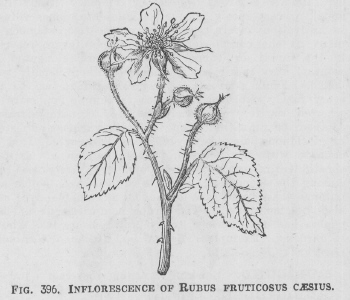
(the Roman name, kindred with ruber, red). Bramble, &c. Including Comaropsis (in part), Dalibarda. ORD. Rosaceae. A large genus (comprising, according to Bentham and Hooker, probably about 100 distinct species) of stove, greenhouse, or hardy, creeping herbs or generally sarmentose and prickly shrubs, broadly dispersed. Flowers white or pink, disposed in terminal and axillary panicles or corymbs; calyx explanate, with a short, rather broad, ebracteolate tube and five persistent lobes; petals five; stamens numerous, very rarely definite; filaments filiform; anthers didymous; carpels numerous, rarely few, inserted on a convex receptacle; achenes drupaceous, rarely dry. Fruit often edible. Leaves scattered, alternate, simple, lobed, three to five-foliolate, or impari-pinnate; stipules adnate to the petioles. Among the most important species of this extensive genus are the following: R. Chamaemorus (Cloudberry), R. fruticosus (Blackberry) and R. f. caesius (Dewberry), R. Idaeus (Raspberry), and R. occidentalis (Virginian Raspberry). A selection of the best-known species is presented below. Except where otherwise indicated, they are hardy, deciduous shrubs. They succeed in almost any good garden soil, and may be propagated by seeds, by layers, and by covering the points of the shoots with soil. R. biflorus is very ornamental on a wall, because of its stems, which appear as if they had been whitewashed. R. laciniatus is a fine, free-growing, and ornamental subject for planting in beds where it can be allowed to grow freely. Of the common Bramble (R. fruticosus) there are several varieties well worthy of being cultivated for their large fruits, which are handsome and good, either raw, cooked, or preserved. They are mostly of American origin, and succeed well under similar culture to the Raspberry (which see). The following are the best: EARLY HARVEST, medium-sized fruit, an immense cropper, very vigorous; KITTATINNY; LAWTON; MAMMOTH; PARSLEY-LEAVED; WILSON, JUN., one of the finest and most prolific varieties, new; WILSON'S EARLY, fruit large, early, plant very productive. The common species itself bears immense quantities of fruits in the hedgerows, which are sometimes gathered and made remunerative. R. arcticus (Arctic). fl. reddish; sepals lanceolate, often shorter than the obovate, entire or emarginate petals. June. fr. amber-coloured, delicious. l. trifoliolate; leaflets rhombic-ovate or obovate, coarsely and often doubly serrated, petiolulate. Stem low, herbaceous, unarmed. Arctic regions of both hemispheres. (B. M. 132; R. G. 314.)
R. australis (Southern).* fl. pink or whitish, fragrant, very numerous, in branched, prickly, downy panicles, 1/3in. to 1/2in. in diameter. Early summer. fr. numerous, yellowish, juicy, austere. l. very variable, ovate to lanceolate, or reduced to prickly midribs, 3in. to 5in. long. Prickles scattered, recurved. New Zealand. A lofty climber, hardy against a wall or in a sheltered spot.
R. biflorus (two-flowered).* fl. white, 1/2in. to 3/4in. in diameter, one to three together on axillary, slender, drooping peduncles; calyx pubescent. May. fr. golden-yellow, globose, 3/4in. in diameter; drupes twenty to thirty. l., leaflets three or five, 1in. to 1 1/2in. long, ovate, lobulate, doubly toothed, white and tomentose beneath, pubescent or hairy above. Stems and branches rambling, white with glaucous bloom; prickles very strong, recurved. Himalayas, 1818. (B. M. 4678.)
R. canadensis (Canadian). American Dewberry; Low Blackberry. fl. white, racemose, with leaf-like bracts. May. fr. blackish, ovate or oblong, excellent, ripening earlier than that of R. villosus. l., leaflets three (or pedately five to seven), oval or ovate-lanceolate, mostly acute, thin, nearly smooth, sharply cut-serrated. Stems extensively trailing, slightly prickly. North America, 1811.
R. Chamaemorus (ground Mulberry).* Cloudberry. fl. white, 1in. in diameter; sepals unequal, villous; petals oblong. June and July. fr. orange-yellow, 1/2in. in diameter; drupes few, large. l. few, sub-orbicular-cordate, obtusely five to seven-lobed, 1in. to 3in. in diameter, petiolate, crenate, wrinkled. Stem 4in. to 8in. high, erect, unarmed, simple, one-flowered, herbaceous or nearly so. Europe (Britain). (Sy. En. B. 440.) R. crataegifolius (Hawthorn-leaved). fl. white, axillary, solitary, or terminal, sub-racemose; sepals acuminate, mostly recurved; petals clawed, obovate-spathulate, often retuse at apex. fr. rich dark red. l. cordate, trifid, or more or less lobed or toothed. Branches, petioles, and nerves of the leaves, armed with recurved prickles. North China and Japan (R. G. 591, 924.)
R. cuneifolius (wedge-shape-leaved). Sand Blackberry. fl. white; petals large; peduncles two to four-flowered. May to July. fr. blackish, ovate or oblong, good-flavoured, ripening in August. l., leaflets three to five, cuneate-obovate, rather thick, serrated above. Stems upright, armed with stout, recurved prickles. Branchlets and under side of leaves whitish-woolly. h. 1ft. to 3ft. North America, 1811.
R. Dalibarda (Dalibarda). This is the correct name of the plant described in this work as Dalibarda repens.
R. deliciosus (delicious).* fl. purple; sepals ovate-oblong, with a dilated acumination, shorter than the oval petals. May. fr. large, and of delicious flavour. l. reniform-orbicular, wrinkled, slightly three to five-lobed, finely serrate-toothed; stipules persistent. Stem erect. Branches, young leaves, and calyx, tomentose-pubescent. h. 3ft. North America, 1870. (B. M. 6062; G. C. n. s., xv. 537.)
R. fruticosus (shrubby).* Blackberry; Common Bramble. fl. white or pink, in terminal racemes, the lateral branches corymbose or elongated. July to September. fr. black or reddish-purple. l. usually pinnately three to five foliolate, subpersistent, glabrous or pubescent; leaflets on long or short petioles, obovate or rhomboid-obovate, coarsely and irregularly serrated or toothed, convex, dark green above, pale and often glaucous beneath. Stem glabrous or bristly, prickly. Europe (Britain), &c. Under this species, Mr. Baker classities twenty-one sub-species.
R. f. caesius (grey). Dewberry. fl., sepals appressed, densely tomentose all over the back. fr., drupes few, large, glaucous. l., leaflets usually three, green on both surfaces. Stem prostrate, glaucous. Prickles unequal, setaceous.
R. Idaeus (Mount Ida). Raspberry. fl. white, drooping; calyx long-tipped; cymes 1/3in. in diameter, few-flowered. June to August. fr., drupes many, red or yellow, hoary. l. ovate or elliptic, acuminate, 3in. to 5in. long, acutely and irregularly serrated, white and hoary beneath. Stems 3ft. to 5ft. high, biennial, terete, prickly, pruinose. Europe (Britain). For culture, &c. see Raspberry.
R. laciniatus (torn).* fl. white or rose-coloured, in loose panicles; calyx segments prickly, somewhat leafy, reflexed at apex; petals three-lobed at apex. June to September. l., leaflets three to five, dissected and sharply serrated, puberulous beneath. Stems nearly terete, straggling. Prickles dilated at base. (W. D. B. 69.)
R. lasiocarpus (woolly-fruited). fl. deep pink, small; petals orbicular or broadly obovate; corymbs small, axillary and terminal, corymbose. May. fr. red or orange, small, globose, hoary. l. 3in. to 10in. long; leaflets five to nine, ovate, elliptic, or ovate-lanceolate, 1in. to 3in. long. acutely toothed or serrated, beneath usually hoary, the terminal one above lobulate. Branches cylindric, rambling. Prickles stout, variable. Himalayas.
R. l. pauciflorus (few-flowered). fl. small, puberulous, crowded in corymbs. A common Himalayan form, glabrous and shining except the under surface of the leaves. (B. R. 854, under name of R. pauciflorus.)
R. nutans (nodding). fl. white, usually solitary, axillary, 1 1/2in. broad, on stout peduncles; calyx tube villous. June. fr. of few scarlet drupes. l., leaflets three, orbicular or sub-rhomboidal, 1 1/2in. to 3in. long and broad, obscurely lobed, acutely and doubly toothed, the lateral ones shortly petiolulate. Stem 1ft. to 2ft. long, unarmed, from a woody rootstock. Himalayas, 1850. (B. M. 5023.) R. nutkanus (Nootka). fl. white, very large; sepals long-cuspidate; peduncles rather few-flowered. August. fr. red. l. five-lobed; lobes nearly equal, broad, coarsely and unequally toothed. Stems flexuous, hirsute. h. varying from 1ft. to 10ft. North America, 1826. (B. M. 3453; B. R. 1368; S. B. F. G. ser. ii. 83.)
R. occidentalis (Western). Black Raspberry; Thimbleberry; Virginian Raspberry. fl. white; petals small, erect, shorter than the sepals. May. fr. purplish-black (rarely whitish), hemispherical, ripening early in July. l., leaflets three, rarely five, ovate, acute, coarsely and doubly serrated, white-downy beneath, the lateral ones somewhat stalked. Stems recurved, with hooked prickles. North America, 1696.
R. odoratus (fragrant). Purple-flowering Raspberry. fl. purplishrose, showy, 2in. broad; calyx lobes tipped with a long, narrow appendage; petals rounded; peduncles many-flowered. June to August. fr. reddish, flat and broad. l. three to five-lobed; lobes pointed and minutely toothed, the middle one prolonged. Stem 3ft. to 5ft. high, not prickly. North America, 1700. (B. M. 323.)
R. parvifolius (small-leaved). fl. red, racemose; calyx segments tomentose, ovate, short. August and September. fr. red, globose. l. trifoliolate; leaflets clothed with white tomentum beneath. Stems terete, tomentose. h. 1ft. to 2ft. Japan, 1818. (B. M. 496.)
R. phoenicolasius (purple-haired). fl. pale pink, in terminal racemes; calyx 1 1/2in. to 2in. in diameter; petals minute, erect. Midsummer. fr. scarlet, ovoid-oblong, 3/4in. long, of forty or more ellipsoid drupes. l. 5in. to 7in. long, pinnately trifoliolate or the uppermost ones simple; leaflets crenate-serrated, white-tomentose beneath. Stem tall, sub-scandent. Japan, 1877. Plant covered with stiff, gland-tipped, red-purple hairs. (B. M. 6479.) R. reflexus (reflexed). fl. white, racemose, axillary; sepals ovate, bluntish, equalling the petals; racemes few-flowered, nearly sessile, reflexed. July and August. l. oblong-cordate, three to five-lobed, densely tomentose beneath; terminal lobe elongated. Stems unarmed, straggling. Branches terete. China, 1817. Greenhouse. (B. R. 461.)
R. rosaefolius (Rose-leaved). fl. white, 3/4in. to 1in. in diameter, solitary or in very loose panicles. August. fr. orange-red, globose or oblong, of innumerable, minute, glabrous drupes. l., leaflets five to seven, ovate-lanceolate, acuminate, doubly incised-serrated, 1in. to 2in. long, rarely more. Stems erect or inclined, with scattered, hooked prickles. Himalayas, 1811. Greenhouse. (F. d. S. 1714.)
R. r. coronarius (crowned). fl., petals numerous, much longer than the calyx. (B. M. 1783; G. C. n. s., xi. 77; L. B. C. 158.)
R. spectabilis (showy).* Salmon Berry. fl. bright red, very large; sepals hairy at base, much shorter than the petals; peduncles solitary or in pairs, one or two-flowered. May. fr. red, ovoid, more than double the size of the common Raspberry, but inferior in flavour. l., nearly glabrous, trifoliolate; leaflets ovate, acuminate, membranous, somewhat pinnatifidincised, serrated, the lateral ones distant from the terminal one, often deeply two-lobed. Stem erect, 6ft. to 10ft. high, unarmed or with deciduous prickles. North America, 1827. (B. R. 1424; L. B. C. 1602.)
R. strigosus (hairy). American Wild Red Raspberry. fl. white, small; petals erect, as long as the sepals. June and July. fr. light red, hemispherical, ripening all summer, "tenderer than the garden or European Raspberry" (Asa Gray). l., leaflets three to five, oblong ovate, acute, cut-serrated, whitish-downy beneath, the lateral ones sessile. Stems biennial and woody, prickly, upright. h. 3ft. North America.
R. triflorus (three-flowered). Dwarf Raspberry. fl. white, small; sepals and petals often six or seven, the latter erect; peduncle one to three-flowered. June. fr. of few separate grains. l. three (or pedately five) foliolate; leaflets rhombic-ovate or ovate-lanceolate, acute at both ends, coarsely and doubly serrated, thin, smooth. Stems ascending, 6ft. to 12ft. high, or trailing, not prickly. North America. (H. F. B. A. i. 62.)
R. villosus (hairy). American High Blackberry. fl. white, racemose, numerous; sepals much shorter than the obovateoblong petals. May and June. fr. blackish, large, ripening in August and September. l., leaflets three (or pedately five), ovate, acute, unequally serrated, the terminal ones somewhat cordate, conspicuously stalked. Stems upright or reclining, armed with stout, curved prickles. h. 1ft. to 6ft. North America, 1777.