Ruscus
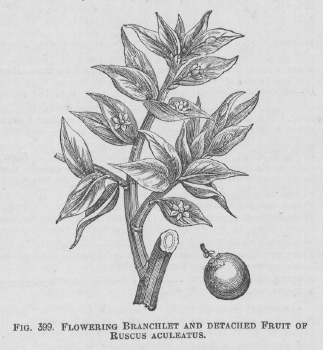
(the old Latin name, used by Virgil and Pliny). Butcher's Broom. ORD. Liliaceae. A small genus (two or three species) of hardy plants, with erect, branched, slightly woody stems, natives of Europe and the whole Mediterranean region, from Madeira to the Caucasus. Flowers small, usually on the face of the cladode; pedicels short, articulated at the apex. Berries globose, pulpy, indehiscent. Cladodes leaf-like, alternate or scattered, ovate or ovate-lanceolate, acute or pungent-pointed, rigidly coriaceous. The species thrive in common soil, and may be propagated by root-suckers.
R. aculeatus (prickly). Common Butcher's Broom; Pettigree or Pettigrue. fl. one or two, bracteate and bracteolate. February to April. fr. bright red, rarely yellow, 1/3in. in diameter. cladodes 1/2in. to 1 1/2in. long, ovate, rigid, spinescent, twisted at the base. Stems 10in. to 2ft. high, erect. Europe (Britain), North Africa &c. (Sy. En. B. 1516.) R. androgynus (hermaphrodite). A synonym of semele androgyna.
R. Hypophyllum (leaf-under-leaf).* Double Tongue. fl. five or six in an umbel, disposed in the middle of the lower cladodes. May and June. fr. red, 1/2in. to 3/4in. thick. cladodes oblong or oblong-lanceolate, 3in. to 5in. long; upper ones alternate; lower ones opposite, ternate, or verticillate, distinctly costate. h. 1ft. to 1 1/2ft. Mediterranean region, 1640. (B. M. 2049.) R. Hypoglossum is regarded, by Mr. Baker, as a form of this species. R. racemosus (raceme-flowered). Alexandrian Laurel. fl. greenish-yellow, hermaphrodite, produced at the ends of the branches. May. fr. red, with a round, coriaceous, white disk at the base. cladodes oblong, acute, about 2in. long, rounded at base, smooth, lucid-green, alternate, sessile. h. 4ft. Portugal, 1739. Evergreen shrub. (W. D. B. 145.) Danae racemosa is the correct name of this plant.