Important: Safety Warning
This page recommends pest-control substances such as arsenic compounds, strychnine, or cyanide — in some cases applied to food crops. These substances are lethal to humans and animals, and their use is now banned or strictly controlled.
This information has been left in for historical purposes but should not be acted upon.
Salix
(the old Latin name used by Virgil, &c.; connected with the Greek Lelike and English Sallow). Osier; Sallow; Willow. ORD. Salicineae. An extensive genus (about 160 species are enumerated by Anderson) of mostly hardy trees or shrubs, broadly dispersed. Flowers sessile; catkins often dense, erect, in temperate regions often early, sessile, and naked, in warmer and frigid regions coaetaneous, leafy-pedunculate; bracts small, entire or rarely toothed. Leaves often narrow or small, entire or serrulated, penniveined; stipules variable. The wood of the Willows "is soft and light, and is applied to a great variety of purposes, especially for building fast-sailing sloops of war, and for making cricket-bats. Split into thin strips, it is manufactured into hats. The twigs have, from the earliest antiquity, been employed in basket-work, and in Pliny's time (as they are, indeed, at present, in the Northern countries of Europe) were twisted into ropes. The leaves of several species are, on the Continent, used as fodder for cattle, being collected in summer and stacked for winter consumption. In Sweden and Norway, the bark is kiln-dried in seasons of scarcity, and is mixed with oatmeal" (Lindley and Moore). The species used for basket-making are commonly called Osiers; those best adapted for wicker-work are S. triandra and S. viminalis. Many species have been introduced into England, but only the most desirable are described in this work. Willow grow most freely when planted near water, but they succeed almost anywhere in heavy soil and damp situations. Propagated freely by cuttings, made by firm wood of almost any reasonable size.
Fungi. The Fungi parasitic on the various species of Willows are rather numerous, though seldom so hurtful as to seriously injure the trees or shrubs. Hence, it is unnecessary to enter upon a long account of them here, and only a few of the more generally-diffused species will be mentioned. The leaves of most kinds of Willows are very apt, in summer and autumn, to become covered with small, yellow or orange spots, which, under a good microscope, are found to be composed of groups of rounded, yellow or orange cells, loosely massed together, and surrounded by the torn edges of the epiderm or skin of the leaf. These belong to a Fungus formerly known as Lecythea caprearum, and as Uredo mixta. The cells are only an early condition of a Fungus named Melampsora salicina. In the latter stage, the Fungus occurs in spring, on leaves lying on the ground, in the form of black spots, made up of oblong, dark spores wedged as closely together as they can lie side by side.
Another very common Fungus on Willows assumes the form of a black crust on the leaves and branches. In its young state, it resembles a dark mould, and has been named Fumago vagans; but, when mature, it shows elongated perithecia with asci, in which lie six brown, multicellular spores. This mature condition is not frequent.
A third Fungus that attacks Willows belongs to the same group (Perisporiacei) as the last, but differs in colour, covering the leaves with a whitish coat (see Mildew and Oidium). This parasite bears the name of Uncinula adunca. The whitish coat is formed by the Oidium stage. After a time, numerous perithecia are formed on it, at first yellow, but afterwards becoming black, each of which bears on its surface a number of stiff hairs, hooked at the tip. For general structure, see references just given.
The leaves of Willows are often spotted by the growth on them of certain Moulds, and of such genera as Septoria and its allies, which are generally regarded as young conditions of Pyrenomycetes (which see for structure); but, beyond rendering the leaves unsightly towards the end of autumn, they do not materially injure the trees. The trunks of old Willow-trees are liable, like almost all other trees, to serious injury from the growth in them of mycelium of some of the larger Fungi, the presence of which is indicated by the appearance, on the exterior of the infected portions of the trunk, of mushrooms, Polypori, or other reproductive bodies, varying according to the species of the Fungi. Trees thus infested are not worth preservation, and had better be used as firewood than be left as centres of infection. The Fungi that grow on the leaves are best got clear of by sweeping up and burning all fallen leaves in autumn.
Insects. Several hundred species of insects are known to feed more or less upon Willows; but only a comparatively small number are so hurtful as to require notice here. Some of the latter are chiefly or wholly associated with the Sallows allied to Salix Caprea.
The trunks of Willows are very frequently tenanted by larvae of Aromia moschata (see Musk Beetle) and of the Goat Moth (which see), and in some districts the twigs of Osiers suffer much from the burrows of larvae of the Clearwing Moths, Sesia formicaeformis and S. bembeciformis (see Sesia). For the proper remedies against these insects, see the headings quoted.
Certain species of Sawflies (e.g., Cryptocampus angustus, C. pentandroe, &c.), one or two Beetles (e.g., Saperda populnea), and some Gall-midges (e.g. Cecidomyia salicina), produce galls in the form of tapering swellings on the twigs of Osiers; while other species of Gallmidges (C. rosaria, &c.) cause the leaves at the tips of the twigs to become crowded into a stunted rosette. These gall-makers can best be reduced in numbers by cutting off the twigs while the galls are still young, and the larvae too immature to survive the withering of their food.
The leaves are liable to be devoured by Cockchafers, by species of Rhynchites, and, worst of all, by the Willow-leaf Beetle (see Phratora vitellinae). For an account of these insects, see the above headings. In some parts of the Fen districts, Osiers have been very much destroyed by the last-named species, but Paris green is now used with success to limit its ravages. Some allied Beetles, of the group Chrysomelidae, may occasionally injure Willows, but are not often sufficiently numerous to require special treatment.
The larvae of a few Butterflies, of many species of Moths, and of a good many Sawflies, feed, more or less exposed, on the leaves of Willows; but an enumeration of the species is not needed, since their general habits are much alike, and the same treatment is employed to get clear of them, viz., to collect and destroy the creatures, whether by hand-picking, or by shaking the branches over sheets or other surfaces.
The leaves of Willows are very liable to be thickly studded with Sawfly galls, some resembling a small bean in shape, imbedded in the leaf-blade singly or in pairs (the work of Nematus viminalis, also known as N. gallarum), or like peas in form, attached to the lower surface of the leaf by one side (galls of N. gallicola, &c.). These galls often greatly disfigure the leaves, but do not seriously affect the health of the plants. The leaves, if necessary, should be removed, while the galls are young, and allowed to wither. The same method may be made use of against the smaller galls, such as the fleshy tubes of Cecidomyia marginem-torquens along the leaf-margins of S. viminalis, or the warty galls of various Mites on the surfaces of the leaves, especially on Sallows allied to S. Caprea.
The species described below are hardy trees, except where otherwise stated.
S. acutifolia (acute-leaved). A synonym of S. daphnoides. S. alba (white).* White Willow. fl., catkins appearing with the leaves, slender, loose, erect, the scales linear. May. l. narrowly lanceolate, long-acuminate, 2in. to 4in. long, silky on both sides, glandular-serrate; petioles eglandular. Trunk 20ft. in girth; bark fissured; twigs silky. h. 80ft. Europe (Britain), &c. (Sy. En. B. 1309.)
S. a. caerulea (blue). l., old ones glabrous, glaucous beneath. Twigs olive. (Sy. En. B. 1310.)
S. a. vitellina (yolk-of-egg-coloured). Golden Willow. fl., scales of catkins longer than in the type. l., old ones glabrous above. Twigs yellow or reddish. (Sy. En. B. 1311.)
S. ambigua (ambiguous). A synonym of S. nigra.
S. babylonica (Babylonian).* Weeping Willow. fl., catkins nearly 1in. long, sub-coaetaneous, few-leaved, very slender, shortly curved; scales ovate-lanceolate. May. l. narrow-lanceolate, 3in. to 6in. long, very long and rather obliquely acuminate, serrulated, often glaucescent beneath; stipules semi-lunar or obtuse; branches often very loosely and very long-pendulous. Buds very acute. h. 30ft. Levant, 1730. (B. F. F. 59.) SYN. S. pendula.
S. b. annularis (ringed). This form is peculiar on account of the blade of the leaves being twisted back, so as to form a kind of ring.
S. Caprea (Caprea).* Common Sallow; Goat Willow. fl., cat-kins silky, preceding the leaves; males 1in. long, very stout; females lengthening to 3in. April and May. l. elliptic, oblong-ovate, or oblong-lanceolate, acute or acuminate, cuspidate, 2in. to 4in. long, dark green above, tomentose beneath, the margins narrowly recurved. Europe (Britain). A silvery tree or large shrub, the earliest-flowering of the British Willows. The twigs with catkins, gathered on Palm Sunday, are called Palm-branches. See Figs. 403 and 404. (Sy. En. B. 1331.) S. C. cinerea (waxy). fl., male catkins less stout than in the type, opening later. l. smaller, narrower, from elliptic-oblong to oblanceolate, undulated at the margins, pubescent above. Buds and twigs tomentose. S. aquatica and S. oleifolia are mere forms of this sub-species.
S. C. pendula (drooping). Kilmarnock Weeping Willow. A variety remarkable for the very decided pendulous character of its branches.
S. daphnoides (Daphne-like). Violet Willow, fl., catkins stout, sessile, clothed with silky hairs, appearing before the leaves; scales black-pointed. April. l. narrow-oblong or linear-lanceo late, very acuminate, 3in. to 6in. long, acutely serrated, with persistent, glaucous bloom, shining above. Twigs violet. h. 10ft. to 20ft. Europe (naturalised in England). (B. F. F. 62; F. D. 2919.) SYN. S. acutifolia.
S. falcata (sickle-shaped). A synonym of S. nigra falcata.
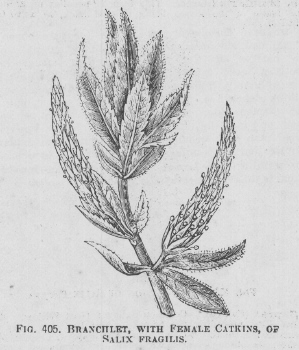
S. fragilis (fragile). Crack Willow; Withy. fl., catkins usually spreading, stout, appearing with the leaves; males 1in. to 2in. long; females slender, often longer. April and May. l. lanceolate, long-acuminate, 3in. to 6in. long, glabrous, glandularly serrated, pale or glaucous beneath, the young ones hairy. Trunk sometimes 20ft. in girth; branches spreading obliquely; twigs yellow-brown, very fragile at the junction, polished. h. 80ft.to 90ft. Europe (Britain).(Sy. En. B. 1306.) S. decipiens is a variety with smaller leaves, and orange or crimson twigs.
S.Iucida (shining). fl., catkins pedunculate, borne on the summit of lateral, leafy branches of the season; scales greenish-yellow, more or less hairy. May and June. l. ovate-oblong or lanceolate and narrow, usually with a long, tapering point, smooth and shining on both sides, serrated; stipules oblong and toothed. Branches very brittle at the base. North America. A beautiful species, sometimes flowering at a height of 3ft., sometimes becoming a small, bushy tree of 12ft. to 15ft. (T. S. M. 310.) S. nigra (black). fl., catkins similar to those of S. lucida; scales short and rounded, woolly. May and June. l. narrow-lanceolate, pointed and tapering at each end, serrated, smooth (except on the petiole and midrib) and green on both sides; stipules small, deciduous. Branches very brittle at base; bark rough and black. h. 15ft. to 25ft. North America. (T. S. M. 307.) SYN. S. ambigua.
S. n. falcata (sickle-shaped). l. elongated-falcate; stipules large, broadly lunate, reflexed. SYNS. S. falcata, S. Purshiana.
S. pondula (drooping). A synonym of S. babylonica.
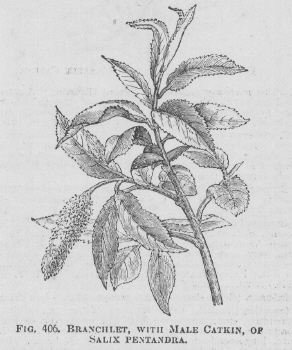
S. pentandra (five-stamened). Bay-leaved Willow. fl., catkins shortly pedunculate; males lin. to 2in. long, erect, at length pendulous; stamens five; females shorter; scales pale. May and June. l. elliptic or ovate-or obovate-lanceolate, acuminate, lin. to 4in. long, glandularly serrulated, fragrant, viscid, shining, paler and reticulated beneath; stipules ovate-oblong or absent. Bark brown. Europe (Britain). A shrub 6ft. to 8ft., or tree 20ft. high. The latest-flowering Willow.(Sy. En. B. 1303.) S. cuspidata is probably a hybrid between this species and S. fragilis.
S. phylicifolla (Phylica-leaved).* Tea leaved Willow. fl., catkins sessile, bracteate; scales linear-oblong, acute, black. April and May. l. ovate-oblong or elliptic-lanceolate, quite glabrous, shining above, glaucous beneath; stipules very small or absent. h. 10ft. Europe (Britain). A very handsome large bush or small tree; when fully developed, it is conspicuous from its spreading, shining, chestnut or reddish branches, and glistening green and glaucous foliage. S. nigricans is closely related to this species. The following British forms have been described as species: (1) Erect, with silky capsules, S. Croweana, S. Davalliana, S. Dicksoniana, S. nitens, S. tenuior, S. Weigeliana. (2) Erect, with glabrous or nearly glabrous capsules, S. Borreriana, S. laxiflora, S. phillyreaefolia, S. propingua, S. tenuifolia, S. tetrapla. (3) More or less decumbent and rooting, with silky capsules, S. radicans. (Sy. En. B. 1334 to 1346.) S. laurina, a small, handsome tree, 20ft. to 30ft. high, is probably a hybrid between S. phylicifolia and S. Caprea. S. purpurea (purple). Purple Osier. fl., catkins sub-sessile, 3/4in. to 1 1/2in. long, opposite or alternate, erect, then spreading or recruved, cylindric; scales purple-black above. March and April. l. often sub-opposite, thin, linear-lanceolate, serrulated, glabrous, 3in. to 6in. long, sparingly hairy when young, shortly petiolate. Bark red or purple. h. 5ft. to 10ft. Europe (Britain). An erect or decumbent shrub. S. Lambertiana, S. ramulosa, and S. Woolgariana are varieties. (Sy. En. B. 1316-1319.) S. Doniana and S. Pontederana are hybrids between this species and, respectively, S. repens and S. cinerea.
S. Purshiana (Pursh's). A synonym of S. nigra falcata.
S. rubra (red). fl., filaments usually more or less free. l. silky beneath. A common and very variable Osier-bed shrub, the result of a cross between S. purpurea and S. viminalis. (Sy. En. B. 1320.) The following is a form:
S. r. Helix (Helix). Rose Willow. fl., filaments united at the top. l. sub-opposite. This plant bears fascicles of diseased leaves, owing to the punctures of a Cynips; hence the common name.
S. Russelliana (Russell's). A synonym of S. viridis.
S. triandra (three-stamened). Almond-leaved or French Willow. fl., catkins shortly pedunculate, lin. to 2in. long, slender, appearing with the leaves, the females narrow; stamens three. April to June. l. linear or oblong-lanceolate, acuminate, glandularly serrated, 2in. to 4in. long, glabrous, glaucous beneath; stipules large, semi-cordate. Bark flaking. Twigs terete. h. 20ft. Arctic Europe (Britain) and North Asia. (Sy. En. B. 1313.) SYN. S. Villarsiana. The following varieties were formerly regarded as distinct species:
S. t. amygdalina (Almond-like). l. rounded at the broad base, glaucous beneath. Twigs furrowed.
S. t. Hoffmanniana (Hoffmann's). l. broader at base than in the type, green beneath. Twigs terete.
S. Villarsiana (Villars'). A synonym of S. triandra.
S. viminalis (twiggy). Osier. fl., catkins golden-yellow, sessile, 3/4in. to 1in. long, opening long before the leaves; scales brown, oblong. April to June. l. linear-lanceolate, acuminate, 4in. to 10in. long, narrowed into the petioles, reticulated above, silvery-silky beneath, the margins revolute, quite entire. Branches long and straight, the young ones silky, the adults polished, h. 30ft. Europe (Britain). Shrub or small tree.(Sy. En. B. 1322.) S. Smithiana and S. stipularis are supposed to be hybrids between this species and S. Caprea or, in the latter, S. cinerea. Both closely resemble S. viminalis.
S. viridis (green). fl., catkins on short, leafy, lateral branches, spreading or recurved, cylindrical, dense in flower, lax in fruit. May and June. l. narrowly lanceolate-elliptic, attenuated at base and long-acuminate at apex, or equally attenuated at each end, glandular-serrated, glabrous on both sides when mature; young ones silky. Young branches downy. h. 30ft. Europe (Britain). (Sy. En. B. 1808.) SYN. S. Russelliana.