Scabiosa
(from scabies, the itch, which disease the common species is said to cure). Pincushion Flower; Scabious. Including Asterocephalus, Knautia, Pterocephalus, and Succisa. ORD. Dipsaceae. A genus comprising, according to the authors of the "Genera Plantarum," not more than eighty distinct species of mostly hardy, annual or perennial herbs, sometimes more or less shrubby at base. Flower-heads blue, rose, purple, yellowish-white, or white, terminal; involucral bracts in one or two series; involucels two, four, or eight-ribbed; calyx bristly; corolla limb four or five-fid, sub-equal, or often oblique or bilabiate; stamens four, very rarely two, all perfect. Leaves entire, toothed, lobed, or dissected. A great many species have been introduced, but the selection given below comprises the best-known. They succeed in ordinary garden soil, and may be increased by seeds, also sometimes by division. S. atropurpurea and its varieties are most useful subjects for cutting, and plants may be grown in pots for winter flowering with good effect. For this purpose seeds should be sown in June or July, and the plants, when large enough, potted off singly and grown in a cool frame. For flowering outside in summer, sow in March or early in April. S. caucasica is a very handsome border plant. The species described below are hardy perennials, except where otherwise indicated.
S. amoena (pleasing).* fl.-heads lilac or rose; corollas radiant; peduncles elongated, villous under the heads. June and July. l., radical ones obovate, toothed or lyrate, rather hairy; cauline ones pinnatifid, with lanceolate, acute, nearly entire lobes. h. 2ft. to 3ft. Russia, 1820.
S. arvensis (field-loving). Egyptian or Gipsies' Rose, &c. fl.-heads pale lilac or blue, 1in. to 1 1/2in. in diameter, depressed; corollas hairy, the inner redder; peduncles long, stout. July to September. l. variable, hairy; radical ones oblong-lanceolate, entire, serrated, or crenate; cauline ones toothed, lobed, or pinnatifid. Stem 2ft. to 5ft. high, stout, hairy. Europe (Britain), &c. (Sy. En. B. 679.) S. atropurpurea (dark purple).* Mournful Widow; Sweet Scabious, &c. fl.-heads normally deep crimson, very sweet scented; corollas radiant, a little longer than the involucre. July and August. l., radical ones lanceolate-ovate, lyrate, coarsely-toothed; cauline ones pinnatipartite, with oblong, toothed or cut lobes. Stem branched. h. 2ft. to 3ft. South western Europe, 1629. A very handsome, hardy annual. Under the name of Saudade, the flowers of this species are largely employed by the Portuguese, Brazilians, &c., for funeral wreaths, and similar purposes. (B. M. 247.) There are several desirable varieties flore-pleno has double, purple or white flowers (F. d. S. 1203); foliis-aureis has very distinct, yellow leaves; nana is not more than 1ft. high, and very compact; striata has flowers spotted and streaked; two other forms have flowers white, and purple margined with white, respectively.
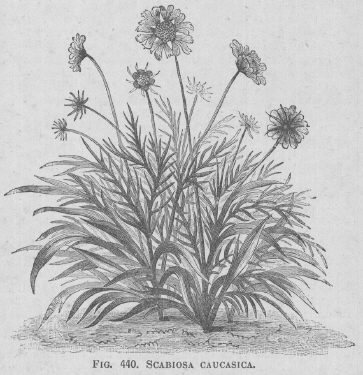
S. caucasica (Caucasian).* fl.-heads pale blue, fully 3in. in diameter, radiant; corollas five-cleft; involucre very villous. June to August. l., radical ones lanceolate, acuminate, quite entire, glaucous. h. 1ft. Caucasus, 1803. (B. M. 886.)
S. c. elegans (elegant). l. whitish; cauline ones undivided, quite entire or nearly so. (R. G. 1212.)
S. c. heterophylla (variable-leaved). fl.-heads pale purple, large. l. hairy, pinnatisect; segments linear-lanceolate, acute. 1883. (R. G. 1084.)
S. Columbaria (Columbaria). fl.-heads lilac or blue-purple, 1in. to 1-1/2in. in diameter; corollas pubescent, those of the inner flowers regular, of the outer ones rayed; peduncles slender. July to September. l. glabrous or pubescent, very variable; radical ones narrow, petiolate, entire or divided; cauline ones pinnatifid, the segments often cut. h. 1ft. to 2ft. Europe (Britain), &c. (Sy. En. B. 678.) S. graminifolia (grass-leaved). fl. heads pale blue, very like those of S. caucasica, but much smaller. June to October. l. linear-lanceolate, quite entire, of a silvery-white colour. Stems suffruticose at base. h. 1ft. South Europe, 1683. This species is well adapted for the border or rockery. (B. R. 835.)
S. pterocephala (wing-headed). fl.-heads purple, 1in. to 1-1/2in. in diameter; peduncles stout, 2in. to 3in. long. Summer. l. simple, elliptic, or lyrate-pinnatifid, crenately-toothed. Greece, 1881. A very ornamental, dwarf, tufted perennial. (B. M. 6526.)
S. succisa (Devil's Bit). Blue Bonnets; Blue Buttons, &c. fl.-heads blue-purple or white, 3/4in. to 1-1/2in. in diameter; involucral bracts shorter than the hairy corollas; peduncles appressedly-hairy. July to October. l. entire, glabrous or hairy; radical ones oblong or obovate, petiolate; cauline ones few, toothed. h. 1ft. to 2ft. Europe (Britain), &c. (Sy. En. B. 677.)
S. Webbiana (Webb's).* fl.-heads creamy-yellow, on long peduncles; corollas nearly equal. July. l., lower ones petiolate, obovate, crenate; upper ones pinnatifid, with ovate or oblong, entire lobes. h. 6in. Phrygia, 1818. Plant clothed with soft, silky, hoary tomentum. (B. R. 717.)