Schizanthus
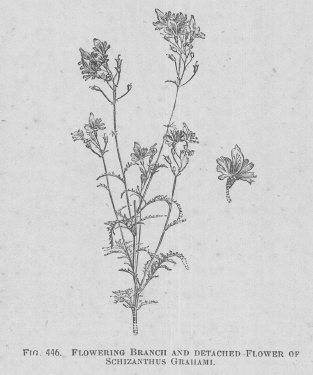
(from schizo, to cut, and anthos, a flower; alluding to the incised corolla). Butterfly or Fringe Flower. ORD. Solanaceae. A small genus (about seven species have been described) of very beautiful and showy, erect, more or less glandular-viscous, half-hardy, annual herbs, restricted to Chilli. Flowers variously coloured; calyx deeply five-cleft; corolla tube short or elongated, cylindrical; limb spreading, oblique, plaited, sub-bilabiate, imbricated, elegantly incised; perfect stamens two; cymes terminal. Leaves often pinnatisect, the segments entire or toothed. Leaves often pinnatisect, the segments entire or toothed. The species and varieties of Schizanthus form very elegant, free-flowering, border plants, in summer and autumn, outside. The half-hardy kinds may be sown in a little heat, in spring, and afterwards planted out; or in autumn, and preserved in a cool house or pit through the winter. S. pinnatus and its garden varieties are hardy, and will grow and flower freely if sown in the open ground, in March or April. These plants are well adapted for pot-culture to flower in early spring; for this purpose, seeds should be sown in August or September, and the young plants grown on singly in a frame or house where frost is merely excluded. They may be grown to flower in 7in. or 8in. pots, during early spring, when the plants become, in a greenhouse temperature, a mass of elegant foliage and curiously-shaped blossoms. Seeds ripen in great abundance. A rich soil is advisable for pot-culture, after the plants are strong enough to bear it; in the open ground, also, they well repay liberal treatment. The best-known species are here described.
S. candidus (white).* fl., corolla white; anterior lip segments laterally bilobed, the lobes shortly and irregularly incised. July. l. pinnatisect or deeply pinnatifld; segments entire, few-toothed. h. 2ft. 1843. Allied to S. Hookeri. (B. R. 1843, 45.)
S. Evansianus (Evans'). A synonym of S. pinnatus.
S. Grahami (Graham's).* fl. ample; corolla lilac or rose-colour; upper lip yellow, tipped with lilac; tube equalling the calyx. June to October. l. once or twice pinnatisect; segments entire or dentate-pinnatifid. h. 2ft. 1831. (B. M. 3044; F. d. S. 712; R. G. 385.) S. G. retusus (retuse).* fl. much larger than in the type; corolla intense rose-colour; middle segment of the anterior lip orange near the apex. l. less dissected. (B. M. 3045, B. R. 1544, and S. B. F. G. ser. ii. 201, under name of S. retusus.) A sub-variety has white flowers with crimson tips.
S. Hookeri (Hooker's). fl., corolla pale rose-colour, except the middle of the upper segment, which is yellow; middle segment of the lower lip furnished with two long horns; stamens long-exserted. l. similar to those of S. Grahami. h. 2ft. 1828. (B. M. 3070.)
S. pinnatifidus (pinnatifid-leaved). A synonym of S. pinnatus.
S. pinnatus (pinnate-leaved).* fl., corolla tube shorter than the calyx; posterior lip often violet or lilac, the middle segment cucullate, bilobed; anterior lip pale, the middle segment more or less yellowish, and spotted with purple or violet, emarginate, the lateral ones four-lobed. June to October. l. once or twice pinnatifid; segments entire, toothed, or incised-pinnatifid. h. 2ft. 1822. The following figures represent different forms of this varibale plant: B. M. 2404; B. R. 725, 1562; H. E. F. 73; P. M. B. ii. 198; S. B. F. G. 63, and ser. ii. 97. SYNS. S. Evansianus (L. & P. F. G. viii. 171), S. pinnatifidus, S. porrigens (B. M. 2521; H. E. F. 86; S. B. F. G. 76). S. Priestii (L. & P. F. G. i. 31) is a white-flowered form.
S. porrigens (spreading). A synonym of S. pinnatus.
S. Priestii (Priest's). A form of S. pinnatus.
S. retusus (retuse). A synonym of S. Grahami retusus.