Scilla
(the old Greek name used by Hippocrates). Squill; Wild Hyacinth. Including Barnardia and Ledebouria. ORD. Liliaceae. A genus embracing nearly eighty species of stove, greenhouse, or hardy bulbous plants, natives of Europe, temperate and mountainous Asia, and extra-tropical, or the mountains of tropical, Africa, with one from Chili. Flowers small or mediocre, racemose, on articulated pedicels; perianth blue, rose, or purplish, persistent for some time; segments nearly equal, distinct or very shortly connate towards the base, spreading, or rarely campanulate-connivent at base, one-nerved; stamens six, affixed at the base or below the middle of the segments; bracts small; racemes sometimes elongated and many-flowered, sometimes reduced to two or three, occasionally nearly corymbiform; scape simple, leafless. Leaves radical, linear, loriform, oblong, or nearly ovate. Bulb tunicated. S. autumnalis, S. nutans, and S. verna, are natives of Britain. Hardy Scillas are amongst the most beautiful of spring-flowering bulbous plants. They succeed in ordinary garden soil, and require to be planted in early autumn when the bulbs are resting. S. sibirica is also well suited for culture in pots; but these must be kept in a cold house or frame, and not subjected to heat. The greenhouse species succeed in sandy loam, and in pots 5in. in diameter, along with other Cape bulbs, in a cool greenhouse. Propagated by seeds, when obtainable, which is, however, a very slow process; and by offsets.
The selection of species given below includes the most popular and beautiful. Most of the descriptions are translated from Mr. Baker's admirable Monograph of the genus, which appeared in the "Journal of the Linnean Society," vol. xiii. The leaves, except where otherwise stated, are cotemporary with the flowers.
S. amoena (pleasing).* Star Hyacinth. fl., perianth blue, rarely whitish, five to six lines long, the segments lanceolate; pedicels ascending 1/2in. to 3/4in. long; raceme loosely three to six-flowered, 1in to 3in. long; scape weak, 4in. to 6in. long. March. l. four or five, flaccid, lorate, ascending, glabrous, 6in. to 9in. long, 1/3in. to 2/3in. broad. Austria, Germany, &c., 1596. Hardy. (B. M. 341; J.F.A. 218; L.B.C. 1015.)
S. a. sibirica (Siberian). A synonym of S. sibirica. S. amoenula (rather pretty). A synonym of S. sibirica.
S. autumnalis (autumnal). fl., perianth reddish-purple, 1/2in. in diameter; pedicels ascending or spreading; racemes short; scapes several, equalling the leaves. July to September. l. autumnal, succeeding the flowers, narrow, 3in. to 6in. long, halfterete, grooved above. Europe (Britain), North Africa. Hardy. (B.M. 919; Sy. En. B. 1526.) The form iaponica has beautiful rose-coloured flowers.
S. Bertheloti (Berthelot's). fl., perianth pale lilac, campanulate, one line long; pedicels ascending, as long as the perianth; raceme twelve to twenty-flowered, 1in. to 2in. long; scape slender, 6in. to 8in. long. April. l. five or six, slender, spreading, lorate, 6in. to 12in. long, 1/2in. to 3/4in. broad, long-attenuated. Tropical Africa, 1862. Greenhouse. (B.M.5308.)
S.bifolia (two-leaved).* fl., perianth blue, sometimes reddish or whitish, four to five lines long, the segments spreading; pedicels ascending, 1/2in. to 1in. long; raceme deltoid, three to eight-flowered, 1in. to 1 1/2in. broad; scape solitary, 3in. to 6in. long. March. l. usually two, opposite, narrowed at apex, cucullate, 4in. to 8in. long, 1/3in. to 1/2in. broad, concave on the face. Mediterranean region, &c. Hardy. (B.M. 746; J.F.A. 117.)
S. b. praecox (early). fl. ten to fifteen, appearing earlier than those of the type, rather large; pedicels 1in. to 1 1/2in. long. l. thicker and broader. A robust form. (S.B.F.G. ser. ii. 14, under name of S. praecox.) S. rosea is a sub-variety of this, with reddish flowers.
S. b. taurica (Taurian). l. usually three or four. Tauria. (R.G. 307.)
S. campanulata (bell-shaped). A synonym of S. hispanica. S. chinensis (Chinese).* fl., perianth rose-purple, one line long; bracts whitish, minute; pedicels ascending, about 1/8in. long, the lower ones often twin; raceme somewhat dense, twenty to sixty-flowered, 1in. to 2in. long; scape slender, straight, 1ft. or more long. June, l. two or three, equalling or exceeding the scape, rather hard, acute, channelled down the face. China, 1826. Half-hardy. SYN. Barnardia scilloides (B.M. 3788; B.R. 1029).
S. concinna (neat). fl., perianth rose-purple within, oblong-cam-panulate, 1/5in. long; pedicels all erecto-patent, four to five lines long; raceme dense, twenty to thirty-flowered, oblong, 1 1/2in. to 2in. long; scape firm, erect, terete, 2in. to 6in. long. Spring. l. three or four, nearly erect, linear, 8in. to 9in. long, 1/2in. to 3/4in. broad, profusely purple-spotted at back. South Africa, 1862. Greenhouse. (Ref. B. 235.)
S. concolor (one-coloured). fl., perianth greenish, rounded, campanulate, about 1/5in. long; pedicels two to four lines long, the lower ones drooping; racemes dense, thirty to fifty-flowered, oblong-cylindrical, 3in. to 4in. long; scapes one to three, flexuous, 3in. to 4in. long. Spring. l. five or six, falcate, ligulate-lanceolate, 5in. to 8in. long, 1 1/4in. to 1 1/2in. broad, obtuse or subacute, very slightly narrowed at base, unspotted. South Africa, 1862. Greenhouse. SYN. Drimia Cooperi (Ref. B.18).
S. Cooperi (Cooper's). fl., perianth bright purple, drooping, campanulate, 1/8in. long, the divisions reflexed from half-way down when expanded; pedicels 3/8in. to 1/2in. long, spreading, or the lowest slightly nodding; raceme moderately dense, thirty to fifty-flowered, 2in. to 3in. long, 1in. broad; scape firm, erect, 4in. to 5in. long. Spring. l. four or five, ascending, 10in. to 12in. long, 1/2in. to 3/4in. wide, green, streaked and spotted with purple on the back downwards. Cape of Good Hope, 1866. Greenhouse. (B.M.5580.) S. Cupani (Cupani's). fl., perianth blue, 1/4in. long, the segments oblong-obtuse; bracts whitish, slightly ciliated, 1/2in. to 3/4in. long; pedicels ascending, 1in. to 2in. long; raceme loosely six to twelve-flowered, sub-corymbose or deltoid, 1 1/2in. to 2in. long and broad; scape slender, flexuous, 3in. to 6in. long. June. l. six to eight, lorate-lanceolate, spreading, 3in. to 4in. long, six to eight lines broad, the margins pellucid and minutely ciliated. Sicily, 1834. Hardy. (B.R. 1878.)
S. floribunda (bundle-flowered). fl., perianth greenish without, rose-purple within; pedicels six to eight lines long, the central ones spreading, the lower ones drooping; raceme rather dense, containing sixty to a hundred or more flowers, 6in. to 8in. long, 2in. broad; scape erect, 6in. to 9in. long. Spring. l. nearly erect, lorate, about 1ft. long, 1 3/4in. to 2in. broad, acute scarcely narrowed at base, pale green, with large bl?? of deeper green. Cape of Good Hope, 1862. Gre?? (Ref. B. 188.)
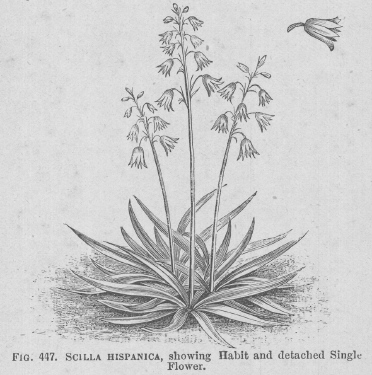
S. hispanica (Spanish).* Large or Spanish ?? fl., perianth usually blue, but often changin?? whitish, sub-globose-campanulate, 1/2in. to 3/4in. long; lower pedicels 1/2in. to 1in. long; raceme equilateral, rather loosely six to twelve-flowered; scape 6in. to 9in. long. May. l. five or six, glabrous, ascending, linear-lorate, 1/2in. to 3/4in., or in cultivated specimens 1in., broad, sub-obtuse, convex at back. Spain and Portugal, 1683. IIardy. SYNS. S. campanulata (B.M. 127), S. patula, Agraphis paniculata. The variety figured in B.M. 1102 has spreading, rather smaller flowers. The following forms, quoted in nurserymen's catalogues, differ in the colour of the flowers: alba, pure white; aperta, light blue; a. purpureo-striata, light blue, with deeper stripe; carnea, flesh-coloured; EMPEROR, porcelain, lined blue very large and beautiful.
S. Hughii (Hugh's). A form of S. peruviana glabra.
S. humifusa (prostrate). fl., perianth reddish-green, small; pedicels one line long; raceme 3in. to 4in. long; scape 3in. to 4in. long, purple at base, green above. Spring. l. two or three, cordate-oblong, 3in. to 4in. long, 1 1/2in. to 2in. broad, pale green, with a few blotches of a darker tint. Natal, 1881. Greenhouse.
S. hyacinthoides (Hyacinth-like).* fl., perianth bluish-lilac, about 1/5in. long, the segments ligulate, puberulous at apex; bracts whitish, minute, persistent; pedicels erecto-patent, the lower ones 1in. to 1 1/4in. long; racemes containing fifty to a hundred and fifty flowers, 6in. to 18in. long, 2in. to 2 1/2in. broad; scape straight, 1ft. to 2ft. or more long. August. l. ten to twelve, spreading, 1ft. to 1 1/2ft. long, 1/2in. to 1 1/4in. broad, narrowed to both ends, minutely ciliate-denticulate on the margins. Mediterranean region, 1585. Hardy. (B.M. 1140.)
S.indica (Indian). fl., perianth greenish-purple, 1/8in. to 1/6in. long. somewhat rounded-campanulate, the segments falcate; pedicels somewhat spreading, three to four lines long; raceme dense, thirty to sixty-flowered, oblong-cylindrical, 2in. to 4in. long; scapes one to three, flexuous, 2in. to 6in. long. June. l. five or six, oblong or lanceolate, acute, often with tiny bulbils on the margins, narrowed at base, 3in. to 6in. long, 1/2in. to 1 1/4in. broad. India, 1816. Stove. SYN. Ledebouria hyacintha (B.M. 3226).
S. italica (Italian). fl., perianth blue, nearly or quite 1/4in. long, segments puberulous at apex; bracts twin; raceme dense, six to thirty-flowered, at first conical, when expanded 1in. to 2in. long, 3/4in. to 1in. broad; scape solitary, slender, 6in. to 10in. long. May. l. four to six, lorate, flaccid, spreading, acute, carinate, 4in. to 8in. long, 1/4in. to 1/2in. broad, narrowed at apex. Italy, &c., 1605. Hardy. (B.M. 663; L.B.C. 1483.) S. purpurea is a robust garden form of this species with more deeply-coloured flowers.
S. lanceaefolia (lance-leaved). fl., perianth sub-globose-cam-panulate, nearly 1/4in. long, the segments purple within, greenish at back, ligulate-lanceolate; pedicels five to six lines long, the lower ones deflexed; raceme dense, thirty to fifty-flowered, oblong, 2in. to 3in. long, 1 1/4in. to 1 1/2in. broad; scapes one to three, firm, terete, 2in. to 4in. long, often decurved. May. l. six to eight, somewhat spreading, oblong, acute, 4in. to 6in. long, 1 1/2in. to 2in. broad, very slightly narrowed-at base, pale green and spotted on the face. Cape of Good Hope, 1818. Greenhouse. (Ref. B. 182.) SYNS. Drimia acuminata (I.B.C. 1041), Lachenalia lanceaefolia (B.M. 643).
S. l. ovatifolia (ovate-leaved). l. shorter than in the type, broadly ovate, 2in. to 3in. long, 1 1/2in. to 2in. broad. 1862. SYN. S. ovatifolia (Ref. B. 183).
S. lanceolata (lanceolate). fl., perianth greenish-purple, tubular-campanulate, 1/3in. long; pedicels dotted with red, somewhat spreading, the lower ones 5in. to 6in. long; raceme very loose, eight to twelve-flowered, 1 1/2in. to 2in. long, 1 1/2in. broad; scape flexuous, 4in. to 5in. long. September. l. five or six, lanceolate, acute, 3in. to 4in. long, eight to ten lines broad, green, unspotted. Cape of Good Hope, 1774. Greenhouse. SYNS. Drimia lanceolate, Lachenalia reflexa (A.B.R. 299).
S. latifolia (broad-leaved). fl., perianth lilac, campanulate, 1/8in. long, the segments ligulate; pedicels spreading, the lower ones five to seven lines long; raceme dense, thirty to sixty-flowered, 3in. to 4in. long, 1in. to 1 1/4in. broad; scape straight, 1ft. or more long. May. l. six to nine, enveloping the base of the scape, lanceolate, slender, 1ft. to 1 1/4ft. long, 1 1/2in. to 2in. broad, narrowed at base and apex, the margins glabrous. Canary Islands, 1777. Greenhouse, S. lusitanica (B.M. 1999) is only a robust garden form of this species.
S. linearifolia (linear-leaved). fl., perianth greenish outside, purple within, nearly or quite 1/4in. long, oblong-campanulate, the segments falcate; pedicels three to five lines long, the lower ones drooping; raceme rather dense, thirty to forty-flowered, oblong, 2in. to 3in. long, 1 1/4in. to 1 1/2in. broad; scape flexuous, 3in. to 4in. long. Spring. l. four to six, nearly erect, linear, 9in. to 12in. long, four to eight lines broad, acute, very slightly narrowed at base, pale green, purple-spotted at back. Cape of Good Hope, 1862. Greenhouse. (Ref. B. 184.)
S. livida (livid). fl., perianth green, tinged on the outside with very dull purple, 1/5in. long, oblong; pedicels erecto-patent, 1/4in. to 1/3in. long; raceme dense, oblong, 3in. to 4in. long, fifteen to sixteen lines broad; scape terete, 4in. to 5in. long. July. l. six to eight in a rosette, sessile, lanceolate, 6in. to 8in. long, 1in. to 1 1/4in. broad, gradually narrowed to an acute point, green and unspotted. Cape of Good Hope, 1883. Greenhouse.
S. lorata (lorate-leaved). fl., perianth livid-purple, the segments tinged with green at back and on the margins, three to four lines long, oblong-campanulate; pedicels four to five lines long, the lower ones drooping; raceme rather dense, thirty to sixty-flowered, oblong-cylindrical, 3in. to 4in. long, 1 1/2in. to 1 3/4in. broad; scape terete, erect, 8in. to 9in. long, ten to twelve lines broad, acute, slightly narrowed at base, green, purple-spotted at back. Cape of Good Hope, 1862. Greenhouse. SYN. Drimia apertiflora (Ref. B.19).
S. lusitanica (Portuguese). A form of S. latifolia.
S. Macowani (Mac Owan's). fl., perianth greenish both inside and out, campanulate; raceme dense, conical, twenty to thirty-flowered; scape equalling the leaves. May. l. three or four, linear, green. h. 6in. South Africa, 1873. Greenhouse. This resembles S. Cooperi, but is inferior to that species from a horticultural standpoint.
S. maritima (sea-loving). A synonym of Urginea maritima. S. microscypha (small-cupped). fl., perianth green; racemes dense, 5in. to 6in. long; scape green, as long as the leaves. Spring. l. two or three, cordate-oblong, 1ft. long, 4in. to 4 1/2in. broad, glaucous-green, marked near the base beneath with purplish-brown bars, and with darker green stripes higher up. Natal, 1881. Greenhouse.
S. monophylla (one-leaved). fl., perianth blue, campanulate, three to four lines long; pedicels ascending, the lower ones 1/2in. to 1in. long; racemes loose, six to twenty-flowered, 1in. to 2 1/2in. long, 1 1/4in. to 1 1/2in. broad; scape slender, flexuous, 3in. to 6in. long. May. l. usually solitary, inclosing the base of the scape, ascending, lorate, 6in. to 9in. long, six to eight lines broad, acute at apex. Spain, Portugal, 1821. Hardy. SYN. S. pumila (B.M. 3023).
S. Natalensis (Natal). fl., perianth blue, three to four lines long, the segments stellate, spreading; bracts solitary; pedicels ascending, the lower ones 3/4in. to 1in. long; raceme dense, containing fifty to a hundred or more flowers, 6in. to 12in. long, 2 1/2in. to 3in. broad; scape erect, terete, four to six lines thick, 1ft. to 1 1/2ft. long. April. l. four to six, lorate-lanceolate, green, glabrous, 9in. to 12in. long, 3in. to 4in. broad, ascending, narrowed and acute at apex. Natal, 1862. Greenhouse. (B. M. 5379; F. d.S. 1043.)
S. n. sordida (mean). fl. smaller and fewer than in the type; scape slender. l. tinged with brown, 7in. to 8in. long, 1 1/4in. to 1 1/2in. broad.
S. nonscripta (undescribed). A synonym of S. nutans.
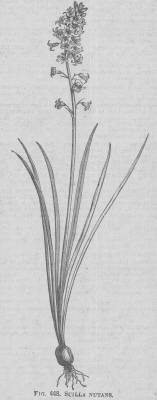
S. nutans (nodding).* Bluebell; Harebell; Wild Hyacinth. fl., perianth blue, purple, white, or pink, drooping; bracts in pairs; pedicels short, curved, erect in bud and fruit; raceme six to twelve-flowered; scape solitary, tall, stout. April to June. l. 10in. to 18in. long, 1/2in. broad, sub-acute, concave. Western Enrope (Britain). SYNS. S. nonscripta, Agraphis nutans, Hyacinthus nonscriptus.(Sy. En. B. 1528.) The following are garden forms: grandiflora alba, large white; rosea, rose; rubra, red-flowered. S. odorata (fragrant). fl. fragrant; perianth blue, campanulate, 1/3in. long, the segments oblong; pedicels ascending, the lower ones 4in. to 6in. long; raceme loose, six to twenty-flowered, 1in. to 2 1/2in. long, 1 1/4in. to 1 1/2in. broad; scape slender, flexuous, 3in. to 6in. long. May. l. three or four, glabrous, 6in. to 9in. long, three to four lines broad, sub-obtuse, channelled down the face, long-narrowed below. Spain and Portugal, 1818. Hardy.
S. ovatifolia (ovate-leaved). A synonym of S. lanceaefolia ovatifolia.
S. pallidiflora (pale-flowered). fl., perianth whitish, tinged with green, campanulate, the segments oblong, sub-obtuse; pedicels straight, the lower ones horizontally spreading, 1in. to 1 1/4in. long; raceme dense, containing a hundred to a hundred and fifty or more flowers, at first conical, 6in. to 10in. long, 3in. broad; scape erect, 1 1/2ft. or more long. Spring. l. five or six, lorate-lanceolate, ascending, 1ft. to 1 1/4ft. long, 1in. to 1 1/4in. broad, glabrous, green. Cape of Good Hope, 1870. Greenhouse. (Ref. B. 179.)
S. patula (spreading). A synonym of S. hispanica.
S. pauciflora (few-flowered). fl., perianth greenish, rounded-campanulate, nearly or quite 1/4in. long, the segments falcate; pedicels five to six lines long, the lower ones drooping; raceme loose, twenty to thirty-flowered, oblong, 3in. to 4in. long, 1 1/4in. to 1 1/2in. broad; scape firm, unspotted, terete, 3in. to 4in. long. Spring. l. a pair, opposite, or rarely three, spreading, oblong-lanceolate, acute, undulated, 2 1/2in. to 3in. long, nine to ten lines broad, pale green and spotted on the face, narrowed at base. Cape of Good Hope, 1862. Greenhouse. (Ref. B. 181.) S. pendula (pendulous). fl., perianth greenish outside, purple within, 1/2in. long, oblong-campanulate; pedicels very slender, 3/4in. to 1 1/4in. long, drooping; raceme rather dense, thirty to sixty-flowered 3in. to 6in. long, 2 1/2in. to 3in. broad; scape very slender, flexuous, 8in. to 9in. long. Spring. l. lorate, 1ft. to 1 1/4ft. long, about 1 1/4in. broad, acute, narrowed at base, nearly flat, pale green, obsoletely spotted. Cape of Good Hope, 1862. Greenhouse.
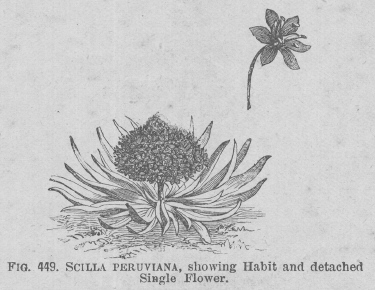
S. peruviana (Peruvian).* Cuban Lily. fl., perianth lilac, reddish, or whitish, five to six lines long, the segments green-striped; bracts whitish, persistent, solitary, 1in. to 2in. long; raceme very dense, comprising fifty to one hundred or more flowers, at first deltoid, at length 4in. to 6in. long and broad; scape robust, striated, 6in. to 12in. long. May. l. six to nine, lorate, 6in. to 12in. long, eight to twelve lines broad, narrowed at base and apex, the margins densely ciliated with minute, white bristles. Mediterranean region, 1607. Hardy. The name of this species has no reference to its native place.(B.M. 749.) alba is a white-flowered garden form.
S. p. glabra (smooth). fl., perianth lilac; lower pedicels 1 1/2in. to 2in. long. l. glabrous on the margins. 1873. S. Hughii is a more robust form, having scape, pedicels, and bracts, tinged with red. and leaves 1 1/2in. to 2in. broad.
S. plumbea (lead-coloured). fl., perianth dirty-blue, 1/4in. long, campanulate; lower pedicels somewhat spreading, six to eight lines long; raceme fifteen to twenty-flowered, 3in. to 3 1/2in. long, 1 1/2in. to 1 3/4in. broad. May. l. lorate-lanceolate, nearly 1ft. long, 1 1/4in. broad, acute, glabrous, unspotted. Cape of Good Hope, 1812. Greenhouse. Closely allied to, and perhaps synonymous with, S. natalensis. (B.R. 1355.) S. prasina (green). fl., perianth entirely green or faintly tinged with purple, rounded-campanulate, the segments half a line broad; central pedicels horizontally spreading, 1/6in. long, the lower ones deflexed; raceme rather dense, thirty to fifty-flowered, lanceolate or sub-cylindrical, 1 1/2in. to 2in. long, six to ten lines broad; scape flexuous, deflexed, 3in. to 4in. long. Spring. l. five or six, spreading, oblong-lanceolate, 4in. to 5in. long, 1in. to 1 1/4in. broad, acute, narrowed below, often purple-spotted. Cape of Good Hope, 1870. Greenhouse.
S. pratensis (meadow-loving).* fl., perianth blue, campanulate, two lines long; pedicels four to six lines long, ascending or somewhat spreading; raceme dense, twelve to thirty-flowered, 1 1/2in. to 2 1/2in. long, 1 1/4in. to 1 1/2in. broad. May. l. three to six, glabrous, narrow-ligulate, 6in. to 12in. long, two to four lines broad, attenuated at both ends. Dalmatia, 1827. Hardy. (B.R. 1839, 63.)
S. princeps (princely). fl., perianth greenish outside, reddish purple within, oblong-campanulate, nearly or quite five lines long, the segments reflexed; pedicels 1in. to 1 1/4in. long, the central ones spreading, the lower ones drooping; raceme dense, comprising a hundred and fifty to two hundred flowers, 1ft. long, 3in. to 3 1/2in. broad; scapes two or three, 7in. to 9in. long. Spring. l. five or six, lorate, 1 1/2ft. to 2ft. long, to 2 1/2in. broad, acute, narrowed at base, pale green, spotted. Cape of Good Hope, 1862. Greenhouse. (Ref. B. 189.)
S. pumila (dwarf). A synonym of S. monophylla.
S. puschkinioides (Puschkinia-like). fl., perianth pale blue, erect, star-like. Spring. l. two to four, obtuse, broadly linear. Turkestan, 1881. A pretty, hardy plant, somewhat resembling S. bifolia in habit. (R.G. 1051, f.1.) S. revoluta (revolute). fl., perianth rose-purple, the falcate segments green-striped at back, rounded-campanulate, 1/8in. long; pedicels spreading, the lower ones six to eight lines long; raceme oblong-lanceolate, loose, twelve to thirty-flowered, 2in. to 3in. long, 1in. to 1 1/4in. broad; scape very slender, flexuous, 3in. to 6in. long, at first nodding at apex, coloured at base. August. l. five to nine, oblanceolate-spathulate, channelled and narrowed at base into a short petiole, 2 1/2in. to 3in. long, six to eight lines broad, slightly wrinkled. Cape of Good Hope, 1774. Greenhouse. SYN. Drimia lanceaefolia (L.B.C. 278).
S. sibirica (Siberian).* fl. one to three, horizontal or slightly drooping, shortly pedicellate; perianth deep blue, six to seven lines long; scapes one to six, fleshy, 3in. to 6in. long. February. l. two to four, ascending, narrow, lorate, at length 4in. to 6in. long, four to six lines broad, slightly cucullate. European Russia, Siberia, &c., 1796. Hardy. (A. B. R. 365; L. B. C. 151.) SYNS. S. amoena sibirica (B. M. 1025), S. uniflora.
S. socialis (social). fl., perianth greenish, rounded-campanulate, 1/6in. long, the segments falcate; pedicels 1/8in. long, the lower ones drooping; raceme dense, twenty to thirty-flowered, oblong, 1 1/2in. to 2in. long, 1in. broad; scape firm, terete, unspotted, 2in. to 3in. long. Spring. l. three or four, spreading, oblong-lanceolate, acute, 2in. to 2 1/2in. long, 3/4in. to 1in. broad, slightly narrowed at base, pale glaucous-green and spotted on the face. Cape of Good Hope, 1862. Greenhouse. (Ref. B. 180.)
S. spathulata (spathulate-leaved). fl., perianth greenish outside, purple within, oblong-campanulate, nearly 1/3in. long; pedicels six to seven lines long, the lower ones drooping; raceme dense, thirty to forty-flowered, 3in. to 4in. long, 1 1/2in. to 1 3/4in. broad; scape flexuous, 3in. to 4in. long. Spring. l. five or six, lorate-spathulate, 6in. to 8in. long, 1 1/2in. to 1 3/4in. broad, pale glaucous-green, with deeper green and purplish blotches. Cape of Good Hope, 1862. Greenhouse. (Ref. B. 187.) S. sub-glauca (rather glaucous) fl., perianth greenish outside, purple within, oblong-campanulate, 1/4in. long; pedicels six to seven lines long, the lower ones drooping; raceme rather loose thirty to forty-flowered, 3in. to 4in. long, 1 1/2in. or rather more broad; scape spotted, 3in. to 4in. long. Spring. l. five or six, lorate-lanceolate, 9in. to 10in. long, 1in. broad, acute, distinctly narrowed at base, pale glaucous green on the face, purple-spotted at back. Cape of Good Hope, 1862. Greenhouse. (Ref. B. 186.)
S. tricolor (three-coloured). fl., perianth green, the segments oblong; filaments bright mauve-purple; lower pedicels spreading, 1/2in. or more long; raceme dense, oblong-conical, 2in. to 3in. long, 1 1/4in. to 1 1/2in. broad; scape flexuous, terete, 6in. to 8in. long. Spring. l. six or seven, lanceolate, erecto-patent, glabrous, 1ft. long, 2in. broad, narrowed to 1in. at the channelled base, dark green, blotched on the face with lighter green, and on the back with claret-brown. Port Elizabeth, 1880. Greenhouse.
S. uniflora (one-flowered). A synonym of S. sibirica.
S. verna (spring). Sea Onion. fl. fragrant; perianth bright blue, 1/2in. in diameter; bracts as long as the pedicels, or longer; lower pedicels 1/2in. long; raceme six to twelve-flowered, sub-corymbose or deltoid, 3/4in. to 1 1/2in. broad; scapes one or two, shorter than the leaves. April and May. l. preceding the flowers, linear, sub-obtuse, 3in. to 10in. long, 1/8in. to 1/6in. broad, recurved, concave. Europe (Britain). (Sy. En. B. 1527; F. D. 568, under name of S. bifolia.)
S. versicolor (various-coloured). fl., perianth whitish, tinged with green, 1/5in. long, the segments ligulate, slightly obtuse; anthers blue; lower pedicels at length spreading, 1 1/2in. to 2in. long; raceme rather dense, fifty to eighty-flowered, 6in. to 8in. long, 3 1/2in. broad; scape erect, 6in. to 8in. long. Spring. l. six to eight, glabrous, ascending, linear-lorate, 6in. to 9in. long, four to six lines broad, green on both sides, acute and narrowed at apex. Cape of Good Hope, 1872. Greenhouse. (Ref. B. 305.) S. villosa (villous). fl., perianth blue, 1/3in. or rather more long, the segments elliptic, rather obtuse; pedicels erecto-patent, the lower ones 3/4in. to 1 1/4in. long; raceme sub-corymbose, six to eight-flowered; scape 2in. to 3in. long. Spring. l. three or four, lorate, spreading, 3in. to 5in. long, 1/4in. to 1/2in. broad, ciliated, loosely pilose on the face, channelled below. Barbary, 1831. Hardy. (B. M. 3211.)
S. zebrina (zebra-striped). fl., perianth greenish and purple, rounded-campanulate, 1/4in. long; pedicels 1/4in. to 1/3in. long, the lower ones drooping; raceme dense, thirty to forty-flowered; scape 4in. to 6in. long, spotted below. Spring. l. five or six, ligulate-lanceolate, nearly erect, 8in. to 12in. long, 1in. to 1 3/4in. broad, acute, slightly narrowed at base, glaucous-green above, below copiously marked with parallel, vertical bars, and towards the base also with horizontal bars, passing into blotches of purple. Cape of Good Hope, 1862. Greenhouse. (Ref. B. 185.)