Scorzonera
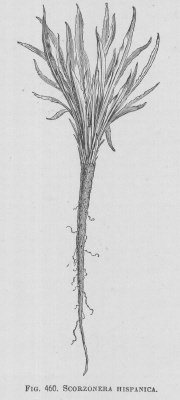
(from old French scorzon, Catalonian scurzon, a serpent; in allusion to the cooling, anti-febrile effects of S. hispanica, which was formerly employed in Spain, on account of these properties, for the cure of serpent bites). Viper's Grass. Including Podospermum. ORD. Compositae. A large genus of hardy, glabrous, floccose-woolly, or hairy, perennial or rarely biennial or annual herbs. About 120 species have been described; but probably the number entitled to that rank is less than 100; they inhabit Europe, North Africa, and Central and Western Asia. Flower-heads yellow or purple, often rather large, on long peduncles; involucre cylindrical or campanulate, with imbricated, acute or acuminate bracts in many series; receptacle naked or foveolate; florets ligulate, truncately five-toothed at apex; achenes linear, sub-terete, or the outer ones angular, glabrous or villous. Leaves alternate, sometimes entire and grass-like or broader, sometimes more or less pinnately lobed or dissected. S. hispanica is cultivated in gardens for the use of its long, tapering roots, which are cooked in a similar way to those of Salsafy. Their outside skin is black; but the inside flesh is white. Seeds should be sown at the end of March, or any time during April, in drills 1ft. apart, and the plants, when large enough, thinned to 6in. or 8in. asunder. An open situation is preferable, and deep soil, which should not be newly manured for the crop. The roots will be ready for use in November, and on through the winter. Some should be lifted before frost sets in, and stored in sand, in a cool shed, to be ready for use whenever required. All the other species may be grown from seeds, sown in the open border, in spring, and the seedlings afterwards thinned out. The perennials may be increased by division of rootstocks, either in autumn or just when growth begins in spring.
The species best known to cultivation are described below; except where otherwise stated, they are perennials.
S. coronopifolia (Buckhorn-leaved). fl.-heads yellow, one to a stem; involucral scales mucronate, the outer ones ovate. June and July. l. lanceolate, mostly pinnatifid; lobes linear, unequal. Stems erect, nearly simple, leafy at base. h. 1ft. North Africa, 1818.
S. hispanica (Spanish).* Common Viper's Grass. fl.-heads yellow; involucre oblong, the scales slightly glabrous, acuminated. June to September. l. amplexicaul, lanceolate, undulated or slightly toothed, glabrous or somewhat pubescent. Stem branched; branches naked, one-headed at apex. Root nearly the shape of a carrot, but smaller and dark-coloured, pure white internally, of a sweet and agreeable flavour. h. 3ft. South Europe, &c., 1576. See Fig. 460.
S. laciniata (torn). fl.-heads yellow; involucral scales slightly hooked at the apex. June and July. l. pinnatisect; lobes linear, entire. Stems sub-erect, naked and one-headed at the apex. h. 2ft. South Europe, 1640. Biennial.
S. mollis (soft). fl.-heads yellow, the rays purplish beneath; involucre, as well as the elongated, sub-corymbose peduncles, woolly-villous. June and July. l. linear-subulate, keeled, woolly-villous; old ones nearly glabrous; young ones undulately crisped on the margins. h. 1 1/2ft. Caucasus, 1818. (B. M. 3027.)
S. purpurea (purple). fl.-heads purplish; involucre cylindrical, the scales broadly lanceolate, not ciliated; achenes smooth. May and June. l. linear-subulate, channelled, triquetrous. Stems branched, two to five-headed. Root cylindrical-fusiform. h. 2ft. Eastern Europe, &c., 1759. (J. F. A. 35.)
S. p. grandiflora (large-flowered). A more showy and much stouter plant than the type, with larger flowers. (B. M. 2294.)
S. p. rosea (rosy). fl.-heads rose-pink; involucral scales lanceolate, acuminate; achenes sulcate, muricated above. July. l., radical ones elongated, linear-lanceolate, flat, glabrous; cauline ones few, carinate-linear. Stems simple, one-headed. h. 1 1/2ft. Eastern Europe, &c., 1807. S. undulata (undulated).* fl.-heads purplish-rose, 2in. to 2 1/2in. in diameter; involucre cylindric, white-downy; peduncles slender, green or purplish. July. l., radical ones nearly 1ft. long, narrowly linear-lanceolate, entire, rather long-petiolate, with a yellow midrib; cauline ones 3in. to 6in. long, gradually narrowed from a broad, sessile base to a very fine point. Stem 1ft. to 2ft. high, slender, branched. Algeria and Morocco, 1874. (B. M. 6127.)