Scutellaria
(from scutella, a dish or platter; alluding to the form of the fruiting calyx). Helmet Flower; Skull-cap. SYN. Cassida. ORD. Labiatae. A genus comprising about ninety species of stove, greenhouse, or hardy, annual or perennial herbs or sub-shrubs, decumbent or diffuse, rarely erect and tall, very rarely shrubs; they are scattered over temperate regions and the tropical mountains. Flowers blue, violet, yellow, or white, solitary or in pairs, axillary or in terminal spikes or racemes; calyx campanulate, two-lipped, the tube dilated opposite the posterior lip into a broad, flattened, hollow pouch, both lip and pouch deciduous in fruit, the anterior lip closed after flowering, persistent; corolla tube long, naked inside; limb bilabiate, the upper lip entire or notched, the lower dilated, its lateral lobes free and spreading, usually connate with the upper lip, rarely with the lower; stamens four. Nutlets sub-globose or depressed. Leaves often toothed, sometimes pinnatifid or entire; floral ones conformed or changed into bracts. S. galericulata and S. minor are the British representatives of the genus. The species described below are, for the most part, very handsome when in flower, and hence are well suited for ornamenting the front of flower borders. Any common garden soil is usually suitable. The herbaceous species may be increased by seeds, or by divisions; and the shrubby kinds may be readily multiplied by cuttings. S. Mociniana is one of the most beautiful of stove, flowering plants, and may be easily grown by anyone with a cool stove or warm greenhouse temperature. The bunches of flowers are freely produced--one on the point of almost every shoot--and are very bright and effective. Cuttings of half-ripened shoots root readily in spring, or at almost any season, in a warm propagating-frame. Young plants should have their points pinched out once or twice when growing, to encourage a bushy habit, and so insure a much larger production of flowers. Nice little specimens may be grown in 5in. pots. They succeed best in loam and leaf soil or decayed manure, with some sand intermixed. Except where otherwise indicated, the species here given are hardy, herbaceous perennials.
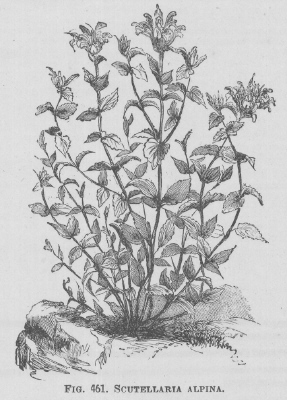
S. albo-rosea (white-and-rose). fl. borne in long, terminal racemes; corolla lilac, becoming paler towards the base of the long tube. Summer. l. ovate-oblong, cordate at base, undulated. Stem tetragonal. h. 1 1/2ft. Woods of the upper Amazons, 1859 Stove shrub. (I. H. 584.) S. alpina (alpine).* fl. in oblong, tetragonal spikes; corolla wholly purple or with the tube or lower lip yellow, 1in. to 1 1/2in. long. August. l. sub-sessile or shortly petiolate, ovate, slightly acute, rounded or cordate at base, loosely-crenate, serrate, six to ten lines long, pubescent or pilose; floral ones coloured, imbricated. Stems procumbent, often rooting at base. Europe and Central Asia, 1752. See Fig. 461. (A. F. P. 26, fig. 3; B. R. 1460; S. B. F. G. 90.) The variety lupulina has entirely yellow flowers. (B. R. 1493, under name of S. lupulina.)
S. aurata (golden-flowered). fl. numerous, erect, in a terminal raceme; corolla yellow, very long, tubular-infundibuliform; pedicels short; bracts linear, reflexed. Summer. l. on rather long petioles, ovate, obtuse, acuminate, auriculate-cordate at base, the lobes approximate, entire, or obsoletely and remotely denticulate. Stem tetragonal. h. 1ft. to 1 1/2ft. Brazil, 1863. Stove perennial. (I. H. 1862, 368.)
S. a. sulphurea (sulphur-coloured). fl. of a pale sulphur-colour, smaller than in the type. (B. M. 5525.)
S. Columnae (Columna's). fl. opposite, secund; corolla dark purple, ten to twelve lines long, loosely pubescent outside, the throat dilated; pedicels as long as the fruiting calyx; racemes 6in. or more long, loose, slightly branched, pilose. July. l. petiolate, ovate, 2in. long, crenate, broadly cordate or truncate at base, scarcely wrinkled, slenderly pubescent; floral ones ovate. Stem erect, 2ft. to 3ft. high, branched, pubescent. South Europe, 1806. (S. B. F. G. 52.)
S. costaricana (Costa Rica).* fl. numerous, racemose, sub-secund; calyx (and pedicel) dark purple, small; corolla of a rich golden-scarlet, the inside of the lips a deep yellow, 2 1/2in. long, erect, tubular-infundibuliform. June. l. ovate, acuminate, serrate-dentate; petioles rather long. Stem dark purple, erect. h. 1 1/2ft. to 3ft. Costa Rica, 1863. A beautiful stove perennial. (B. M. 5439.) S. galericulata (skull-cap). fl. secund, pubescent, solitary; corolla blue, variegated with white inside, 2/3in. long, the tube curved; bracts leaf-like; pedicels very short. July to September. l. shortly petiolate, 1/2in. to 2 1/2in. long, oblong or ovate, cordate at base, obtuse or sub-acute, rather remotely crenate-serrate. Stems 6in. to 18in. long, slender, simple or branched. Europe (Britain), &c. (Sy. En. B. 1060.)
S. grandiflora (large-flowered). fl. in tetragonal, oblong spikes, which are eventually 1 1/2in. long; corolla purplish, smaller than in S. orientalis. July. l. long-petiolate, somewhat roundish-ovate, incised-toothed, softly tomentose beneath or on both sides; floral ones entire, imbricated, pubescent. Stems procumbent. Altaian Alps, Siberia, 1804. (B. M. 635.) SYN. S. pulchella.
S. Hartwegi (Hartweg's).* fl. scattered, in loose, simple racemes; corolla bright red, 1in. long, with a violet lower lip. Summer. l. ovate. slightly acuminate, unequally crenate-serrate, roundly truncate or loosely cordate at base, green above, purple, and puberulous on the veins, beneath; petioles puberulous. h. 1ft. to 2ft. Quito, 1882. A very ornamental, stove sub-shrub. (B. M. 6615.)
S. incarnata (flesh-coloured). fl. in terminal, secund spikes; calyx tubular, compressed; corolla flesh-coloured or pale reddish-violet, pubescent, six times longer than the calyx, with a spreading limb. Summer. l. petiolate, ovate, deeply serrated, 1in. to 3in. long, intense green, pubescent above, tomentose beneath; floral ones linear-lanceolate, equalling the pedicels. Stem erect, 2ft. high, pubescent. Central America, 1856. Stove perennial. (B. M. 4268.)
S. i. Trianai (Triana's). This variety chiefly differs from the type in the much richer rose-scarlet of its corolla, and in the smaller, glabrous foliage. (B. M. 5185.) S. japonica (Japanese). fl. opposite, loose; calyx slightly pilose; corolla blue, six to eight lines long, pubescent; racemes loose-flowered, 6in. long. Summer. l. petiolate, ovate, obtuse, deeply crenate, rounded or truncate at base, glabrous; lower ones 1 1/2in. long; floral ones gradually becoming smaller. Stems prostrate at base; branches ascending. Japan. (P. M. B. x. 123.)
S. Lehmanni (Lehmann's). fl. bright red-scarlet, disposed in short, terminal racemes. Summer. l. cordate, petiolate. Stems erect. h. 1ft. to 2ft. Columbia, 1884. An ornamental stove perennial. (R. G. 1152, fig. 1, a-c.)
S. macrantha (large-flowered). fl. opposite, secund; calyx pilose; corolla blue, 1in. long, the tube much dilated upwards, the hood incurved; racemes many, simple. August. l. sessile, lanceolate, obtuse, entire, nearly glabrous, ciliated; floral ones longer than the calyx. Stem procumbent at base, ascending, often purplish, nearly glabrous. Eastern Asia, 1827. (B. M. 4420.)
S. minor (lesser). Hedge Hyssop. fl. pale pink-purple, 1/3in. long. July to October. l. shortly petiolate or sessile, 1/3in. to 1in. long, obtuse, with one or two crenatures near the base; upper ones quite entire. h. 4in. to 6in. Europe (Britain), &c. Habit resembling S. galericulata, but smaller. (Sy. En. B. 1061.)
S. Mociniana (Mocini's).* fl. opposite, secund; calyx one-sixth the length of the corolla; corolla showy, bright scarlet, 1 1/4in. to 1 1/2in. long, with the inside of the lip yellow and the tube clothed with short, fine hairs, the limb erect. Summer. l. petiolate, ovate, sub-sinuate-crenate, slightly hispid above, nearly glabrous beneath; lower floral ones conformed, the upper ones small, oblong. h. 1 1/2ft. Mexico, 1868. A very beautiful stove shrub. (Gn., Sept. 1, 1877; I. H. 562; R. H. 1872, 350.) S. orientalis (Oriental).* fl. in oblong, tetragonal spikes; corolla yellow, or with the lower lip fuscous or purplish, 1in. to 1 1/4in. long. August. l. petiolate, ovate, incised-toothed, four to ten lines long, hoary beneath; floral ones entire, membranous, slightly imbricated. Stems creeping, and often rooting from the base, ascending, slenderly cano-tomentose. South Europe and Central Asia, 1729. (B. M. 2120; S. B. F. G. 45.)
S. parvula (rather small). fl., calyx as long as the pedicels; corolla violet, pubescent, twice or thrice the length of the calyx. Summer. l. ovate, or the uppermost ones ovate-lanceolate, sessile by a truncate or slightly cordate base, about 1/2in. long, some of the lower ones with one or two coarse teeth, the lowest slender-petiolate. Roots tuberous. h. 4in. to 10in. North America, 1822. Plant branching from the base, usually erect, (H. E. F. 106.)
S. pulchella (pretty). A synonym of S. grandiflora.
S. purpurascens (purplish). fl. in terminal, loose racemes; corolla 3/4in. long, the tube and upper lip bright blue, the lower lip dark violet with a median white stripe. Summer. l. on long petioles, broadly ovate, obtuse, sinuate-crenate, very broadly truncate, rounded, or sub-cordate at base, slightly hispid above, or glabrous on both sides. h. 1ft. to 2ft. South America, 1880. A useful, decorative, greenhouse perennial. (B. M. 6464.)
S. serrata (serrated). fl., corolla blue, fully 1in. long, nearly glabrous, with a narrow tube, a moderately ampliate throat, and a rather narrow upper lip; raceme simple or rarely a pair of racemes at the base of the terminal one. August. l. three to five pairs, ovate or ovate-oblong, coarsely and sharply serrated, acute or acuminate, mostly acute at the base, 2in. to 4in. long; upper floral ones entire and lanceolate. Stem 1ft. to 2ft. high. North America, 1800. (A. B. R. 494.) S. splendens (splendid).* fl. scattered; corolla scarlet; ten to eleven lines long, the tube elongated, slender, the lobes shortened: racemes simple, elongated. October. l. petiolate, broadly ovate, obtuse or scarcely acuminate, 4in. to 5in. long, deeply cordate at base, hairy on both sides; floral ones minute. Stems ascending, branched, hairy or pubescent. h. 1ft. Mexico, 1841. Stove perennial. (B. M. 4290, under name of S. cordifolia.)
S. Ventenatii (Ventenat's). fl., calyx small; corolla scarlet, elongated, many times longer than the calyx, the upper lip deeply four-cleft; bracts very deciduous, narrow, the lower ones sub-ovate; racemes terminal, elongated, sub-secund or sub-distichous. August. l. long-petiolate, rather thick, cordate-ovate, somewhat obtuse, deeply-serrated. h. 1 1/2ft. Santa-Martha, 1844. An erect, branched, softly pubescent, greenhouse perennial. (B. M. 4271.)
S. villosa (villous). fl. glandular-villous; corolla scarlet, the tube elongated, slenderly funnel-shaped, the lobes shortened; bracts small; racemes terminal, many-flowered, short, corymbose. July. l. petiolate, cordate-ovate, soft, acuminate, deeply sinuate-toothed, wrinkled, pilose, purple beneath. Stems acutely tetragonal, branched. h. 1 1/2ft. Peru, 1842. Stove shrub. (B. M. 4789; F. d. S. 961.)