Sempervivum
(the old Latin name used by Pliny, and derived from semper vivo, to live for ever; alluding to the well-known tenacity of the species). House Leek. Including Aeonium and Greenovia. ORD. Crassulaceae. A genus comprising fifty or more species of greenhouse or hardy, thick, fleshy herbs or subshrubs, of variable habit, often stemless, and emitting young plants from the axils, sometimes caulescent and leaf; they inhabit the mountains of Central and Southern Europe, Madeira, the Canary Islands, Asia Minor, Nubia, Abyssinia, and the Western Himalayas. Flowers white, pink, greenish, yellow, or purplish, in paniculate, often dense cymes; calyx cut or parted into six or numerous segments, rarely five-cleft; petals six or numerous, free, or connate at base, and adhering to the filaments, oblong or lanceolate, acute or acuminate; stamens twice as many, or rarely the same number, as the petals, free; filaments filiform. Leaves alternate, thickly fleshy, often revolute. S. tectorum is found growing on walls and houses in Britain, but it is not indigenous. Sempervivums succeed in any sandy soil, and may be readily propagated from seeds, or by the young plants which appear round old ones at the base. All the hardy species are admirably adapted for planting on rockwork; and the greenhouse ones, S. tabulaeforme, for instance, are valuable for succulent and carpet bedding during summer.
Mr. J. G. Baker's admirable classification of the hardy species in cultivation (published in the "Gardeners' Chronicle," n. s., vol. xii.) is appended. By its help, the names of any of the hardy species here described may be readily determined. Mr. Baker says that the following eleven forms "cannot be regarded as more than varieties or sub-species belonging to one variable specific type": S. arvernense, S. atlanticum, S. Boissieri, S. Boutignyanum, S. calcaratum, S. calcareum, S. glaucum. S. Lamottei, S. Schottii, S. tectorum, and S. triste.
Sub-genus I. Sempervivum proper.
Parts of the flowers usually in twelves. Open flower bell-shaped.
RHODANTHA.--Flowers reddish.
Group 1. Ciliata. Leaves of the barren rosette glabrous on the face when mature, shortly ciliated on the edges only. Leaves large, green or slightly glaucous, with a conspicuous, red-brown tip: S. arverncnse, S. Boissieri, S. Boutignyanum, S. calcaratum, S. tectorum. Leaves large, green or glaucous; red-brown tip none or very obscure: S. atlanticum, S. glaucum, S. Lamottei, S. Schottii. Leaves large, purplish-brown throughout: S. triste. Leaves large, very glaucous, with a distinct red-brown tip: S. calcareum. Leaves small, green, with a distinct red-brown tip: S. parvulum. Leaves small, glaucous, with a distinct red-brown tip: S. Greenii. Leaves small, green; red-brown tip none or very obscure: S. Funckii, S. Verloti.
Group 2. Pubescentia. Leaves of the barren rosette pubescent on the face, as well as ciliated on the edges, not tipped with a tuft of spreading hairs. Flower small; stamens two-thirds as long as the petals: S. assimile. Flower large; stamens half as long as the petals: S. anomalum, S. flagelliforme, S. montanum.
Group 3. Barbatula. Leaves of the barren rosette strongly ciliated on the edges, and furnished with a tuft of short, straight hairs at the tip. Moderately tall: S. Fauconneti, S. fimbriatum, S. Pomelii. Dwarf: S. barbatulum.
Group 4. Arachnoidea. Dwarf species, with the tips of the inner leaves of the rosette connected by fine, fleecy threads, like a spider's web. Arachnoid threads many: S. arachnoideum, S. Moggridgei. Arachnoid threads few: S. Doellianum, S. oligotrichum.
CHRYSANTHA.--Flowers yellow.
Leaves obovate-cuneate, glabrous on the face: S. Wulfeni. Leaves obovate-cuneate, hairy on the face: S. Braunii, S. grandiflorum, S. ruthenicum. Leaves oblanceolate, very hairy on the face: S. Pittoni.
Sub-genus II. Diopogon.
Parts of the flower usually in sixes. Flowers always yellowish. Expanded flower spreading widely. Flowers small; petals not fimbriated on the edge and keel: S. Heuffelii, S. Reginae-Amaliae. Flowers large; petals fimbriated on the edge and keel. New rosettes rolled up into round balls: S. arenarium, S. soboliferum. New rosettes not rolled up into round balls: S. hirtum.
The best-known species are described below. Except where otherwise stated, they are hardy perennials.
S. aizoides (Aizoon-like). fl. yellow, corymbose; petals five to eight, spreading. May to July. l. scattered, obovate, flat, quite entire, glabrous, Stem erect, branched. h. 1ft. Madeira. Greenhouse, evergreen shrub.
S. anomalum (anomalous). fl. four to eight in a dense head, all sessile or sub-sessile; corolla bright mauve-purple, 1in. in diameter, very hairy on the outside. June. l. thirty to forty to a rosette, oblanceolate, cuspidate, green, with pubescent faces, hairy-edged, the outer ones only tinted with red-brown, 3/8in. to 1/2in. long. Flowering stem 3in. to 4in. long, its leaves hairy all over and tinted with red-brown, the lowest 1/2in. to 3/4in. long. Barren rosettes not exceeding 1in. in diameter. A garden species.
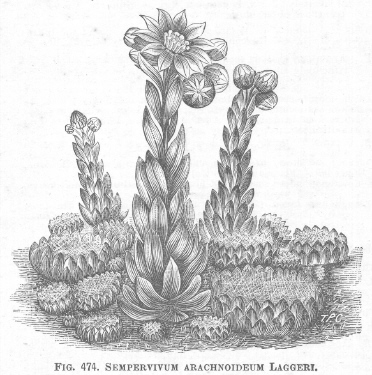
S. arachnoideum (cobwebby).* fl. nine to twelve-parted, less than 1in. in diameter; petals bright red, lanceolate; filaments bright purple; panicle dense, few-flowered, clothed with slightly fragrant, glandular hairs. June. l. about fifty to a rosette, oblong-cuneate, obscurely cuspidate, minutely glandular-pubescent above, the tips connected by long, soft, white hairs; outer leaves reddish-brown at back, 3/8in. long. Flowering stem 3in. to 4in. long, its leaves furnished at tips with tufts of soft hairs. Barren rosettes 1/2in. to 3/4in. in diameter. Pyrenees and Central Europe, 1699. (B. M. 68; J. F. A. (App.) 42.)
S. a. Laggeri (Lagger's).* A large variety, having fully-developed rosettes 1 1/2in. in diameter.
S. arboreum (arborescent). fl. golden-yellow, disposed in a loose panicle: petals nine to eleven. March to December. l. cuneiform, glabrous, ciliated, spreading, and rosulate at the tops of the branches. Stem arborescent, smooth, branched. h. 3ft. to 6ft. Portugal, &c., 1640. Greenhouse, evergreen shrub. (B. R. 99; S. F. G. 473.)
S. a. atropurpureum (dark purple). l. blackish-purple. A very effective variety when grown in a sunny position.
S. a. variegatum (variegated). l. green, margined with creamy-white.
S. arenarium (sand-loving).* fl. six-parted, many in a dense head, 2in. to 3in. diameter; petals pale yellow, 1/2in. to 5/8in. long, distinctly tricuspidate. Summer. l. sixty to eighty to a rosette, oblanceolate, acute, not cuspidate, minutely ciliated on the edges; outer ones a little tinted with red-brown, 1/2in. to 3/4in. long. Flowering stem 6in. to 9in. long, finely pubescent, the crowded leaves strongly ciliated on the margins. Rosettes (and general habit) as in S. soboliferum. Tyrol, 1879. SYN. S. cornutum.,
S. arvernese (Auvergne). fl., petals pale pink, 1/4in. to 1/3in. long; filaments and anthers red; panicle 2in. to 3in. long and broad, the lower flowers distinctly pedicellate. Summer. l. oblanceolate-cuneate, cuspidate, bright pale green, the outer ones 1in. to 1 1/4in. long, the edges regularly ciliated. Flowering stem 6in. to 8in. long, the lower leaves about 1in. long. Barren rosettes 1 1/2in. to 2 1/2in. in diameter. Central France.
S. assimile (similar). fl. 3/4in. in diameter; calyx densely pubescent; petals pale rose, linear. July. l. sixty to eighty to a rosette, obovate-cuneate, cuspidate, pale glaucous-green, not red-tipped, shortly ciliated on the margins, minutely pubescent on the face, the outer ones 3/4in. to 1in. long. Flowering stem about 6in. long. Barren rosettes 1 1/2in. to 2in. broad. Tyrol. S. atlanticum (Atlantic).* fl. pale red, 1in. in diameter, twelve-parted; calyx segments twice as long as the tube; panicle short, 3in. to 4in. in diameter. Summer. l. oblanceolate-cuneate, cuspidate, pale green, glabrous when mature, scarcely tipped with red-brown, ciliated on the margins, the outer ones 1in. to 1 1/2in. long. Flowering stem nearly 1ft. long, its leaves much tinted with red-brown. Barren rosettes 2in. to 3in. in diameter. Greater Atlas, 1873. (B.M. 6055, under name of S. tectorum atlanticum.)
S. aureum (golden).* fl. yellow; petals twenty, linear; stamens also twenty; panicle dichotomously-branched, many-flowered. July and August. l. obovate-spathulate, with membranously cartilaginous, quite entire margins, glaucous. Stem erect, glabrous. h. 1ft. Teneriffe, 1815. Greenhouse, herbaceous subshrub. SYNS. S. Bollii, S. calyciforme (B. R. 892), Greenovia aureum (B. M. 4087).
S. barbatulum (slightly bearded). fl. nine to twelve-parted; petals rose-red, 1/3in. long; panicle compact, few-flowered, densely pilose. l. oblanceolate, densely pubescent, ciliated on the margins, and furnished with a dense tuft of hairs at the tip, the outer ones about 1/2in. long. Flowering stem 3in. to 4in. high, its red-tinted, pubescent leaves 1/2in. to 3/4in. long. Barren rosettes about 1/2in. in diameter. Alps. A well-marked, dwarf-habited plant.
S. Boissieri (Boissier's).* fl. 1in. in diameter, twelve to fourteen-parted; petals pale red, very hairy; filaments bright red; panicle about 2in. broad each way, the lower flowers sub-sessile. July. l. oblanceolate-cuneate, cuspidate, broadest near the middle, with rather long, brown cilia, hardly at all brown-tinted at top, 1in. to 1 1/4in. long. Flowering stem 8in. to 9in. long, the leaves red-tinted, closely imbricated. Barren rosettes very dense, 2in. to 2 1/2in. in diameter. 1878. A garden species.
S. Bollii (Boll's). A synonym of S. aureum.
S. Boutignyanum (Boutigny's). fl. 3/4in. in diameter, twelve to fourteen-parted; petals pale rose, 3/4in. long, densely glandciliated; panicle 2in. to 3in. long and broad, simply branched, many-flowered. Summer. l. oblanceolate-cuneate, cuspidate, with a green, glabrous face and a distinct, decurrent, red-brown tip, the outer ones 1in. to 1 1/4in. long. Flowering stem 6in. to 8in. long, its leaves 1in. or more long. Barren rosettes 2in. to 3in. broad. Pyrenees, 1878.
S. Braunii (Braun's).* fl. ten to twelve-parted, 3/4in. to 1in. in diameter; petals dull yellow, unspotted, with a green keel; filaments greenish, obscurely tinted with purple; panicle compact, many-flowered, 2in. to 4in. in diameter. July. l. thirty to forty to a rosette, obovate-cuneate, obscurely cuspidate, glandular-pubescent; outer ones obscurely purple-tipped, 3/4in. to 1in. long. Flowering stem 6in. to 9in. long, the upper part shortly pubescent, its leaves 1in. to 1 1/2in. long. Barren rosettes 1 1/2in.to 2in. in diameter. Tyrol, 1874.
S. caespitosum (tufted). fl. yellow, disposed in cymose, dichotomously-branched corymbs; petals seven or eight, spreading. April to September. l. oblong-linear, glabrous, stiffly ciliated, marked with brown lines on both surfaces, crowded in a rosulate manner; cauline ones scattered. Stem very short, at length a little branched, leafy at the apex. h. 6in. Grand Canary Island, 1815. Greenhouse, evergreen shrub. This plant has been known to remain alive in an herbarium for eighteen months, and to grow when subsequently planted. SYN. S. ciliatum (B. M. 1978).
S. calcaratum (spurred).* fl. 1in. in diameter; petals dull reddish white, 1/2in. long; panicle 6in. to 8in. long and broad, the lower branches deeply forked. Summer. l. 4in. long, 3/4in. to 1in. broad, rather glaucous, with a distinct red-brown tip, the edges bordered with stiff cilia. Flowering stem above 1ft. long. Barren rosettes 3in. to 4in. in diameter. 1874. A common form in English gardens, where it is variously known as S. Camollei, S. italicum, S. juratum, S. Royeni, S. rusticanum, and S. Seguieri. S. calcareum (chalk-loving).* fl. ten to twelve-parted; corolla 3/4in. in diameter; petals pale red, greenish down the keel, densely ciliated; panicle 3in. to 4in. long and broad, eight to twelve-branched. Summer. l. oblanceolate-cuneate, cuspidate, very glaucous, with very distinct red-brown tips, stiffly ciliated on the margins, the outer ones 1in. to 1 1/4in. long. Flowering stem less than 1ft. long, with densely imbricated leaves, 1in. to 1 1/2in. long. Barren rosettes about 2in. in diameter. Calcareous Alps of Dauphine. SYN. S. californicum (of gardens).
S. californicum (Californian). A garden synonym of S. calcareum.
S. calyciforme (calyx-formed). A synonym of S. aureum.
S. Camollei (Camolle's). A garden synonym of S. calcaratum.
S. canariense (Canary Islands).* fl. white, pedicellate; petals nine or ten, linear; branches of panicle expanded. June and July. l., radical ones expanded, rosulate, obovate-spathulate, villous, large; cauline ones scattered, ovate. h. 1 1/2ft. Canary Islands, 1699. A strong-growing, greenhouse, evergreen shrub.
S. ciliatum (ciliated). A synonym of S. caespitosum.
S. cornutum (horned). A synonym of S. arenarium.
S. cruentum (bloody). fl. yellow, small, six to eight-parted. May. l. cuneate-spathulate, highly glabrous, thick, attenuated into the petiole, papillose on the margins, green and somewhat channelled above, slightly convex beneath. h. 1ft. to 2ft. Canary Islands, 1824. Greenhouse, evergreen shrub. (B. R. xxvii. 61, under name of Aeonium cruentum.) S. Doellianum (Doell's). fl. nine or ten-parted; calyx densely pubescent; petals bright red, lanceolate, 1/3in. long; filaments bright purple; panicle compact, few-flowered, the larger flowers distinctly pedicellate. June. l. forty to fifty to a rosette, oblanceolate, obscurely cuspidate, slightly hairy above, the edges minutely ciliated, the tips of the inner leaves connected by a few cobwebby threads; outer leaves 1/4in. to 3/8in. long, red-tinted at back. Flowering stem 4in. to 6in. long, its leaves having only an obscure tuft of hairs at the tip. Barren rosettes 1/2in. to 3/4in. in diameter. Bernese Oberland. SYN. S. heterotrichum.
S. Fauconneti (Fauconnet's). fl. nine to twelve-parted, nearly 1in. in diameter; petals bright red, lanceolate, glandular on the back and edges; filaments bright purple. Summer. l. about fifty to a rosette, oblanceolate, obscurely cuspidate, the surfaces with a few glandular papillae and streaks of purple, the edges ciliated with deflexed hairs, the outer leaves tinged with red, about 3/4in. long. Flowering stem 6in. to 8in. long, clothed with long hairs. Barren rosettes 1 1/2in. in diameter. Jura Mountains Rare in English gardens.
S. fimbriatum (fringed).* fl. about twelve-parted, 1in. in diameter; petals bright red, lanceolate, glandular on the back and edges; panicle open, the few branches bearing each six to ten flowers. July. l. fifty to sixty to a rosette, oblanceolate, obscurely cuspidate, all green, the edges crowded with deflexed hairs, the outer leaves turning red, and reaching 1/2in. to 3/4in. long, Flowering stem 6in. to 9in. high, densely glandular-pilose, the lower of the red-tinted leaves 1in. to 1 1/2in. long. Barren rosettes 1in. to 1 1/2in. in diameter. Alps of Dauphine.
S. flagelliforme (whip-like). fl. about twelve-parted, six to eight in a dense head, all sessile or nearly so; corolla bright red, above 1in. in diameter, densely glandular-pilose outside. June. l. forty to fifty to a rosette, oblanceolate, obscurely cuspidate, minutely downy above, pale green throughout, the edge fringed with short hairs, the outer ones 3/4in. long. Flowering stem 3in. to 4in. long, its imbricated leaves tipped with red-brown, the lowest about 1in. long. Barren rosettes 1in. to 1 1/2in. in diameter, with the lax new ones on long, spreading stalks. Native place unknown. Well known in cultivation.
S. Funckii (Funck's).* fl. eleven or twelve-parted, nearly 1in. in diameter; petals bright red-purple, densely glandular-pubescent; panicle 2in. to 3in. in diameter, the lower flowers distinctly pedicellate. July. l. eighty to a hundred to a rosette, oblanceolatecuneate, cuspidate, green and glabrous at maturity, not tipped with red-brown, fringed with dense, marginal cilia, the outer ones 1/2in. to 3/4in. long. Flowering stem 6in. to 9in. long, densely pilose, the lower leaves 1in. long. Barren rosettes 1 1/2in. to 2in. in diameter, surrounded by a dense circle of young ones on bright red, decumbent footstalks. Tyrol, &c. (B.H. 1873, 13, under name of S. Funckii aqualiense.)
S. glaucum (glaucous). fl. 1in. in diameter; petals bright red, more than twice as long as the calyx; filaments deep purple; panicle short, 2in. to 3in. in diameter, the branches few-flowered. Summer. l. oblanceolate-cuneate, cuspidate, glabrous, ciliated on the margins, having only a faint red-brown spot at the tip. Flowering stem 6in. to 9in. long, densely hairy above. Barren rosettes 2in. to 3in. in diameter. Simplon Alps.
S. globiferum (globe-bearing). A synonym of S. grandiflorum.
S. glutinosum (clammy). fl. golden-yellow; petals eight to ten; panicle loosely branched. July and August. l. cuneiform, viscid, rather scattered, fringed with adpressed, cartilaginous ciliae. h. 2ft. Madeira, 1777. Greenhouse, evergreen shrub. (B. M. 1963; B. R. 278.) S. grandiflorum (large-flowered). fl. few, very large, ten to twelve-parted, sub-sessile, in a dense head; corolla 1 1/4in. to 1 1/2in. in diameter; petals pale yellow, with a flush of purple inside at the base; stamens generally bright mauve-purple. Summer. l. about forty to a rosette, obovate-cuneate, obscurely cuspidate, pubescent, the very tip reddish-brown; outer ones spreading, 3/4in. to 1in. long. Flowering stem 3in. to 4in. high, densely pubescent, its crowded leaves 3/4in. to 1in. long. Barren rosettes about 1 1/2in. in diameter, the new ones on decumbent peduncles 1in. to 2in. long. Native country unknown. (B. M. 2115; B. M. 507, under name of S. globiferum.)
S. Greenii (Green's). fl. eleven or twelve-parted, 1/2in. in diameter; petals pale red, densely ciliated; filaments bright mauve-purple; panicle 1 1/2in. to 2in. broad, three or four-branched. July. l. forty to fifty to a rosette, oblanceolate-cuneate, cuspidate, glaucous, with a distinct brown-red tip, ciliated on the edges, the outer ones 3/4in. to 1in. long. Flowering stem 6in. to 12in. long. Flowering stem 6in. to 12in. long, its hairy, red-tinted leaves 3/4in. to 1in. long. Barren rosettes about 1 1/2in. in diameter. Probably the French Alps. 1877.
S. heterotrichum (variably hairy). A synonym of S. Doellianum.
S. Heuffelii (Heuffel's).* fl. six-parted; calyx bright red-brown when old; petals pale straw-yellow, 3/4in. long, permanently erect, with three small cusps; panicle dense, many-flowered, 2 1/2in. to 3in. in diameter, the lower flowers pedicellate. August. l. thirty to forty to a rosette, obovate-cuneate, distinctly cuspidate, the upper third, or even half, tinted with bright red-brown, the margins stiffy ciliated; outer leaves spreading, 3/4in. to 1in. long. Flowering stem 6in. to 8in. long, densely pubescent, its close, red-brown leaves 3/4in. to 1in. long. Barren rosettes 1 1/2in. to 2in. in diameter. Transylvania and Greece. (R. G. 858, Fig. 2, under name of S. patens.) S. hirtum (hairy). fl. usually six-parted; petals pale yellow, 1/2in. to 3/4in. long, laceolate, the point tricuspidate; panicle few or many-flowered, 1 1/2in. to 4in. in diameter. June. l. about fifty to a rosette, obovate-cuneate, finely glandular-pubescent, ciliated down the margins; outer ones fantly tinted with red, 1/2in. to 3/4in. long. Flowering stem 6in. to 9in. long, densely pilose, the crowded leaves pubescent. Barren rosettes 1in. to 1 1/4in. in diameter, not globular. Central Europe, 1804. (A. F. P. 65.)
S. hirtum (hairy). A synonym of S. soboliferum.
S. holochrysum (wholly golden). fl. golden, glabrous; hypogynous scales broad, truncate, very slightly emarginate; panicle 9in. long, very dense, pyramidal. December to February. l. dark green, spathulate, obtuse, glabrous, shining, cartilaginously ciliated, attenuated-tetragonal at base red-margined at apex. Stem shrubby, erect. Teneriffe, 1816. Greenhouse. SYN. S. urbicum (B. R. 1741).
S. italicum (Italian). A garden synonym of S. calcaratum.
S. juratum (sworn). A garden synonym of S. calcaratum.
S. Lamottei (Lamotte's).* fl. 1in. in diameter, twelve to sixteen-parted; calyx densely pilose; petals pale pink; filaments bright purple; panicle like that of S. tectorum. Summer. l. obovatecuneate, cuspidate, glabrous on the faces; outer ones 1 1/4in. to 1 1/2in. long, with stiff marginal cilia, and very faintly red-brown, tinted at the tip. Flowering stem often above 1ft. long. Barren rosettes 3in. to 4in. in diameter. Central France.
S. Moggridgei (Moggridge's).* fl. red, cymose, 3/4in. in diameter; calyx cup-shaped, glandular-pubescent; petals twice as long as the sepals, spreading. September. l. 3/4in. long, elongate-cuneate or oblanceolate, green, glabrous, with minutely ciliated margins and acute tips; lower cauline ones pale green and reddish. Flowering stem 9in. high, stout, leafy. Rosettes 2in. in diameter, of about a hundred leaves. Alps, 1881. (B. M. 6610.) S. monanthes (one-flowered). fl. purplish, small; petals six to nine, scarcely longer than the calyx; scales obcordate; peduncles naked, generally one, rarely few, flowered. July to September. l. terete, clavate, glabrous, crowded in a rosulate manner. h. 1in. to 2in. Canary Islands, 1777. A very dwarf, greenhouse, evergreen shrub. (B. M. 93.)
S. montanum (mountain).* fl. twelve to fourteen-parted; petals bright mauve-purple, 1/2in. to 5/8in. long, linear, acuminate; panicle very dense, 1/2in. to 2in. in diameter, the branches very pilose, and the lowest flowers nearly sessile. June. l. tightly packed, sixty to eighty to a rosette, oblanceolate-cuneate, cuspidate, entirely green, slightly pilose on the face, regularly ciliated on the margins, the outer ones 3/4 in. to 1in. long. Flowering stem about 6in. long, the densely imbricated leaves tipped with red-brown, the lower ones 1in. to 1 1/2in. long. Barren rosettes 1 1/2in. to 1 3/4in. in diameter. Alps and Pyrenees. (J. F. A. v. 41.)
S. oligotrichum (few-haired). fl. about ten-parted, 3/4in. in diameter, in a dense head; petals bright red; filaments bright purple. Summer. l. thirty to forty to a rosette, oblanceolate, obscurely cuspidate, minutely pubescent, the edges minutely ciliated; inner ones connected by a few cobwebby threads, which nearly or quite disappear at flowering time; outer ones about 1/2in. long. Flowering stem 2in. to 4in. long, its leaves bright red and densely pubescent. Barren rosettes about 1in. in diameter. Tyrol.
S. Paivae (Baron Paiva's). fl. green, scentless, 3/4in. broad; petals erecto-patent, acuminated, with recurved and spirally twisted tips. August. l. highly glaucous, 1in. to 2 1/2in. long, 1/2in. to 1in. broad, those of the flowering branches thick and fleshy, of the barren ones thinner, and finely serrulate-ciliated. Canary Islands, 1866. A low, straggling, greenhouse, evergreen shrub. (B. M. 5593.) S. parvulum (rather small). fl. 3/4in. in diameter; petals pale red; panicle short, corymbose, about 2in. to in diameter. July. l. oblanceolate-cuneate, cusidate, with a distinct, red-brown tip, minutely but stiffly ciliated on the edges, the outer ones about 1in. long. Flowering stem 6in. to 12in. long, very pilose, its leaves red-brown, the lowest 3/4in. to 1in. long. Barren rosettes 1in. to 1 1/2in. in diameter. Alps of Dauphine, 1878. A rare form in cultivation.
S. Pittoni (Pitton's). fl. nine to twelve-parted, ten to twenty in a dense head, 1 1/2in. to 2in. in diameter, densely pilose; petals primrose-yellow, whitish inside towards the base, 3/8in. long, lanceolate; filaments pale. July. l. sixty to eighty to a fully-developed barren rosette, oblanceolate, tipped with claret-purple, densely and persistently pubescent, the tip deltoid-cuspidate; outer ones about 3/4in. long. Flowering stem 4in. to 6in. long, densely pilose, its leaves tipped with claret-purple. Barren rosettes 1in. to 1 1/2in. in diameter, the young ones sessile. Alps of Styria.
S. Pomelii (Pomel's).* fl. ten to twelve-parted; corolla bright rose-red, about 1in. in diameter; petals widely spreading; panicle 3in. to 4in. in diameter, its simple branches bearing six to twelve flowers. July. l. fifty to sixty to a rosette, oblanceolate, distinctly cuspidate, with a few hairs on both surfaces, the outer ones tinged with red, 3/4in. to 1in. long. Flowering stem 6in. to 9in. long, densely pilose, its hairy leaves much imbricated the lower ones 1in. to 1 1/2in. long. Barren rosettes 1 1/2in. to 1 3/4in. in diameter. Auvergne.
S. Reginae-Amaliae (Queen Amalia's of Greece). fl. six or seven-parted; petals pale yellow, ligulate, obtuse; panicle dense, many-flowered, capitate, the lowest flowers shortly pedicellate. Summer. l. a hundred or more to a rosette, obovate-cuneate, distinctly cuspidate, bright purplish-brown in the upper half, the edges ciliated; outer ones spreading, 1in. to 1 1/4in. long. Flowering stem 6in. high, densely pubescent, the crowded leaves brown. Barren rosettes about 3in. in diameter. Greece.
S. Royeni (Royen's). A garden synonym of S. calcaratum. S. rusticanum (rustic). A garden synonym of S. calcaratum.
S. ruthenicum (Russian). fl. about twelve-parted; petals pale yellow, linear, not more than 3/8in. long; filaments finally bright mauve-purple; panicle short and compact, densely pubescent. Summer. l. forty to fifty to a rosette, obovate-cuneate, cuspidate, slightly glandular-pubescent, ciliated at edges with short, decurved hairs; outer ones tinted at back, 3/4in. to 1in. long. Flowering stem 6in. to 12in. long, shortly pubescent upwards. Barren rosettes 1 1/2in. in diameter. South-east Russia, &c.
S. Schottii (Schott's). l. twelve to fourteen-parted; lower ones densely sessile; petals pale red, with a deeper keel, twice as long as the calyx; filaments deep purple; panicle short and compact, 2in. to 3in. in diameter. Summer. l. oblanceolate-cuneate, cuspidate, glabrous, ciliated on the margins, scarcely tipped with red-brown, the outer ones 1in. to 1 1/4in. long. Flowering stem nearly 1ft. long, its oblong-lanceolate, red-tinted leaves 1in. to 1 1/2in. long. Barren rosettes 2in. to 3in. in diameter. Tyrol, 1874
S. Seguieri (Seguier's). A garden synonym of S. calcaratum.
S. Smithii (Smith's). fl. pale yellow, sessile; petals twelve, ovaloblong, spreading; branches of the panicle revolute at the points, bearing flowers on the upper side. July and August. l. scattered, obovate, acuminate, flat, concave, slightly spotted. Stem erect, hispid. h. 1ft. Canary Islands, 1815. Greenhouse, evergreen shrub. (B.M. 1980.) S. sobiliferum (sobole-bearing).* Hen-and-Chickens House-leek. fl. six or seven-parted; petals pale yellow, lanceolate, 1/2 in. long, obscurely tricuspidate; panicle short, dense, many flowered. 3in. to 4in. in diameter, the lower flowers distinctly pedicellate. Summer. l. sixty to eighty to a rosette, obovatecuneate, obscurely cuspidate, minutely ciliated on the edges; outer ones tinted with bright red-brown, 3/4in. to 1in. long. Flowering stem 6in. to 9in. long, very robust, quite hidden by the leaves. Barren rosettes globose, 1in. to 1 1/2in. in diameter; the copious new sessile ones attached to the parent only by a slender thread. Austria. A well-known garden plant. (B. M. 1457; J. F. A. 12, under name of S. hirtum.)
S. stellatum (star-like). fl. golden-yellow, panicled; petals six to eight, spreading; scales palmate, with subulate lobes. July and August. l. scattered, oblong, spathulately cuneiform, obtuse, villous. Stem erect, branched, puberulous. h. 6in. Madeira, 1790. Greenhouse annual. (B. M. 1809, under name of S. villosum.)
S. tabulaeforme (table-formed).* fl. very pale sulphur-coloured; petals ten to twelve, linear-lanceolate; glands minute, pedunculate. June and July. l. spathulate, flat, ciliated, attenuated at base, crowded at the top of the stem, and forming a flat, rosulate disk, in consequence of being so closely imbricated over each other. h. 1ft. Madeira, 1817. Greenhouse, evergreen shrub.
S. tectorum (roof-loving). Bullock's Eye; Common Houseleek; Jupiter's Beard; Sengreen. fl. 3/4in. to 1in. in diameter; petals linear, pale red, keeled with deeper red; filaments bright purple; panicle 5in. to 6in. long, with ten or twelve scorpioid branches. July. l. fifty to sixty to a rosette, obovate-cuneate, cuspidate, 1 1/2in. to 2in., or finally 3in., long, pale green, with a distinct red-brown tip, the edges ciliated. Flowering stem about 1ft. long, densely pilose. Barren rosettes 3in. to 4in. in diameter. Britian (but not indigenous). (Sy. En. B. 538.)
S. t. atlanticum (Atlantic). See S. atlanticum.
S. tortuosum (twisted). fl. yellow; petals seven or eight, spreading; scales two-lobed. July and August. l. obovate-spathulate, scattered, rather convex beneath, nearly or quite 1in. long and 1/2in. broad. Stem erect, branched. h. 6in. to 9in. Canary Islands, 1779. Greenhouse, evergreen shrub. (B. M. 296.)
S. triste (sad). fl., calyx deeply tinted with red-brown; corolla bright red, 1in. in diameter; panicle 6in. long, 3in. to 4in. in diameter, the larger flowers distinctly pedicellate. Summer. l. oblanceolate-cuneate, cuspidate, glabrous, the margins shortly ciliated, the whole upper part, both back and face, suffused with red-brown. Flowering stem as robust as in S. tectorum, its leaves strongly tinted with red-brown, the lower ones 2in. to 3in. long. Barren rosettes 2in. to 3in. in diameter. A rare garden form.
S. urbicum (city), of Lindley. A synonym of S. holochrysum.
S. Verloti (Verlot's). fl. twelve to fourteen-parted, 3/4in. to 7/8in. in diameter; petals rose-red, densely ciliated on the back and edge; filaments bright purple; panicle 3in. to 4in. in diameter, each of the simple branches eight to twelve-flowered. July. l. about fifty to a rosette, oblanceolate-cuneate, cuspidate, faintly glaucous, only red-brown at the extreme tip, ciliated on the margins, the outer ones 3/4in. to 1in. long. Flowering stems 6in. to 9in. long, the lowest leaves about 1in. long. Barren rosettes 1 1/2in. to 2in. in diameter. Alps of Dauphine.
S. villosum (villous). fl. yellow, with fringed scales. June and July. l. obovate, crowded, gibbous beneath, villous, five lines long, three lines broad. Stem rather erect, twisted. h. 6in. to 9in. Canary Islands, 1777. Greenhouse, evergreen shrub. (B. R. 1553.) S. Wulfeni (Wulfen's).* fl. twelve to fourteen-parted; petals pale yellow, 1/2in. long, linear; filaments bright mauve-purple; panicle short, dense, 2in. to 3in. in diameter, densely pilose. Summer. l. about fifty to a rosette, obovate-cuneate, cuspidate, slightly glaucous, faintly tinted with red-brown at the tip, the edges ciliated; outer ones 3/4in. to 1in. long. Flowering stem 6in. to 9in. long, densely pilose upwards, its lanceolate leaves 1in. to 1 1/2in. long. Barren rosettes 1 1/2in. to 2in. in diameter. Central Europe. Habit of S. tectorum. (J. F. A. sup. 40, under name of S. globiferum.)
S. Youngianum (Young's). fl. yellow. June. l. sub-cartilaginous, thick, shining green, obcordate-spathulate, sub-tetragonal at base, obsoletely mucronate at apex, shortly ciliated on the margins. Stem thick. h. 3ft. Canary Islands, 1843. Greenhouse, evergreen shrub. (B. R. XXX. 35, under name of Aeonium Youngianum.)