Sequoia
(derivation obscure, but it has been suggested that it is "a modification of See-qua-yah, the name of a celebrated Cherokee chief," Hemsley). SYNS. Gigantabies, Washingtonia (of Winslow), Wellingtonia. ORD. Coniferae. A small genus (two species) of gigantic, hardy, evergreen, densely branched, Californian trees. Flowers monaecious, the males in the upper axils or at the tips of the branchlets, solitary; female catkins terminal, ovoid or oblong. Leaves alternate, spirally affixed, in S. sempervirens often sub-lanceolate and distichously spreading, in S. gigantea frequently much shorter, more obtuse, and appressedly imbricated, but leaves of both forms are sometimes observable in each species. Cones 1/2in. to 1 1/2in. long. "The timber is of a beautiful red colour, fine and close-grained, but light and brittle,and never attacked by insects. It is the Californian Redwood or Bastard-tree of the settlers" (Gordon, "The Pinetum"). The following interesting particulars respecting the dimensions of these trees in a grove in Yo Semite Yalley, are gleaned from the "Gardeners' Chronicle," n. s., x. 240: "The grove contains between ninety and a hundred big specimens of the Sequoia gigantea, growing out of the thick forest. The 'Father of the Forest,' a great prostrate trunk, measures 435ft. in length, and 110ft. in circumference. He must have been much longer when living. Along the inside of the fallen trunk is a tunnel 35ft. long, and, in places, 8ft. to 10ft. high. The 'Mother of the Forest,' standing at the farther end of the grove, is 327ft. high, and 90ft. in circumference. She stands quite dead and bare, having suffered from the ravages of fire, and is entirely barkless from top to bottom. A great living monster is the 'Pioneer's Cabin,' probably so called from a recess in the lower part of the trunk big enough to hold a large family party at breakfast. The circumference of this tree 5ft. from the ground is 92ft. by our own measuring. Perhaps the most beautiful of the trees in the grove are three named 'The Three Graces.' They stand only a few feet apart, and, with their branches intertwining, run up to an almost equal height of 265ft. Another great tree is called the 'Key Stone State,' 325ft. high; its branches begin at 150ft. from the ground. But perhaps the greatest curiosity is a big fellow, which has been purposely thrown, cut off 6ft. above the ground, and a pavilion built on the standing stump. There is room enough in the pavilion for a very pretty dance--space for two sets of Lancers, or for sixteen couples to spin round with ease. We measured the dancing space, and found the diameter 30ft., less 20in.; the circumference, 85ft."
Sequoias are readily propagated by means of cuttings, inserted in sandy loam, under a hand glass, in autumn, and kept shaded from bright sunlight, in a somewhat moist atmosphere, until roots are formed. The variegated forms are better grafted. All are almost indifferent as to soil. When seeds are to be had, they should be sown in a cold frame, in spring, and the seedlings transplanted, as soon as they are large enough to handle, to the open ground.
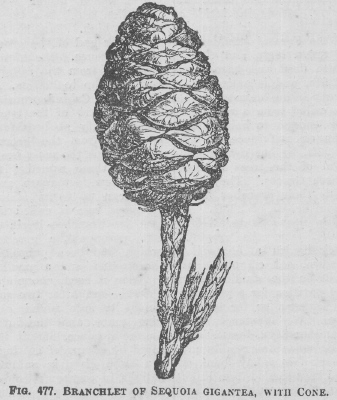
S. gigantea (gigantic).* Big-tree; Mammoth-tree. l. needle-shaped, spirally alternate, spreading, light green on young plants; those on adult trees scale-formed, closely inlaid, rounded at back, concave above; those on the branchlets much shorter, very close, and regularly imbricated; those on the larger branches longer, looser, decurrent at base, and tapering to an acute point. cones solitary on the ends of the branchlets, 2in. long, ovate, blunt. Branches horizontal, much divided; branches cylindrical, frequently pendulous, thickly leafy. 1853. SYN. Wellingtonia gigantea (B. M. 4777-8; F. d. S. 892-3).
S. g. aurea (golden). this differs from the type only in the golden or yellowish colour of some of the smaller twigs. It is a pretty form when in good condition.
S. g. pendula (pendulous).* Branches numerous, deflexed from their base, drooping regularly one over the other, so as to produce an elegant, compact, conical plant. 1871.
S. sempervirens (evergreen).* Californian Evergreen Redwood. fl., males globular, solitary at the tips of the branchlets, on slender footstalks, thickly covered with small, scale-like leaves. l. on the lateral branches and branchlets linear, blunt, two-rowed, flat, alternate, straight, rarely falcate, shining, 1/2in. to 1in. long; those on the main branches and terminal points of the flower-bearing branchlets very short, narrow, sharp-pointed, or scale-like, imbricated or closely spiral. cones solitary, terminal, globular or egg-shaped, 1in. long; scales cuneiform. Branches horizontally spreading, irregularly scattered alternately along the stem; branchlets very numerous, in two rows, frequently drooping. The leaves turn purplish-brown in winter. S. s. albo-spica (white-spiked). A form in which the tips of the young shoots are of a creamy-white colour.
S. s. glauca (glaucous). l. linear, acute, 1/4in. long, of a fine glaucous-blue tint, particularly below, either loosely imbricated or openly disposed round the branches. Branchlets very much narrower and slenderer than in the type.
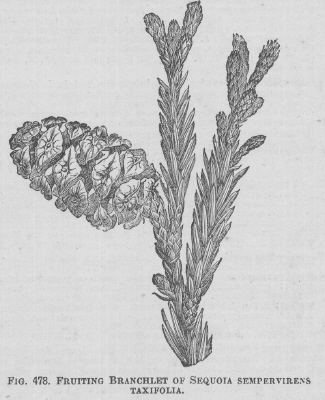
S. s. taxifolia (Yew-leaved). This variety only differs from the type in having somewhat broader leaves.