Sesia
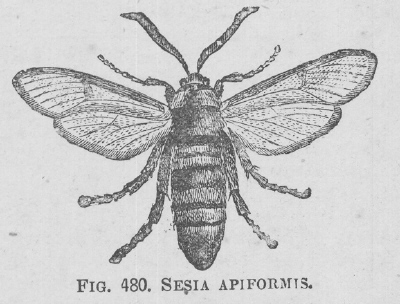
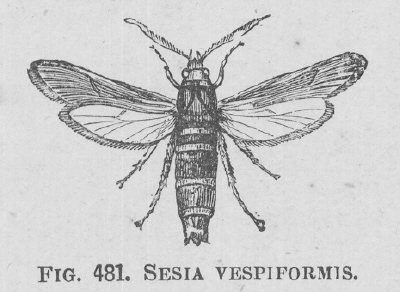
A genus of Moths, generally called "Clearwings," in reference to the absence of scales from the greater part of the surface of the wings, which are, consequently, nearly transparent. This, together with the length and narrowness of the wings, and the form and colouring of the bodies, gives the Moths a striking resemblance to insects of the widely-different groups of Bees, Wasps, and two-winged Flies. S. apiformis, one of the largest British species, is very like a hornet in general appearance (see Fig. 480), and is known as the Hornet Clearwing. Others, e.g., S. vespiformis (see Fig. 481) and S. formicaeformis, are much like some of the smaller Hymenoptera; while others, e.g., the Currant Clearwing (S. tipuliformis) closely resemble slender, two-winged Flies. These resemblances probably afford protection from enemies. The larvae live in the branches, stems, or roots of various plants, boring into the wood or pith. They become pupae in their tunnels. The more hurtful species are the following: Red-belted Clearwing (S. myopaeformis)--the larvae feed, often in large numbers, in the wood of Pear-trees; the moth is black, with a bright red belt round the middle of the abdomen. Currant Clearwing (S. tipuliformis)--the larvae (see Fig. 482) are common in twigs of Currants; the moth is black, with two narrow, yellow lines on the back of the thorax, and three narrow, yellow belts round the body, and the wings are yellowish near the tip, with black veins. Red-tipped Clearwing (S. formicoeformis)--the larvae feed in Willow and Osier twigs; the moth is black, with a deep red belt round the abdomen, and a broad, red tip to each fore wing. Hornet Clearwing (S. apiformis)--the larvae live in wood of Poplars, each feeding for two years; the moth is much like a hornet in size and colour, being marked with brown, orange, and yellow. Willow Hornet Clearwing (S. bembeciformis)--the larvae live in twigs of Willows and Osiers; the moth is much like the last-named, but the head is brown, not yellow, and there are no yellow spots on the thorax.
Remedies are very difficult of application, because of the concealed mode of life of the larvae. Of course, the moths ought to be captured, when they can be found, and this is most likely to be accomplished in the early morning, soon after they crawl out of the pupa cases, and while they are resting on the tree or twig. No remedial measures can be taken while the larvae are in the wood; and when holes are visible the moths have escaped. Badly-infested trees should be cut down and burned, to destroy the larvae. If twigs of Currants, Osiers, or other plants liable to attack, suddenly begin to droop, they should be cut off, and the larvae therein destroyed.